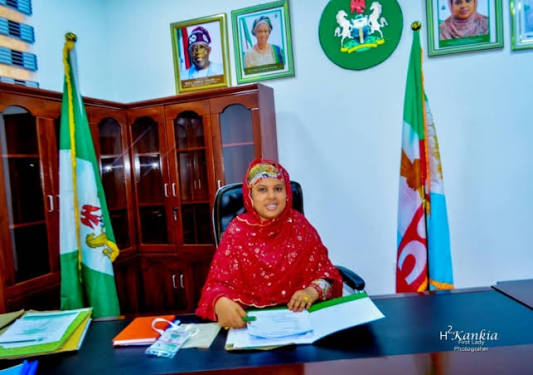
The First Lady of Katsina State, Hajiya Zulaihat Dikko Radda, has called for stronger political commitment, sustained investment and community action to eliminate harmful social norms that fuel Sexual and Gender-Based Violence (SGBV), describing the menace as a major obstacle to development and economic growth.
At the Nigeria Governors’ Spouses’ Forum (NGSF)-Ford Foundation State-Level Advocacy Engagement held in Katsina on July 1, 2026, the First Lady said preventing gender-based violence requires collective efforts from government, traditional and religious leaders, civil society organisations, the media and communities.
She said SGBV should no longer be viewed as a private or social issue alone but as a development challenge, public health concern, governance issue and economic burden that weakens families and denies society its human potential.
“I sincerely appreciate the Nigeria Governors’ Spouses’ Forum, the Ford Foundation and all our partners for their commitment and continued support in our collective efforts to protect women, girls and other vulnerable members of our communities,” she said.
Hajiya Zulaihat noted that while the 2020 declaration of a State of Emergency on Gender-Based Violence by the Nigeria Governors’ Forum demonstrated strong political will, the country must now focus on implementation, stronger institutions, adequate funding and sustained commitment.
According to her, prevention remains the most humane, cost-effective and sustainable response to gender-based violence.
She explained that violence thrives where harmful social norms are tolerated, laws are weakly enforced and communities are not empowered to become part of the solution.
The First Lady said the NGSF-Ford Foundation initiative seeks to address these gaps through policy advocacy, community mobilisation, behaviour change communication and stronger accountability mechanisms while strengthening existing government institutions rather than creating parallel structures.
She also stressed the need to tackle economic vulnerability, identifying it as one of the key drivers of violence against women and girls.