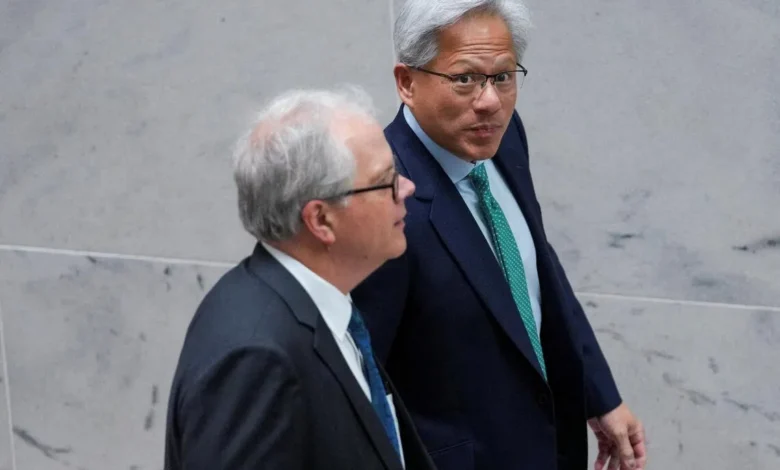
Nvidia chief executive officer Jensen Huang defended open-weight artificial intelligence systems as crucial to the nascent AI industry, sending a cautionary message to officials in Washington who are debating how to respond to a surprise breakthrough from Chinese start-up Moonshot.
After meeting with US lawmakers in Washington on July 28, Huang said that open-weight models, which allow users to download and customise the technology, were essential to ensuring that AI is adopted safely and securely across the economy.
“For the American industry, we need open weight for security, we need open weight for safety,” Huang said in brief remarks to reporters following visits with Democratic Senators Mark Warner and Adam Schiff.
“It’s really important for the vibrancy of the whole industry.”


The Nvidia chief spoke as the Trump administration and Congress grapple with the challenge posed by a new open-weight model from Chinese start-up Moonshot AI that rivals offerings from Anthropic and OpenAI.
The emergence of Kimi K3, which became available for public download on July 27, has stirred concerns in the tech industry that policymakers may crack down on open AI systems.
Since Moonshot’s Kimi release, Huang has escalated his defence of open-weight models, joining Microsoft. CEO Satya Nadella and dozens of other tech companies in warning via a letter posted on July 24 against curbing that approach to AI technology.
Open-weight models “are an important part of that foundation because they make advanced AI more accessible, adaptable and widely available”, read the letter, which Huang shared in his first post to a new personal X account.
On July 27, Nvidia followed up with another missive in support of open-weight models, calling them pivotal to stronger cybersecurity. Like the message from July 24, it had the support from dozens of tech companies.
“Blanket restrictions on open frontier AI systems would weaken defensive capacity and risk concentrating power, dependence and vulnerability in a few closed providers,” according to the post from Nvidia, which also included Microsoft, Palantir Technologies and Salesforce.
Nvidia may stand to benefit financially from a shift to open models, since they are cheaper and could open the door to more AI revenue flowing to the hardware powering the technology.
While some AI developers in the US, like OpenAI, do offer open-weight models, much of their focus has been on closed or proprietary systems that they sell to customers.
Chinese companies, including DeepSeek, have previously flooded the market with more affordable, open models that typically lag behind the most cutting-edge software from US rivals but nonetheless offer a compelling product for the price.
Following his meeting with Huang, Warner said that the Nvidia chief had made a compelling argument on open-weight systems.
“Now that we’ve seen some of these Chinese models like Kimi come out, and more and more American companies go to open source, I’m not sure this is a genie we can put back in the bottle,” said Warner, who serves on the Senate Intelligence committee.
Democratic Senator Elizabeth Warren, who invited Huang to appear publicly before the Banking Committee in June, said she was disappointed that he had not agreed to testify.
“He can’t find even an hour to answer questions from Congress in public?” she said, according to a statement from her office.
As part of his visit to the nation’s capital, Huang also met with US Commerce Secretary Howard Lutnick, according to a person familiar with the matter.
Their meeting took place as the Commerce Department puts the finishing touches on a framework for reviewing the safety of cutting-edge AI models. Axios reported earlier on the sit-down with Lutnick.
An Nvidia spokesperson had no comment on the Lutnick meeting but said in a statement that Huang was in Washington to discuss the company’s efforts to support “American leadership in AI, including in open source”.
Open-source software is a related concept to open weights but involves more access to the underlying code. BLOOMBERG


