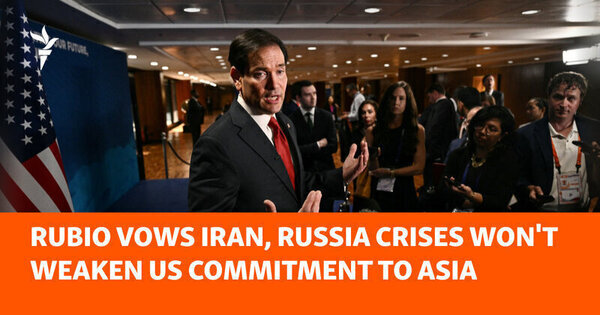
MANILA— As US Secretary of State Marco Rubio concluded his first Southeast Asia trip as Americas top diplomat, he sought to reassure regional partners that the war in Iran and Russia’s invasion of Ukraine would not weaken Washington’s commitment to the region.
The message came as Washington confronts an escalating standoff with Iran, stalled diplomacy over Russias war in Ukraine and intensifying competition with China across the Indo-Pacific. Yet Rubios visit also underscored a widening gap between US strategic priorities and Southeast Asias increasingly economic view of security.
While Rubio went to the Philippine capital for the three-day Association of Southeast Asian Nations (ASEAN) foreign ministers meeting, much of the focus was on the situation in the Gulf as the US military intensified attacks on Iran.
SEE ALSO:


Trump Threatens To Use Iranian Assets To Pay For Shipping Damage
Theres always going to be a concern that America is so focused on one place that it cant focus on another, Rubio told reporters at the end of the trip.
But, he argued, the United States has the capacity to remain engaged simultaneously in Europe, the Middle East and Asia through its diplomatic, military and economic presence.
Officially, ASEAN ministers discussed the South China Sea, Myanmar, Ukraine and regional cooperation. Privately, diplomats said the conflict involving Iran and threats to commercial shipping through the Strait of Hormuz dominated conversations.
Southeast Asian economies remain heavily dependent on imported energy, making any disruption in Gulf shipping an immediate economic concern rather than a distant geopolitical crisis. Rising freight, insurance and fuel costs could quickly feed inflation across the region.
Rubio argued that Washington remains fully engaged despite the Middle East crisis, pointing to longstanding security partnerships and daily diplomatic engagement across Asia. But for many governments, reassurance alone may not address growing concerns over economic vulnerability.
Dato Dr. Ilango Karuppannan, a veteran Malaysian diplomat and former ambassador, said Washington continues to view Southeast Asia largely through a strategic lens.
In 33 years of Malaysian foreign service, I watched Washington approach Southeast Asia mainly through the lens of security, he told RFE/RL. The focus was on alliances, deterrence and the balance of power.
ASEAN governments value the US security presence, he said, but their immediate anxieties are increasingly domestic.
Much of it sits in the price of diesel, the cost of imported food, the electricity bill, and whether shipping routes remain open, reliable and insurable.
The Iran crisis has amplified those concerns.
Scattered debris and smoke, at an unknown location, during what the U.S. Central Command (CENTCOM) says are strikes on Iran
A disruption in the Middle East can raise freight, fuel and insurance costs across Southeast Asia within weeks, Karuppannan said. Governments then face inflation, higher subsidies, pressure on household incomes and greater costs for industry.
His assessment highlights a challenge for Washington: military deterrence does little to ease rising living costs. A carrier strike group may contribute to deterrence, he said, but it does not lower a household electricity tariff.
Rubio also met Russian Foreign Minister Sergei Lavrov in Manila to discuss Ukraine, held talks with Chinese Foreign Minister Wang Yi amid renewed South China Sea tensions, and defended the administrations hard line toward Tehran.
On Ukraine, Rubio acknowledged previous diplomatic efforts had produced little progress while insisting President Donald Trump remained open to future negotiations.
His remarks on Iran were more confrontational, arguing Tehran was seeking negotiations but remained unwilling to accept lasting agreements. He also reiterated Washingtons commitment to respond to attacks on commercial shipping.
SEE ALSO:
Rubio Says Iran-Backed Houthis’ Red Sea Blockade ‘Problematic’
Those positions may reassure US allies, but they also reinforce concerns across Southeast Asia that prolonged instability in the Gulf could further disrupt energy markets and slow economic growth.
The Iran crisis also reinforced ASEANs long-standing effort to avoid choosing sides between Washington and Beijing.
The Middle East crisis may also make Southeast Asian governments even less willing to support Western sanctions.
ASEAN never formally adopted sanctions against Russia following its invasion of Ukraine, and higher energy prices could further reduce appetite for similar measures targeting either Moscow or Tehran.
Marie Schroeter, former Philippines director of Germanys Friedrich-Ebert-Stiftung, said regional governments tend to prioritize national economic interests over geopolitical alignment.
I think thats a very Western mindset, she told RFE/RL. The response from Southeast Asia to the energy crisis is basically focusing on their own national needs.
She also cautioned against treating ASEAN as a unified geopolitical actor, noting that foreign policy choices continue to vary widely across the region.
Commitment Remains
Rubio repeatedly emphasized that the United States remains committed to the Indo-Pacific despite simultaneous crises elsewhere. Few ASEAN governments question the value of continued US security engagement.
The larger question is whether security alone will sustain American influence.
The Iran conflict has shown that governments increasingly judge the major powers by whether they can help manage energy costs, shipping risk and inflation, Karuppannan said.
This creates a risk for Washington. The US may remain militarily important while becoming less economically relevant.
Rubio Vows Iran, Russia Crises Won’t Weaken US Commitment To Asia
Share
Copy link
Facebook
X (Twitter)
LinkedIn
Email
Share
Share
Copy link
Facebook
X (Twitter)
LinkedIn
Email
Share
Follow us
Facebook
X (Twitter)
Youtube
Instagram
Follow us


