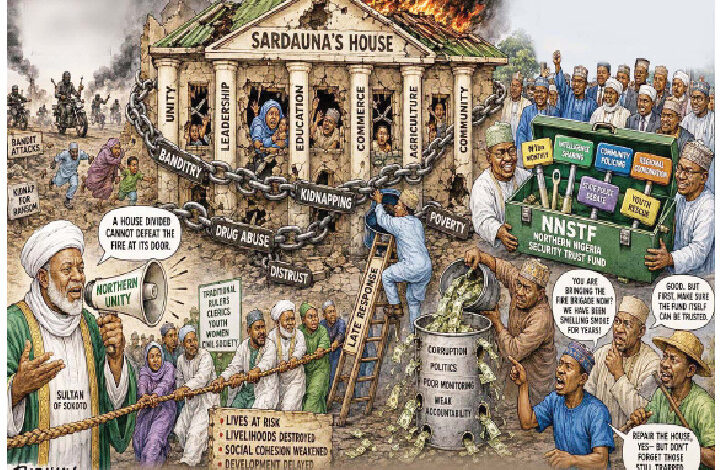
In what appears to be a last-ditch attempt to rescue the North from crippling insecurity, governors of the 19 northern states met in Kaduna midweek to announce the creation of the Northern Nigeria Security Trust Fund (NNSTF) to confront the region’s worsening security crisis. This decision is a milestone, given what some Nigerians describe as the region’s lackadaisical attitude in combating insecurity rippling through parts of the country, especially the North.
There’s no need to reiterate the fact that insecurity has continued to threaten peace, livelihoods and development across the North. This fact was repeated by the Chairman of the Northern States Governors’ Forum, Muhammadu Yahaya, who declared, “Across the North, in every state, the threats posed by banditry, terrorism, kidnapping, drug abuse and other forms of criminality have continued to undermine peaceful coexistence, disrupt livelihoods and weaken social cohesion, thereby slowing down the pace of development in our great region.”
Chained North
The inauguration of the NNSTF could not have come at a better time. In a situation where lives have been reduced to disposable objects and citizens turned into soft targets for criminal elements to kill them without facing the wrath of the law, Wednesday’s event, which drew northern leaders across the spectrum, became a defining moment, showing that the region’s political leadership was finally waking up from slumber to take charge and safeguard the lives and property of Nigerians.
Many analysts, including this writer, have long argued that insecurity is a northern matter to be resolved by the region. Those who attempt to muddle up the discourse have often resorted to global colouration in a bid to hide the real motives behind criminal groups now challenging the nation’s sovereignty. Apart from the absence of adequate boots on the ground, the incapacity to rein in the criminal activities of these terror groups is not unconnected to attempts by rogue security personnel and their collaborators to ensure insecurity remains a conduit pipe for siphoning security funds to satisfy their insatiable greed.
From the uprising of the Boko Haram insurgency that led to the killing of its leader, Mohammed Yusuf, by the police in Maiduguri, to the murderous activities of bandits and kidnappers, insecurity has become a source of livelihood and a profitable venture for many. Stories by those who have had contact with these criminals have bitter narrations of how these bandits and kidnappers have enjoyed the cooperation of some rogue security personnel who sometimes serve as channels of arms to promote these criminal activities.
Politicised Insecurity
The role of negative partisan politics has widened the gulf in creating a united platform to confront these violent non-state actors threatening the corporate existence of the nation. To those unafraid of the truth, the weaponisation of insecurity assumed a frightening dimension when, ahead of the 2015 polls, terror groups were imported to make the country ungovernable in the event former President Goodluck Jonathan refused to be defeated. Unexpectedly, the son of the fisherman from the Niger Delta creeks said his ambition was not worth the blood of any Nigerian. Since then, our politics has been mired in conspiracies, bloodshed, and heavy commercialisation.
The North under Muhammadu Buhari experienced terrible years as the country became a horrifying cynosure of barbaric killings and destruction. Despite appointing northerners as heads of the nation’s security agencies, Arewa bled ceaselessly and was turned into an Internally Displaced Persons (IDP) camp, with millions siphoned under the guise of security votes into the safe vaults of European banks and real estate. The storm of insecurity remains the product of political leadership and citizens who place ethnicity and religion above justice and equity.
Money Not The Issue
If the availability of funds could resolve insecurity, the North and other parts of Nigeria should have been a haven. Sadly, after over 20 years of insecurity in Nigeria, the north and the entire nation are still confronted by immobilising insecurity that has discouraged both local and foreign investments. Despite governors’ visits to many countries to woo investors, these visits have not translated into real investment beyond hope. Sadly, hope could turn out to be a good breakfast but a desolate dinner. Some governors of the north may be genuinely concerned about securing their states, but they are too few to create the required impact to turn the tables on the forces of insecurity and their promoters.
What happened in Kaduna this week remains more of a ceremonial outing that requires further interrogation on how to secure the North truly. The present storm of insecurity is linked to the absence of patriotic leadership anchored in the acquisition of obscene wealth, which has impoverished the people. The meeting’s resolution that each northern state should pay N1 billion monthly over the next 12 months may not be realised due to differing interests and needs. States like Kano, Gombe, Kogi, among others, may be less inclined to pay such whopping sums, as the security situation in their states is not as serious as that in Niger, Plateau, and Benue, among others. I am yet to be convinced that all 19 states will be willing to pay N1 billion every month.
The Real Deal
As it stands, the North remains a huge potential for Nigeria’s growth and at the same time the greatest threat. As long as northern leadership remains incapable of resolving insecurity, the ravenous clouds of instability will hang over the nation’s skies. Corruption hinged on the acquisition of materialism has continued to frustrate efforts at uniting northerners against their killers. Tragically, those saddled with the responsibility of saving the troubled House of Sardauna are not united. Democratisation of security management from the ward to the highest level remains the only option in tackling insecurity. We are approaching a situation in which security is devolved to the sub-national unit. For now, it has become more politics than a genuine attempt to salvage Sardauna’s House from its self-inflicted ruins.