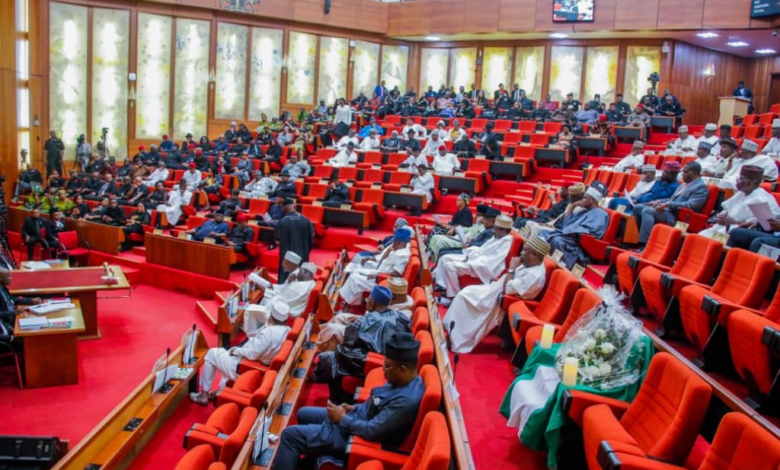
The Senate has advanced a bill to establish a regulatory framework for the coordination, disclosure, and management of foreign aid, grants, and donations received by Nigeria.
The bill, titled “A Bill for an Act to Provide for the Regulation, Coordination, Transparency and Disclosure of Foreign Aid, Grants and Donations in the Federal Republic of Nigeria, 2026 (SB. 1034),” sponsored by Senator Ibrahim Hassan Dankwambo (PDP-Gombe North), scaled second reading during Wednesday’s plenary.
Leading the debate, Dankwambo said the proposed legislation was aimed at promoting order, accountability and strategic coordination in the management of foreign assistance.
He noted that Nigeria receives substantial foreign support in the form of grants, technical assistance, humanitarian interventions and concessional financing from bilateral and multilateral partners, which have contributed to sectors such as health, education, agriculture and humanitarian services.
However, the senator said the country’s foreign aid management system remained fragmented, poorly coordinated and lacking adequate transparency.
He explained that donor-funded projects were often scattered across Ministries, Departments and Agencies (MDAs), with some implemented outside the national budget framework, duplicated or not fully aligned with national development priorities.
“This weak coordination undermines efficiency, reduces value for money and, in some cases, erodes public trust,” Dankwambo said.
The lawmaker said the bill was supported by constitutional provisions, particularly Sections 80 to 83 of the 1999 Constitution, as amended, which provide for legislative oversight of public funds and for the Auditor-General to audit public accounts.
According to him, foreign aid, once received and deployed within Nigeria, becomes a public resource and should be subject to transparency, accountability and constitutional oversight.
He also referenced the Fiscal Responsibility Act of 2007, which requires prudent management of public resources and proper integration of revenues and expenditures into a coherent fiscal framework.
Dankwambo said the legislation would address the existing gap in foreign aid management by ensuring that donor funds were not treated as “off-budget” resources outside accountability structures.
“The problem is not the absence of institutions, but the absence of a binding legal framework that coordinates them,” he said.
He explained that while the Federal Ministry of Finance engages development partners, the Budget Office integrates some projects, the Debt Management Office handles concessional loans and the Accountant-General’s Office tracks disbursements, there was no unified legal structure compelling coordination among all stakeholders.