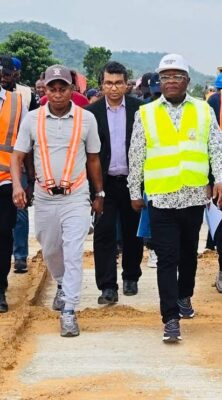
Minister of Works, David Umahi, may have intended to calm public outrage over flooding along the Lagos-Calabar Coastal Highway corridor, but his recent inspection tour has instead exposed troubling gaps in accountability, planning, and transparency surrounding one of Nigeria’s most controversial infrastructure projects.
Standing before affected communities and lawmakers, Umahi dismissed growing complaints that the coastal highway is worsening flooding, insisting that the problem predates the project. But for many residents watching their homes and livelihoods go underwater, that explanation rings hollow — and increasingly dismissive.
This is not just about geography or climate change. It is about a government project that has dramatically altered a fragile coastal ecosystem without convincingly demonstrating that adequate safeguards were in place before construction began.
By shifting blame to “poor drainage,” “waste disposal,” and long-standing environmental vulnerabilities, the minister appears to sidestep a more uncomfortable truth: major infrastructure projects of this scale are expected to anticipate — not amplify — existing risks.


Communities along the corridor are not asking for sympathy; they are demanding answers. If flooding was always a known risk, why did the project design not fully mitigate it? If environmental impact assessments were conducted, why are their outcomes only now being cited as a basis for future action rather than preemptive protection?
Even more concerning is the minister’s admission that the highway sits higher than surrounding communities — effectively altering natural water flow patterns. In coastal engineering, such elevation differences are not minor details; they are critical design factors that can determine whether nearby settlements are protected or submerged.
Umahi’s argument that residents are clogging drainage systems with refuse, while not entirely unfounded, risks becoming a convenient scapegoat. It shifts responsibility from systemic planning failures to individual behaviour, ignoring the fact that well-designed infrastructure should remain resilient even in less-than-ideal human conditions.
The situation becomes even more troubling when demolition threats enter the conversation. The suggestion that homes previously spared during construction may now be removed to accommodate service lanes raises serious questions about the project’s planning integrity. Were these communities ever part of a coherent long-term design, or are they now collateral damage in a constantly evolving blueprint?
For a project of such national significance — one backed by the directive of President Bola Ahmed Tinubu — the absence of clear, proactive communication has deepened public mistrust. Stakeholder engagement, now being proposed as a solution, should have been foundational from the outset, not an afterthought in the face of mounting criticism.
Ultimately, the flooding crisis along the coastal highway corridor is not just an environmental issue; it is a test of governance. It raises fundamental questions about how projects are conceived, executed, and monitored in Nigeria.
Until the Federal Ministry of Works provides transparent data, independent assessments, and verifiable mitigation plans, Umahi’s assurances will remain exactly that — assurances, not answers.
For the residents watching floodwaters creep into their homes, rhetoric offers no relief. What they need is accountability — and fast.