0
Stella Omona
The United Nations Resident Coordinator in Nigeria, Mohamed Malick Fall, has urged the Federal Government and development partners to accelerate implementation of the Sustainable Development Goals (SDGs) through greater efficiency, innovative financing and stronger use of technology even the country called for deeper collaboration with the UN and development partners to accelerate the implementation of the SDGs, with a strong emphasis on innovative financing, coordinated humanitarian action and data-driven poverty reduction.
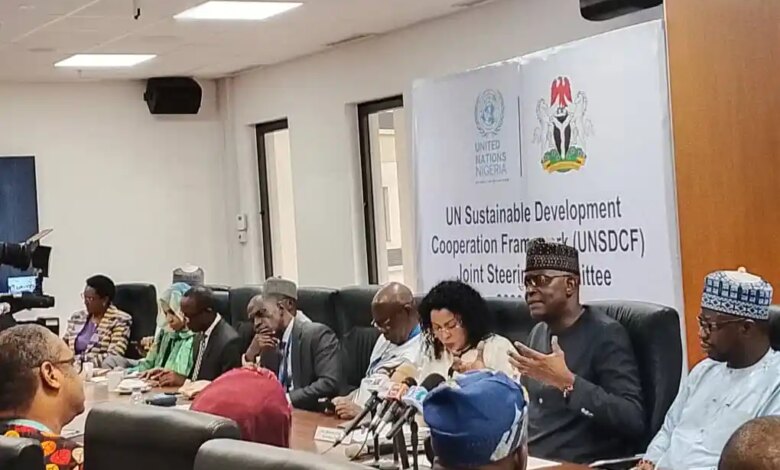
Speaking on Monday at the United Nations Joint Steering Committee Meeting of the United Nations Sustainable Development Cooperation Framework (UNSDCF) in Abuja, the UN representative said only four years remain to achieve the 2030 Agenda, warning that progress on many SDG indicators in Nigeria and globally remains too slow.
He called on the Steering Committee to move beyond policy discussions to practical implementation, stressing the need for “speed and scale” to deliver meaningful impact in a country with Nigeria’s rapidly growing population.
The UN official noted that declining international development assistance and growing global challenges, including conflict, climate change and economic hardship, make it imperative for Nigeria to strengthen domestic resource mobilisation, attract private sector investment and adopt innovative financing mechanisms.
He also challenged the UN system to become more efficient by embracing digital technology, artificial intelligence and data-driven planning to maximise the impact of limited resources.
Despite Nigeria’s challenges, the Resident Coordinator said the country possesses enormous economic and human potential, urging stakeholders to shift the national narrative from problems to opportunities capable of driving sustainable development and improving the lives of millions of Nigerians.
“Only four years remain to achieve the Sustainable Development Goals, yet progress on many indicators is too slow. What we need now is speed and scale—we must move from talking about development to delivering measurable results.
“Nigeria has enormous potential. We must shift the narrative from focusing on challenges to unlocking opportunities through innovation, domestic resource mobilisation, private sector investment and technology to transform the lives of millions of Nigerians.”
Also speaking, the Minister of Budget and Economic Planning, Senator Abubakar Bagudu, urged the UN and development partners to strengthen support for Nigeria through innovative financing and increased private sector investment to accelerate the achievement of the Sustainable Development Goals (SDGs) by 2030.
Bagudu said the country had implemented major macroeconomic reforms that are creating a more stable investment climate and freeing up resources for development.
He noted that while government funding remains important, achieving the SDGs would require significantly more resources, stressing that private capital, impact investments, guarantees and other innovative financing mechanisms must be leveraged to bridge the funding gap.
The minister said Nigeria’s ambition to build a $1 trillion economy and lift millions out of poverty by 2030 aligns with the global development agenda, adding that progress in Nigeria would have a significant impact on global poverty reduction.
Bagudu also highlighted the Federal Government’s plan to transform Nigeria’s 8,809 wards into centres of prosperity through targeted investments and development programmes, while calling on the UN system and development partners to deepen collaboration in mobilising resources for sustainable and inclusive growth.
He reaffirmed the government’s commitment to investing in human capital, health, education and economic opportunities to improve the lives of Nigerians and achieve the 2030 Sustainable Development Goals.
On his part, the Minister of Humanitarian Affairs and Poverty Reduction, Dr. Bernard M. Doro, reaffirmed the Federal Government’s commitment to ensuring that no Nigerian is left behind under President Bola Ahmed Tinubu’s Renewed Hope Agenda.
The minister highlighted the ministry’s flagship One Humanitarian, One Poverty Response System (OHOPRS) as a key reform designed to harmonise humanitarian assistance, social protection and poverty reduction initiatives under a unified national framework.
According to the minister, OHOPRS brings together federal and state governments, United Nations agencies, development partners, civil society organisations and the private sector to deliver coordinated and accountable interventions for vulnerable Nigerians.
A major component of the framework, the National Poverty Intelligence Lab, was also unveiled as a critical data platform that will generate real-time multidimensional poverty information to improve programme targeting, accountability and evidence-based policymaking.
The minister noted that the initiative complements the work of the Office of the Senior Special Assistant to the President on Sustainable Development Goals in coordinating SDG implementation across all levels of government.
He stressed that the Renewed Hope Agenda aligns closely with the global 2030 Agenda by prioritising poverty eradication, healthcare, education, food security, water and sanitation, women’s empowerment, youth development and resilient communities.
The minister expressed appreciation to the United Nations, bilateral and multilateral partners, civil society organisations and the private sector for their continued technical and financial support, urging stakeholders to strengthen institutional collaboration, leverage technology and mobilise innovative financing to fast-track SDG implementation.