The Federal Government and the Lagos State Government have intensified efforts to counter the ongoing public scrutiny over the Lagos-Calabar Coastal Highway, maintaining that the project is not responsible for the widespread flooding that recently submerged parts of Lagos, even as critics continue to demand the release of environmental assessment documents for the multi-billion-naira project.
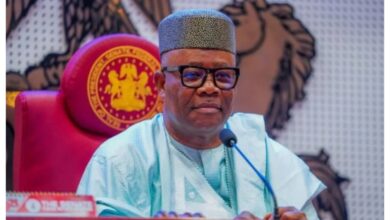
The latest defence came on Tuesday after Governor Babajide Sanwo-Olu hosted the Minister of Works, David Umahi, and members of the National Assembly in Lagos, subsequent to President Bola Tinubu’s directive for an on-the-spot inspection of the highway amidst mounting allegations that its construction altered natural drainage channels and worsened flooding in surrounding communities.
Dismissing the allegation, Umahi said the inspection became necessary because of “the negative narrative on social media claiming that the Coastal Highway caused flooding in Lagos.”
The minister said, “The Coastal Highway was designed to improve drainage and facilitate the evacuation of floodwaters from shoreline communities.”

READ RELATED STORY :
Umahi rebukes Makinde over comments on Lagos-Calabar coastal highway costs
He affirmed that blocked drainage channels, indiscriminate refuse disposal, and environmental violations, rather than the highway itself, accounted for the flooding witnessed across parts of the state recently.
He added that the highway was deliberately elevated to withstand tidal surges and provide long-term flood protection. He remarked that buildings erected below approved flood levels would remain vulnerable irrespective of the road project.
The Governor of Lagos State, Babajide Sanwo-Olu, established a fact that Lagos’ coastal geography makes seasonal flooding inevitable.
He said, “Lagos is a coastal city. When people say Lagos has flooded, without mincing words, we will always experience some level of flooding. We only pray that it will not be severe.”
He also accused some social media users of circulating photographs taken at the peak of flooding without showing that floodwaters later receded, while blaming indiscriminate refuse disposal for blocking drainage systems across the metropolis.
The government’s response came after some days of public criticism from environmental advocates, engineers, and commentators who questioned whether sufficient environmental safeguards preceded construction of the coastal highway.
Among the most vocal critics is the Arise TV anchor, Rufai Oseni. He challenged both the Lagos State Ministry of Environment and relevant federal agencies to publish every document relating to the project’s Environmental Impact Assessment.
Oseni said during The Morning Show, “Today, I would like to challenge the Ministry of Environment in Lagos, and challenge the Federal Ministry of Environment and Works to please show us one mail trail and the negotiations and conversations over the environmental impact assessments.
“I also want to challenge them to bring out the critical work of the environmental impact assessment and the narrative around the effects of this coastal road on Lagos, on flood waters, when it was done, and the mitigating effect that they said was going to be done.”
The broadcaster later renewed his criticism after documents relating to the project’s environmental approval surfaced, questioning the sequence of approvals.
He wrote on his X page, “An EIA is a prerequisite before you start a project.”
He argued that conducting or concluding such an assessment after construction had commenced defeated its preventive purpose.
Umahi had earlier claimed that flooding along parts of the corridor reflected broader urban drainage failures rather than engineering defects in the highway itself. He said Lagos’ drainage master plan had not been fully implemented and urged greater collaboration between federal and state authorities to improve storm-water management.
The debate ensues as persistent rainfall continues to expose the vulnerability of several Lagos communities to flooding, reigniting longstanding concerns over urban planning, environmental compliance, drainage infrastructure, and coastal resilience.
While the Federal Government still stands on the fact that the Lagos-Calabar Coastal Highway is intended to reduce, not worsen, flooding, critics still insist that greater transparency over the project’s environmental planning is necessary to restore public confidence and settle the intensifying controversy.