0
ABUJA – Prominent Nigerians who cut across the opposition political parties have called on leaders of the opposition to unite ahead of the 2027 general elections.
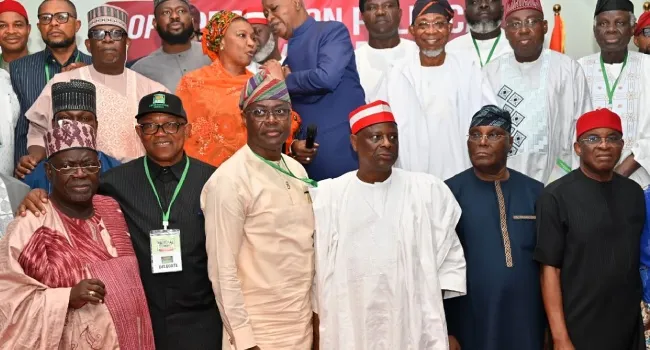
Specifically, the prominent Nigerians under the aegis of G-100, appealed to leading opposition figures, including Senator David Mark, former Vice President Atiku Abubakar, Mr. Peter Obi, Governor Seyi Makinde, Senator Bala Mohammed, Senator Seriake Dickson, Mr. Rotimi Amaechi, Senator Rabiu Musa Kwankwaso, Ogbeni Rauf Aregbesola, Alhaji Kabiru Tanimu Turaki, Dr. Hakeem Baba-Ahmed, Mr. Donald Duke, Prof. Sadiq Umar Abubakar Gombe, Prince Adewole Adebayo and other political leaders, to begin sincere negotiations aimed at presenting a united front for the 2027 elections.
The G-100, in an open letter to opposition leaders on Sunday in Abuja, signed by Salihu Mohammed Lukman, Hon. Nnena Ukeje, Elder Simon Achuba, Dr. Akilu Indabawa, Hon. Annie Ekeh, Prof. Anthony Kila, Dr. Awalu Anwar, Dr. Emeka Ejikonye, Dr. Ibrahim Moddibo, Dr. Ladan Salihu and 90 other members, urged them to set aside personal ambitions and unite behind a single presidential candidate ahead of the 2027 general elections, warning that Nigeria’s democracy risks gradual erosion without a strong and cohesive opposition.


In an open letter titled, ‘The Doctrine of a Necessary Democratic Opposition’, the G-100 said Nigeria has reached a critical point where neutrality and silence in the face of the country’s challenges amount to complicity.
Addressed to opposition leaders, civil society organisations, intellectuals and Nigerians, the letter argued that the country’s difficulties extend beyond economic hardship to what it described as deep-rooted structural and political deficiencies that have weakened governance and accountability.
According to the group, Nigeria’s political system has increasingly rewarded loyalty over merit, patronage over public service, and power over accountability, creating conditions that have contributed to widespread poverty, unemployment and public disillusionment.
The prominent Nigerians maintained that sustainable economic recovery cannot be achieved without strengthening democratic institutions, insisting that politics remains the foundation upon which lasting national development must be built.
The G-100 expressed concern over what it described as the growing dominance of the ruling party alongside increasing divisions within the opposition, warning that the combination poses a threat to democratic accountability.
It argued that democracy thrives only when governments face credible alternatives capable of peacefully challenging and replacing them through elections.
Drawing lessons from Nigeria’s political history, the group cited the role of the G-34 in resisting military rule and the National Assembly’s adoption of the Doctrine of Necessity during the constitutional crisis created by the illness of the late President Umaru Musa Yar’Adua as examples of moments when national interest prevailed over political considerations.
The coalition of 100 prominent Nigerians said the country now requires a similar demonstration of statesmanship, noting that democracies often decline gradually through weakened institutions, fragmented opposition and public apathy rather than through sudden authoritarian takeovers.
It stressed that the proposed ‘Doctrine of a Necessary Democratic Opposition’ is intended to preserve democratic competition by ensuring that citizens always have a credible alternative to those in power.
According to the coalition, the proposed alliance should be built around a common programme, shared strategy and agreement on a single presidential standard- bearer capable of providing Nigerians with a credible electoral alternative.
The G-100 argued that while political ambition is legitimate in a democracy, it should not supersede national interest, adding that opposition leaders risk undermining their own prospects if they remain divided.
The coalition also called on civil society organisations, academics, labour leaders, professionals, religious leaders and other opinion moulders to actively defend democratic principles and encourage issue-based politics.
As part of its next steps, the group announced plans to convene a National Council of Opposition Leaders within the next two weeks.
According to the letter, the meeting will seek commitments from opposition leaders to place national interest above personal ambition and work towards the emergence of a single presidential candidate.
The planned gathering, it said, will also reaffirm the principles of the Ibadan Declaration of April 2026 as a framework for opposition unity ahead of the 2027 elections.