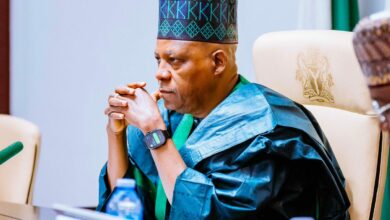
Kaduna State Government has faulted the African Democratic Congress, ADC, governorship candidate, Alhaji Isa Mohammed Ashiru, over his criticism of Governor Uba Sani’s commitment to education, saying the state has consistently exceeded global funding benchmarks.
The Commissioner for Information and Culture, Malam Ahmed Maiyaki, in a statement on Wednesday, said Ashiru is entitled to criticise the government but should base his arguments on verifiable facts.
“Mr. Ashiru is entitled to criticise the government. But when an aspirant to the highest office in the state gets basic facts about education funding wrong, a little lesson becomes necessary,” he said.
Maiyaki faulted Ashiru’s claim that UNESCO recommends that governments should allocate 15 to 20 per cent of their budgets to education.
He pointed out that the Education 2030 Framework for Action recommends at least four to six per cent of Gross Domestic Product or 25 per cent of total public expenditure for education.
According to him, Kaduna State allocated 25 per cent of its total budget to education in 2024; 26.14 per cent in 2025 and another 25 per cent of its N985.9 billion 2026 budget, amounting to approximately N246.5 billion, to the education sector.
“For three consecutive years, therefore, Governor Uba Sani has committed about one-quarter of Kaduna State’s annual budget to education,” he disclosed.
The commissioner said the state’s investment had also produced measurable results in basic education, tertiary education and skills development.
Maiyaki said the National Board for Technical Education had recognised three Skills Development and Vocational Training Centres established by Governor Uba Sani as the best-equipped and structured skills training facilities in Nigeria.
The statement added that Kaduna State has reduced its out-of-school children population from more than 550,000 to 187,719 within three years through sustained investments, enrolment campaigns and infrastructure development.
He said the Federal Government had also drawn from the Kaduna model, in developing national interventions on skills training and addressing the out-of-school children challenge.
On the Kaduna State University (KASU), the commissioner said the Uba Sani administration had made several financial interventions, including more than N800 million in staff welfare, about N146 million for withheld salaries and SIWES-related obligations, and a N50 million monthly standing intervention.
The statement added that the government provided more than N200 million in overhead support to the university in 2026 alone and over N300 million for accreditation of 57 academic programmes and resource verification for 60 postgraduate programmes.
The commissioner said the interventions contributed to the full accreditation of seven professional programmes and the university’s Digital Learning Centre.
Maiyaki also disclosed that the administration has committed more than N1.6 billion to scholarships and other student-support programmes, alongside a 50 per cent reduction in tuition fees across state-owned tertiary institutions.
The statement argued that these interventions “are hardly the actions of a government that is ‘lukewarm’ towards education.”
On claims that about 200 professors and other academic staff have resigned from KASU because of poor working conditions, the commissioner challenged those making the allegation to provide evidence.
“Those advancing the claim should provide the names of the alleged 200 academics, their dates of resignation and their stated reasons for leaving. Repetition does not turn an unverified allegation into fact,” he pointed out.
The government recognises the role of the Academic Staff Union of Universities (ASUU-KASU) in advocating for its members’ welfare, he said, adding that the administration is committed to constructive engagement on genuine outstanding issues.
Maiyaki however said the domestication of Federal Government-ASUU agreements in state-owned universities requires “serious legal, financial and institutional consideration not political grandstanding.”