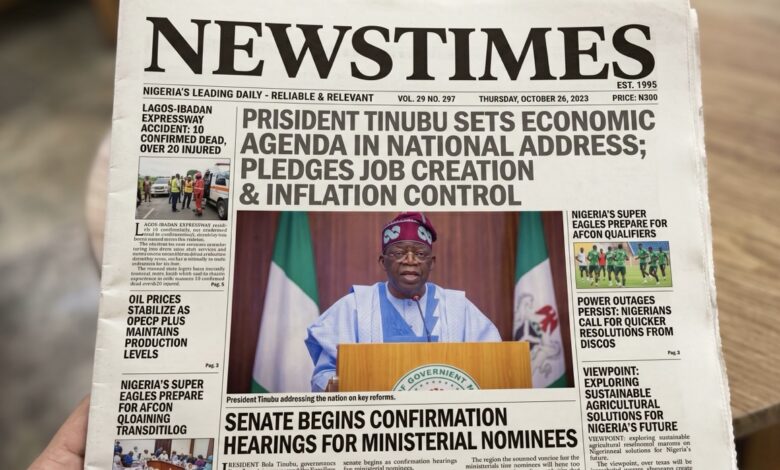
President Bola Tinubu last week Thursday, revealed that he intends to revive the four moribund Petroleum Refineries in the country. Tinubu, who made the disclosure while receiving the National Executive of the Nigerian Union of Petroleum and Natural Gas Workers (NUPENG), led by its National President, Comrade Salimon Akanni Oladiti at the State House in Abuja, noted that he would not allow the huge investments made over many years by previous governments to go to waste. He declared that in-depth research, restructuring, and leadership will reposition the refineries to deliver value and profit. According to Mr. President, the Federal Government will encourage detailed research and technical assessments to identify the structural, operational, financial, and managerial challenges affecting the facilities and develop sustainable solutions.
Hear him: “The refineries that you mentioned are going to come back to work; we’re just building a very firm, resetting, and structural reworking of the economy of it. Ordinary flame and smoke of a refinery doesn’t mean that it’s working until it’s profitable and yields the value for which it was built. I’m not a man who goes looking back on everything because I’ve accepted the assets and liabilities of my predecessors. No matter what has happened in the years past, it’s now my responsibility as President to fix it and make it work for the greatest common good of our population. I take responsibility for that, and we will do it.’’
While I agree that the nation has sunk substantial amounts of money on the rehabilitation of the four refineries, I don’t think that this is the way to go, Mr. President. Those refineries are old. They have been cannibalised and seen better days. Those NUPENG members that were clapping for you during the visit are part of those who ran those refineries aground. Mr. President should please not again fall into the hands of the cabals in the oil and gas industry.
The Warri refinery was built and commissioned in 1978. It has a nameplate crude distillation capacity of 125,000 barrels per day. Presently, many of its components are outdated. The Kaduna Refinery was built in 1979 and officially commissioned on April 4, 1980. It has a processing capacity of 110,000 barrels per day following subsequent expansions. Getting parts for the turn-around would be a herculean task. The Port Harcourt Refinery consists of two plants. The older pant was built and commissioned in 1965, with an initial capacity of 35,000 barrels per day, which was later expanded to 60,000, and a newer plant was commissioned in 1989, with a capacity of 150,000 barrels per day, giving a combined capacity of 210,000 per day.
Two years ago, and under your watch, the Nigerian National Petroleum Company (NNPC) Ltd. spent over $2 billion on the turn-around maintenance (TAM) of the Port Harcourt Refinery. Those sharks in the oil sector embarrassed your office when you issued a statement congratulating Nigerians on the “successful revival” of the refinery. In your statement, you directed the NNPCL to promptly reactivate the refineries in Warri and Kaduna. That statement was signed on your behalf by your Special Adviser on Information and Strategy, Mr. Bayo Onanuga. The NNPCL lined up tankers loading fuel from the refinery for the cameras. Few days later, an investigative reporter at the site, as well as marketers confirmed that not a single drop of fuel has been lifted from the refinery.

Again, former President Olusegun Obasanjo was on national television to debunk the claim that the refinery was working and he was very blunt when he said that the refinery could not work due to historical corruption, alleging that the NNPCL misled the nation on the functionality of the refinery. Obasanjo had, on several occasions, told the nation that while he was at the helm of affairs as President between 1999 and 2007, he invited Shell to manage the refineries and they told him point blank that it could not be done. ‘’The NNPC Ltd. knew that they could not do it, but they knew they could eat and carry on with the corruption that was going on in the NNPC. When people were there to do it, they put pressure. In a civilised society, those people should be in jail,” Obasanjo stated. Obasanjo did not end it there, and also alleged that the NNPC Ltd. under Tinubu squandered more than $2bn on a refinery that will not work.
“If a company like Shell tells me what they told me, I will believe them. If anybody tells you now that it (the refinery) is working, why are they now with Aliko (Dangote)? And Aliko will make his refinery work; not only make it work, he will make it deliver.”
Obasanjo concluded with a Yoruba proverb, comparing inflated claims about the refineries’ performance to a farmer who planted 100 heaps of yam but falsely claimed to have planted 200. “They say that after he has harvested 100 heaps of yams, he will also have 100 heaps of lies. You know what that means,” he concluded.
As expected, there was immediate pushback from the NNPC Ltd. which went ahead to invite the former President for a tour of the facility to see things for himself. The invitation was rightly rejected by Obasanjo, as he claimed that the mode of invitation was disrespectful.
The several billions of Naira that have been spent on TAM has not yielded a single drop of fuel, yet it is the same refineries that President Tinubu is set to ‘revive’ once again. In 2021, the sum of $1.4bn was approved for the rehabilitation of the Port Harcourt refinery. $897 million was earmarked for Warri, and $586m for the Kaduna refineries. Nothing came out of the exercise. A total of $396.33m was spent on Turnaround Maintenance (TAM) between 2013 and 2017. Despite all the financial allocations, the refineries remain unproductive till date.
Just recently, the NNPC Ltd. signed another bogus MoU with two Chinese firms on the maintenance of the refineries while opening a new window for technical equity partnerships. The deal was signed with Sanjiang Chemical Company Limited and Xingcheng (Fuzhou) Industrial Park Operation and Management Co. Ltd, marking what the national oil company described as a “critical milestone” in its refinery transformation drive.
The agreement was executed in Jiaxing City, China, on April 30, 2026, by the Group Chief Executive Officer (GCEO) of the NNPC Ltd., Bashir Bayo Ojulari, alongside the Chairman of Sanjiang Chemical Company, Guan Jianzhong, and Chairman of Xingcheng Industrial Park, Bill Bi.
According to a statement issued by the Chief Corporate Communications Officer of NNPC Ltd., Andy Odeh, the MoU sets the stage for a potential Technical Equity Partnership aimed at completing outstanding work at the Port Harcourt and Warri refineries, as well as ensuring their long-term operational efficiency. The national oil firm said the collaboration would go beyond rehabilitation, extending into full-scale operation and maintenance of the facilities to achieve “best-in-class, sustainable performance.”
However, a former President of the Organised Private Sector of Nigeria, Dele Oye, tore apart the deal and demand its immediate cancellation. Oye stated that the two Chinese companies selected by the NNPC Ltd., Sanjiang Chemical Company Limited and Xingcheng (Fuzhou) Industrial Park Operation and Management Co. Ltd., are technically unqualified, financially questionable, and have no business being handed responsibility for two of Africa’s most complex and strategically vital refineries.
Oye, speaking on Arise News, stated that after conducting what he described as a due diligence exercise through his organization, the Alliance for Economic Research and Ethics, stated that: “These two companies have nothing to offer Nigeria. They have no professional experience. They have no engineering experience. They have never been in the industry to run a refinery of this magnitude. Sanjiang Chemical is not an EPC company. It is not an engineering company. They are into the downstream. They are more into chemicals. They have never run any refinery. They have never rehabilitated one,” he stated, adding that the Hong Kong-listed company was currently running low on cash and carrying short-term borrowings. “It doesn’t have the technical competence. It has never done any similar business.”
Also, former Vice President, Atiku Abubakar, carpeted the choice of the two companies in managing the nation’s refineries. While he acknowledged Sanjiang as a legitimate petrochemical company, he stressed that it is fundamentally a downstream fine chemicals manufacturer specializing in surfactants, ethylene oxide, methanol-to-olefins, and light hydrocarbon processing, not crude oil refining.
He said; “There is no publicly available evidence anywhere in the world showing that Sanjiang has ever built, operated, or managed a full-scale crude oil refinery of the magnitude and complexity of Port Harcourt or Warri refineries. Processing petrochemical derivatives is not the same as running an aging national refinery burdened with decades of operational decay”.
But the NNPC Ltd. justified the choice of Sanjiang Chemical in particular, arguing that modern refineries are increasingly designed as integrated energy hubs rather than standalone fuel plants, and that Sanjiang’s experience in converting refinery byproducts into high-value chemicals such as polypropylene and surfactants made it a suitable partner.
This writer thinks the way to go is for the federal government to completely hands-off the management of these refineries. The four refineries with capacity to refine 445,000 litres of fuel should be sold to any interested buyer and money realised from the sale invested in any local or foreign concern to establish a new refinery in the country.
With Dangote refinery now fully operational and three other privately-owned refineries still in the works, one or more modular refineries would ensure that the nation has enough fuel for local demands and export. With up to five or six private refineries in the country, healthy competition would be ensured, and the fear of a Dangote refinery monopolising the sector would be a thing of the past.
After that, the government should raise a committee, like the Oputa Panel, that will bring all the people involved in the refinery scam to a public trial so that they can tell the Nigerian people how the billions of dollars that have been allocated for rehabilitation or TAM were spent with nothing to show. Top officials of the NNPC Ltd. told the nation that the Port Harcourt refinery was fully working in November, 2024. It raises eyebrows that Mr. President is talking about another round of turnaround of these moribund, fraud-ridden sector. Those who run our refineries aground must be made to account for the huge billions allocated to the sector by past governments. If we don’t do this, we will further embolden corruption in this country.
See you next week.
What do you think about this?
Drop your opinion in the comment section.
FOLLOW US & Share this with someone who needs to see this.