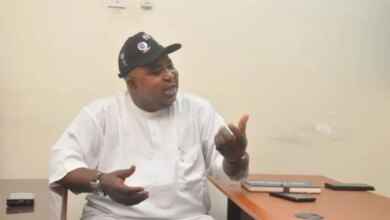
A constitutional argument, not missing school records, was the focus of Denge Onoh’s defence of President Bola Tinubu’s nomination form submitted to the Independent National Electoral Commission(INEC).
Onoh, a former South East spokesman to the President and chairman of the Forum of Former Members of the Enugu State House of Assembly, insisted that what the constitution requires is what matters.
READ RELATED NEWS
ADC flags election credibility risks, seeks INEC answers
Tinubu vows to defeat opposition in 2027, insists INEC is neutral
PDP accuses INEC of blocking electronic candidate submission
A report obtained from The Guardian on Tuesday, 4 August pointed to Onoh’s statement that the President acted within the law by presenting his Bachelor of Science degree from Chicago State University and National Youth Service Corps certificate without listing primary and secondary school certificates. Onoh also said that the Constitution and court decisions support that position.
The issue came up after questions were asked about Tinubu’s Form EC9, where the sections for primary and secondary school education were left blank.

He said the argument had been wrongly turned into a political fight.
He said the Constitution sets only the minimum educational requirement for anyone seeking the office of President. And, according to him, Tinubu’s university degree is already higher than that minimum standard.
Constitution sets the minimum
Onoh pointed to Section 131(d) of the 1999 Constitution, which he said requires a presidential candidate to be educated up to at least School Certificate level or its equivalent.
He said Tinubu’s Bachelor of Science degree in Business Administration from Chicago State University already satisfies that requirement.
“The basic baseline threshold required to contest for the office of the President under Section 131(d) of the 1999 Constitution is to be educated up to at least School Certificate level or its equivalent. President Tinubu possesses a valid Bachelor of Science degree in Business Administration from Chicago State University,” he said.
Onoh argued that once a candidate presents a qualification that is higher than the constitutional requirement, there is no legal basis for asking for lower academic certificates.
“Legally, when a candidate presents a credential that surpasses the constitutional threshold, that single higher qualification satisfies the law. You cannot demand a lower foundation when the architectural masterpiece is already standing,” he said.
He also said Supreme Court decisions have consistently held that anyone seeking elective office is not required to submit every academic certificate obtained from primary school to university level.
The courts, as Onoh claimed, have maintained that presenting a valid higher qualification is enough to establish eligibility and that candidates are not legally required to account for every lower school attended once the higher qualification has been accepted.
He appealed to Nigerians to separate constitutional interpretation from political arguments.
“The public must separate emotional politics from constitutional law,” he said.
Blank sections not against the law
Onoh also defended the decision to leave parts of the nomination form blank. He said a candidate may lawfully leave the sections for primary and secondary education empty if valid tertiary qualifications have been submitted.
The law is concerned with false information or forged documents, not with the absence of lower academic records where a higher qualification has already been provided, Onoh maintained.
“What the law frowns against is the presentation of false information or forged documents. By opting to leave those spaces blank and attaching his higher credentials, the President has maintained utmost integrity, transparency, and compliance with the Electoral Act,” he said.
Onoh dismissed criticism of Tinubu’s nomination papers, describing the controversy as the result of “sheer political mischief and legal illiteracy.”
He also asked opposition parties and critics to study Nigeria’s electoral laws instead of engaging in what he described as “selective amnesia and synthetic outrage.”
“This orchestrated propaganda is dead on arrival,” he said.
Onoh further said Tinubu’s academic records had already been examined and confirmed.
He said, “President Tinubu’s academic record has been thoroughly vetted and affirmed globally, including confirmation by the BBC Fact Checkers and Chicago State University under deposition.”
He advised the opposition to focus on what he called constructive engagements instead of trying to create a controversy over the President’s nomination papers.
For More News Details, Visit New Daily Prime.