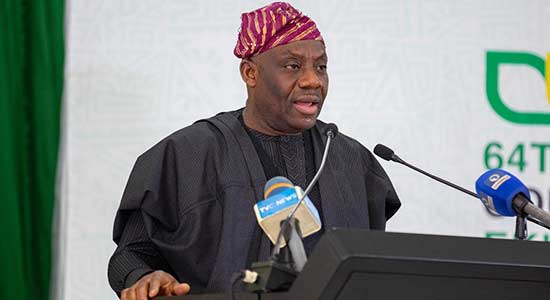
Nigeria’s large youthful population has not translated into enough skilled artisans to meet the country’s growing demand for technical labour, Minister of Education Tunji Alausa has said.
Alausa said the shortage has become so pronounced that Nigerians are being forced to look beyond the country for artisans needed for construction and other skilled work.
The minister made the remarks in a video shared on Friday while explaining the importance of developing technical and vocational skills among young Nigerians.
He illustrated the value of vocational professions by contrasting their earning potential with that of conventional white-collar careers in developed countries.


“In America, Europe, or anywhere, a plumber earns more than a doctor, and an electrician earns more than a lawyer,” Alausa said.
According to him, Nigeria’s challenge is not simply a shortage of jobs. It is also a mismatch between the skills available in the country and the expertise required by its expanding economy.
“When you are building your house, you don’t even have the artisans to do your tiling, your screeding. We were going to Togo to bring these people in,” he said.
Alausa also cited the experience of Aliko Dangote during the construction of his refinery as an example of the country’s skills deficit.
He said Dangote disclosed that almost 22,000 artisans had to be brought into the country from outside to work on the refinery project.
“It was like we’re suffering in the midst of plenty,” the minister said, describing the situation as “severe, debilitating suffering in the midst of plenty.”
In his opinion, the contradiction is particularly striking given Nigeria’s population structure.
He said the country has a unique demographic advantage, with about 70 per cent of its population below the age of 30.
“When I was given the opportunity by the president to be the Minister of Education, I looked at it that Nigeria has a unique demography,” he said.
The minister put Nigeria’s population at about 220 million in the video.
His comments place vocational and technical education at the centre of the challenge facing a country with a large pool of young people but an apparent shortage of workers with practical skills.
The comparison with plumbers and electricians in developed economies also points to a different perception of vocational work. Alausa’s position is that skilled trades should not be treated as inferior alternatives to university education, particularly when such professions can command substantial incomes where the necessary expertise is available.
The minister’s remarks also provide a rationale for strengthening technical education as a pathway from Nigeria’s youthful population to productive employment.
Rather than having young Nigerians acquire qualifications without corresponding practical competencies, the emphasis is on developing skills that industries, construction projects, and households can actually use.
Nigeria’s population, thus, should constitute an economic advantage. But without deliberate investment in practical skills, the country could continue to possess millions of young people while importing the artisans needed to build its own infrastructure.
READ RELATED NEWS UPDATES
Lagos turns skills training into livelihood push for 6,190 residents
Shettima urges collaborative action to drive national skills acquisition
We’ve met all demands, no justification for strike – Education Minister Alausa