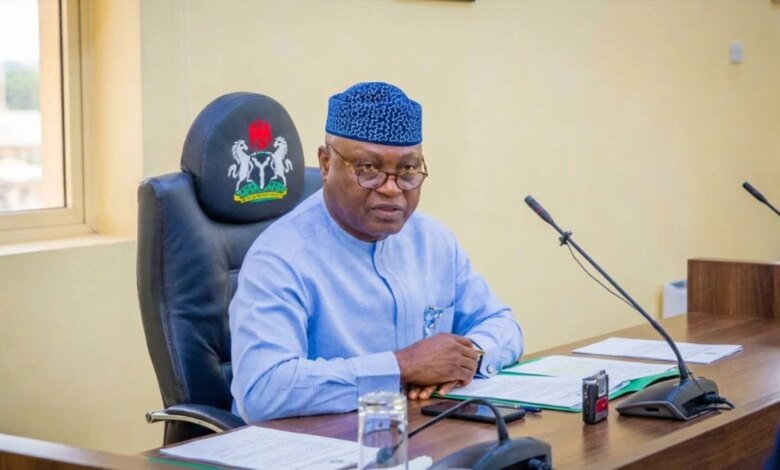
Ekiti State Governor, Biodun Oyebanji, has approved the immediate dissolution of boards, commissions and parastatals across the state, while also terminating the appointments of all political appointees.
The affected political appointees include Special Assistants, Senior Special Assistants and Technical Assistants serving in the state government.
The development comes ahead of the commencement of Oyebanji’s second term in office on October 16, 2026.
A statement issued on Sunday by the Governor’s Special Adviser on Media, Yinka Oyebode, said the decision was taken as the administration gradually winds down its first term.

The move is expected to affect several government-appointed officials and members of boards across different agencies and parastatals.
However, the governor made exceptions for certain statutory institutions whose leadership will remain in place despite the dissolution.
Among those excluded are the Ekiti State Independent Electoral Commission, the Civil Service Commission, the House of Assembly Service Commission and the Judicial Service Commission.
The governing councils of state-owned tertiary institutions will also continue in their current form.
According to the statement, the decision concerning the tertiary institutions is in line with an earlier directive by the governor.
Oyebanji also approved the retention of the chairmen of some key state agencies.
The chairmen of the State Universal Basic Education Board, the Local Government Service Commission and the Teaching Service Commission will remain in office.
Their respective boards, however, have been dissolved.
The arrangement means that while the leadership of the affected agencies will continue to function, the existing boards under them will no longer remain in place.
The governor also exempted Directors-General and Technical Advisers from the termination of political appointments.
They will therefore continue in their respective positions as the administration prepares for the next phase of governance.
The latest decision comes less than three weeks before Oyebanji is expected to begin his second term.
The governor was sworn in as Ekiti State governor on October 16, 2022, and will commence another four-year tenure on October 16, 2026.
His re-election was confirmed after he emerged from the June 20, 2026 governorship election in the state. The transition into the second term has now entered its final phase.
In recent days, Oyebanji has been holding town hall meetings with residents and stakeholders across the state as part of preparations for the 2027 budget.
At one of the meetings in Ekiti North Senatorial District, the governor said his second-term projects would focus on improving commerce, productivity and economic activities across the state.
He also said government spending would be directed towards areas such as healthcare, electricity, roads and water.
“In our second term, whatever we are going to do must add value, because resources are limited. There must be value addition. We must catalyse productivity and ensure our people are productive. It is only when there is value that artisans like welders and auto mechanics can thrive and become prosperous,” the governor said.
Oyebanji has also been consulting communities on their development priorities ahead of the 2027 budget.
At a separate town hall meeting in Ekiti South Senatorial District, the governor described the people of the state as his “benevolent employers”.
“I have absolute respect for Ekiti people and will never disrespect them. You put us in this position; you are our employers,” he said.
The consultations have featured traditional rulers, community leaders, youths and other groups across the state.
Several communities have used the meetings to request more attention to roads, electricity, water supply, healthcare and security.
Moreover, Oyebode said Oyebanji appreciated the contributions made by the affected appointees during the first term.
The governor also wished them success in their future endeavours.
The latest development is not the first major restructuring carried out by the Oyebanji administration.
In August 2025, the governor dissolved the State Executive Council and directed affected commissioners and Special Advisers to hand over to permanent secretaries or the most senior civil servants in their respective ministries, departments and agencies.
At the time, some commissioners and Special Advisers were retained because of the nature of their assignments.
The former cabinet members were later recalled in December 2025 following discussions involving the leadership and stakeholders of the All Progressives Congress in the state.
The reconstituted executive council was subsequently inaugurated as the administration prepared for the 2026 governorship election.