BRICS leaders on Saturday called for “maximum restraint” over escalating tensions in the Middle East, urging countries involved to avoid actions that could further aggravate the situation.
The call was contained in the New Delhi Declaration, unanimously adopted on Saturday during the BRICS leaders’ summit in New Delhi, India. The declaration expressed deep concern over the continued escalation of tensions in the Middle East and reaffirmed the bloc’s commitment to resolving international disputes through dialogue, consultation and diplomacy.
“We express deep concern over the continued escalation of tensions in Middle East/West Asia and, recalling our respective national positions, call for exercising maximum restraint,” the declaration said.
The leaders also called for the protection of civilians and civilian infrastructure in accordance with the principles of the United Nations Charter, including respect for the sovereignty and territorial integrity of states.


The declaration comes as the United States and Iran have resumed tit-for-tat strikes following a pause in fighting for much of August. The conflict has raised concerns about security in the region and its potential effects on energy supplies, shipping and international trade.
The statement also expressed serious concern over attacks on civilian infrastructure and peaceful nuclear facilities operating under safeguards of the International Atomic Energy Agency. BRICS said nuclear safeguards, safety and security should be maintained even during armed conflicts to protect people and the environment.
The declaration was significant because the BRICS grouping includes countries with differing positions and interests regarding the Middle East, including Iran and the United Arab Emirates. Reaching a common position therefore required members to agree on language that addressed the conflict without directly naming the principal parties involved.
BRICS currently comprises Brazil, Russia, India, China, South Africa, Egypt, Ethiopia, Indonesia, Iran and the United Arab Emirates. The expanded grouping gives African countries, including South Africa, Egypt and Ethiopia, a direct presence in the bloc’s discussions on international political and economic issues.
Read related news:
Report: Saudi Arabia carried out covert strikes on Iran during Middle East conflict
Oil Prices Break Above $100 as Middle East Tensions Deepen
Oil prices spike as brent hits $125 amid rising Middle East tensions
Beyond the Middle East crisis, the New Delhi Declaration addressed international trade. The leaders voiced concern about the increasing use of unilateral tariff and non-tariff measures, saying such policies could distort trade. Their position comes amid wider disputes over tariffs and sanctions affecting several BRICS members.
The leaders also reiterated their support for a multilateral international system and peaceful approaches to resolving disputes. The declaration called for greater use of dialogue and diplomacy at a time when several conflicts are putting pressure on international institutions.
Chinese President Xi Jinping also urged BRICS to play a role in efforts to promote peace in the Middle East, saying the conflict was causing serious losses across the region and did not serve the common interests of the international community.
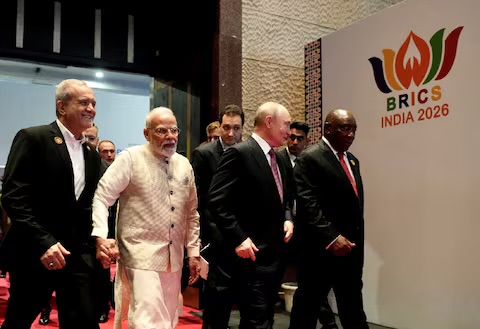
The two-day summit is being hosted by Indian Prime Minister Narendra Modi in New Delhi, with leaders and senior representatives from the expanded BRICS grouping attending.
The adoption of the declaration gives the bloc a collective position on the Middle East conflict while highlighting its broader calls for diplomacy, protection of civilians, multilateralism and greater cooperation among developing countries.