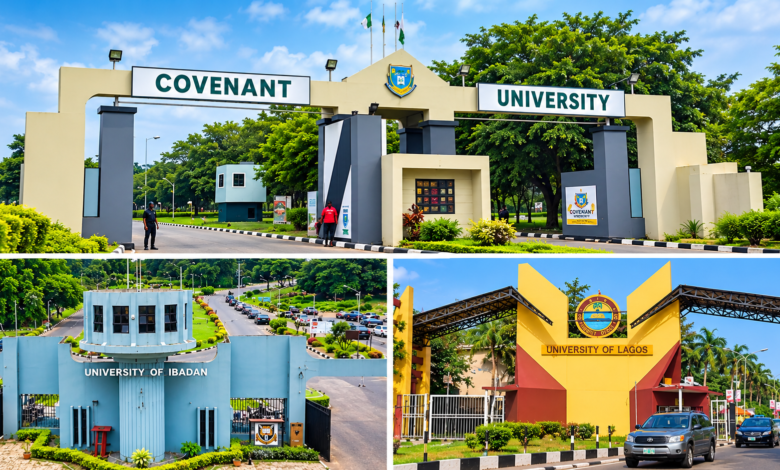
Covenant University, the University of Ibadan and the University of Lagos have emerged as Nigeria’s joint highest-ranked universities in the 2027 Times Higher Education World University Rankings, placing in the 801–1,000 global band.
The result puts three institutions at the top of Nigeria’s table, while the country recorded 29 ranked universities, five more than the 24 listed in the 2026 edition.
The five new entrants are Osun State University, University of Maiduguri, Olabisi Onabanjo University, Kwara State University and Michael Okpara University of Agriculture, Umudike.
Covenant’s return to the joint top position is also notable. It had ranked third among Nigerian universities in the previous edition, when the University of Ibadan and University of Lagos shared the national lead.

The 2027 ranking covers 2,297 universities across 118 countries and territories, making it one of the largest global assessments of research-intensive higher education institutions. Times Higher Education (THE) uses 17 performance indicators grouped into five areas: teaching, research environment, research quality, international outlook and industry.
That methodology matters because the table is not simply a measurement of classroom teaching.
A university can perform strongly because of research output and influence, international collaboration, industry links or the environment supporting academic work. Consequently, a university’s position in the THE table should not be read as a complete assessment of students’ classroom experience, accommodation, facilities or graduate employment prospects.
The Nigerian results also reveal different institutional strengths.
UNILAG recorded Nigeria’s highest quality-research score at 67.8, while Bayero University was the country’s strongest performer for international outlook. Covenant University recorded the highest industry score among Nigerian institutions, pointing to its performance on THE’s industry-related indicators.
Behind the three national leaders, Ahmadu Bello University and Bayero University occupied the 1,001–1,200 global band. Landmark University and the University of Ilorin also joined that band.
The University of Ilorin’s placement is particularly notable for students and researchers in Nigeria’s North-Central region, while Kwara State University entered the global ranking for the first time in the 2027 edition, although it was placed in the 2,001+ band.
Other Nigerian universities spread across the remaining bands, including Babcock University, Obafemi Awolowo University, University of Nigeria, Nsukka, University of Benin, University of Jos, University of Maiduguri, Federal University of Technology, Akure, Lagos State University and University of Port Harcourt.
At the bottom of the ranked table, several institutions were placed in the 2,001+ category. These include Delta State University, Ekiti State University, Federal University of Agriculture, Abeokuta, Federal University Oye-Ekiti, Kwara State University, Michael Okpara University of Agriculture, Umudike and the University of Port Harcourt.
The increase from 24 to 29 ranked Nigerian universities is another significant part of this year’s result.
However, 33 additional Nigerian institutions submitted data but were classified as “reporter” institutions rather than ranked universities. THE said such universities provided information but did not satisfy the eligibility requirements for a ranking.
READ RELATED NEWS UPDATES:
Among the reporter institutions are Abia State University, Al-Hikmah University, Baze University, Bells University of Technology, Bingham University, Bowen University, Federal University of Petroleum Resources, Effurun, Nile University of Nigeria, Rivers State University and University of Cross River State.
THE’s eligibility framework helps explain why submitting data does not automatically translate into a ranking. Eligible institutions must teach undergraduates, conduct research across a range of subjects and have produced at least 1,000 research publications between 2021 and 2025, with at least 100 publications in each year.
Globally, the University of Oxford retained first place for an 11th consecutive year. In sub-Saharan Africa, the University of Cape Town led the region after rising to joint 147th globally from joint 164th in the preceding edition.
THE said the number of ranked universities in sub-Saharan Africa increased from 55 to 69.
For Nigeria, therefore, the headline is not only that three universities occupy the highest national band. The larger development is the expansion of Nigeria’s representation in a global research-focused assessment.
Still, the figures also show why university rankings should be read carefully. The 801–1,000 label identifies a performance band, not an exact national or global position. More importantly, the methodology rewards particular aspects of university performance.
The 2027 table consequently offers a snapshot of Nigeria’s research and international higher education footprint, rather than a complete verdict on every aspect of university life.
With 29 institutions now ranked, the next challenge for Nigerian universities is translating stronger research visibility into sustained academic quality, useful innovation, stronger industry links and tangible outcomes for students and society.