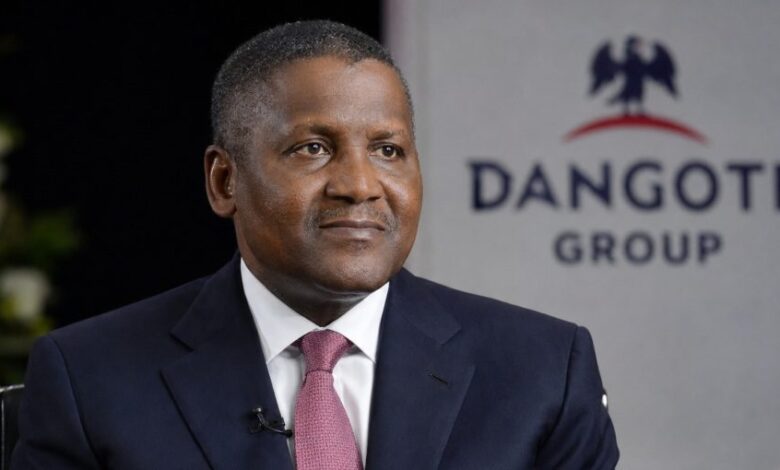
The price disparity between Nigeria and its neighbours is sustaining petrol smuggling, President of Dangote Industries Limited, Aliko Dangote, has said and warned that the incentive to move the commodity across the country’s borders will persist as long as traders can secure substantially higher returns outside Nigeria.
Dangote said petrol sells between 30 and 50 per cent higher in neighbouring countries, creating a lucrative margin for those who divert supplies intended for Nigerian consumers.
He made the disclosure during an interview on Arise TV on Tuesday while discussing petrol prices, domestic supply and the possible impact of the ongoing crisis in the Middle East on petroleum markets.
Responding to concerns over the cost of petrol in Nigeria despite domestic production, Dangote said the assessment of whether the commodity was expensive should take into account prevailing prices in neighbouring countries.


“You know, expensive is relative. In the sense that today, maybe, you know, a lot of them, there’s ignorance also. What they need to do is ask, what is the neighbour’s price?” he said.
Dangote disclosed that petrol produced for the Nigerian market was still being smuggled across the borders because of the substantial price differential.
“I don’t know if you know that there’s still a lot of smuggling of the same petrol we are producing to our neighbouring countries,” he said.
According to him, the disparity creates an immediate commercial attraction for smugglers. Petrol purchased at the Nigerian pump price can be transported to a neighbouring country and sold at a premium, generating a return that would be difficult to obtain from many conventional businesses within a comparable period.
“Because those neighbouring countries are about 30 to 50 per cent more expensive than Nigeria. So, it’s not actually like for like,” Dangote said.
He cited Niger as an example, saying petrol there was selling 20 to 25 per cent above the Nigerian price.
“And people can now go and ask, okay, fine, what is the price of, even now at N1,350? Okay, the price in Niger is 20 to 25 per cent more than Nigeria,” he said.
Dangote questioned the attraction of such a margin to traders seeking quick profits.
“So, what business are you going to do that will make you have an instant 25 per cent return?” he asked.
He further illustrated how petrol could allegedly be diverted from its declared destination and taken towards the border.
“So, it means that, yes, you take the [petrol], you go and take it across the border. You pretend you are taking it to Sokoto, you go and just take it to Ilela, and you sell,” he said.
The implication, as described by the industrialist, is that Nigeria’s domestic supply can be depleted when products are redirected towards markets where they command higher prices.
Dangote, however, said the emerging challenge for Nigeria’s downstream petroleum sector may not be restricted to pump prices.
He cautioned that the Middle East crisis could put greater pressure on the availability of petroleum products, potentially shifting public concern from affordability to supply.
“And the problem now, going forward, I must also warn that this crisis in the Middle East is not even about price; it’s about availability,” he said.
Dangote said his refinery was prepared to support the Nigerian market and dismissed concerns that its operations would contribute to shortages.
“We will deliver to Nigeria. Nigerians don’t need to worry. There will not be any shortage from our own part,” he said.
He added, “There won’t be any shortage. There will not be any queues. We will make sure that we keep satisfying the market, despite all odds.”
His comments also came as the Dangote Petroleum Refinery and Petrochemicals opened its N2.15tn initial public offering on the Nigerian Exchange.
The offer, launched at the NGX trading floor in Marina, Lagos, comprises 4.1 billion ordinary shares priced at N525 each. The minimum subscription is 10 shares, valued at N5,250.
The refinery’s listing offer marks the first time a petroleum refinery has been offered to investors on the Nigerian stock market since the Exchange was established 66 years ago.
The IPO is open to retail, institutional and eligible African investors and is scheduled to close on October 13, 2026.
But beyond the market offering, Dangote’s remarks place the petrol debate within a larger supply equation. Domestic production does not automatically guarantee that every litre produced will reach Nigerian consumers when significant price differences exist across nearby borders.
The challenge, therefore, extends beyond how much motorists pay at filling stations. It also concerns where available supplies ultimately go, the commercial incentives shaping their movement and Nigeria’s capacity to prevent domestic petroleum products from being diverted to more profitable foreign markets.
READ RELATED NEWS UPDATES