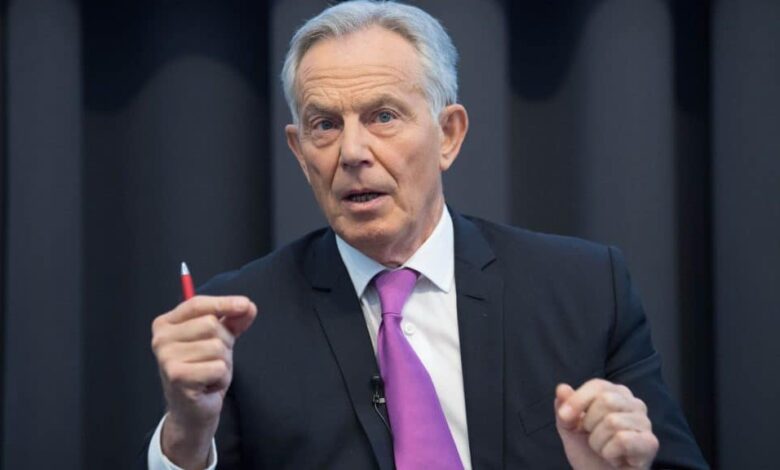
Former prime minister Tony Blair has urged Prime Minister Andy Burnham to put Britain on a path towards rejoining the European Union within the next decade, reopening one of the country’s biggest political debates 10 years after the Brexit referendum. The proposal is not UK government policy, and Britain could not simply return to the EU automatically: any future application would require negotiations and approval from all EU member states.
Blair made the call in a new report from the Tony Blair Institute for Global Change, published on Thursday, which argues that Britain should seek closer cooperation with Europe immediately while working towards possible membership of a reformed EU over the longer term.
The intervention puts fresh pressure on Burnham, who has declined to rule out putting EU membership in a future Labour manifesto but has said his immediate priority is improving trade and cooperation with Brussels rather than seeking membership now.
Blair wants a new approach to Europe
The Tony Blair Institute report, Beyond Leave and Remain: A Path to Rejoining a Reformed Europe, argues that Britain’s relationship with Europe should no longer be defined mainly by the arguments that dominated the 2016 referendum.

Blair wrote that Britain should be clear about wanting “back into a formal relationship with the EU”, although he said the bloc itself would need to reform in areas including competitiveness, technology, energy, defence and border policy.
The institute’s central recommendation is that Britain should spend the next decade rebuilding its economy and strategic influence while working with European countries on issues where closer cooperation benefits both sides.
Its report says: “Over the next decade, Britain should work towards the ambition of rejoining a significantly reformed EU.”
That is an ambition rather than a proposed fixed date for Britain to become a member.
The report argues that future negotiations should be based on whether an agreement benefits Britain economically and strategically, rather than maintaining automatic post-Brexit restrictions against particular forms of cooperation.
Free movement could return to the debate
One of the most politically sensitive parts of Blair’s proposal concerns freedom of movement.
The institute argues that Britain should be willing to discuss some form of free movement if it forms part of an agreement giving the UK deeper access to European markets.
It says ending free movement after Brexit did not, by itself, permanently reduce overall migration because migration from non-EU countries subsequently increased before later falling following tighter immigration policies.
The report does not say Britain should immediately restore the system that existed before Brexit.
Instead, it argues that free movement, participation in the single market, customs arrangements and financial contributions should all be open to negotiation if a future government believes the overall agreement benefits Britain.
This distinction matters for Nigerians living in Britain.
A future UK-EU agreement could affect employment, travel and migration rules for British and European citizens, but it would not automatically give every Nigerian resident in Britain EU free-movement rights. The effect on an individual would depend on their citizenship, immigration status and the terms of any eventual agreement.
British citizens of Nigerian heritage, however, could potentially benefit from any future restoration of wider rights to work, study or live across EU countries — but only if such arrangements were actually negotiated.
Burnham focuses on closer ties, not immediate membership
Burnham has previously said he hopes Britain will rejoin the EU during his lifetime, but he has stopped short of adopting that objective as current government policy.
Asked this week whether Labour could campaign to rejoin the EU at the next general election, he did not rule it out.
Instead, he said his immediate priority was rebuilding relations with Europe and reaching practical agreements capable of helping the British economy.
His government is currently concerned about the EU’s proposed “Made in Europe” industrial rules, which could restrict access for British companies to parts of European procurement and supply chains.
Burnham has argued that Britain should be treated as a trusted European partner, particularly because UK and EU manufacturing supply chains remain closely connected.
For example, Britain’s car industry remains heavily linked to European factories and markets.
That makes the debate about Europe more than a constitutional argument. It also concerns jobs, manufacturing, investment, energy, trade and the cost of doing business.
Rejoining would not be automatic
Even if a future British government decided to seek EU membership, the process would involve considerably more than announcing that Brexit had been reversed.
Under Article 49 of the Treaty on European Union, a former member wishing to return must apply through the normal accession process. Article 50 also explicitly states that a country that has left and later wants to rejoin must follow Article 49.
The European Commission explains that a candidate must demonstrate that it can meet EU membership obligations and adopt the bloc’s laws and standards.
All EU governments would need to agree to open negotiations, and ultimately every member state would have to approve and ratify the accession treaty. The European Parliament would also have to give its consent.
That means Blair’s proposed 10-year timetable is a political objective, not a guaranteed route back into the EU.
The eventual negotiations could involve difficult questions over the single market, freedom of movement, financial contributions, regulation and Britain’s previous opt-outs.
Brexit debate remains politically divided
Blair’s intervention has also drawn opposition from those who believe the 2016 referendum result should not be revisited.
Conservative and Reform UK figures have argued that politicians should concentrate on making the existing post-Brexit settlement work rather than seeking to reverse Britain’s departure.
Within Labour, opinion is also divided.
Some senior figures have publicly supported a future return to the EU, while others have warned that reopening the membership question could revive the political divisions that followed the 2016 referendum.
Britain voted by 51.9 per cent to 48.1 per cent to leave the EU in June 2016, and formally left the bloc on 31 January 2020.
The country subsequently left the EU single market and customs union at the end of the Brexit transition period in December 2020.
Why the debate matters to Nigerians in Britain
For Nigerians living in the UK, the consequences of Britain’s future relationship with Europe could be practical rather than simply political.
Closer economic integration could influence employment, investment and the businesses that depend on European imports or exports. There could also be implications for British citizens who want to study, work or establish businesses in EU countries.
However, there is no immediate change to immigration rules, travel rights or employment rights as a result of Blair’s proposal. For now, Britain remains outside the European Union, single market and customs union, while Burnham’s government is concentrating on negotiating closer cooperation.
Visit NewDailyPrime for UK and international coverage
Related news
EU deal delay costs UK £100m weekly
SNP plans Westminster boycott if Burnham blocks Scottish independence vote
NewDailyPrimeUK News