A few months before the 2023 general elections, the Emir of Kano, Muhammadu Sanusi, warned voters to reject any politician who promised an easy road. “Anybody who tells you that it is going to be easy,” he said in Kaduna in October 2022, “please, don’t vote for him. It’s either that he’s lying to you, or he does not know what job he’s going to get.”
The problem is that the most remarkable things politicians do at election time are not to say what needs to be done and how, but to say what voters want to hear, anyhow.


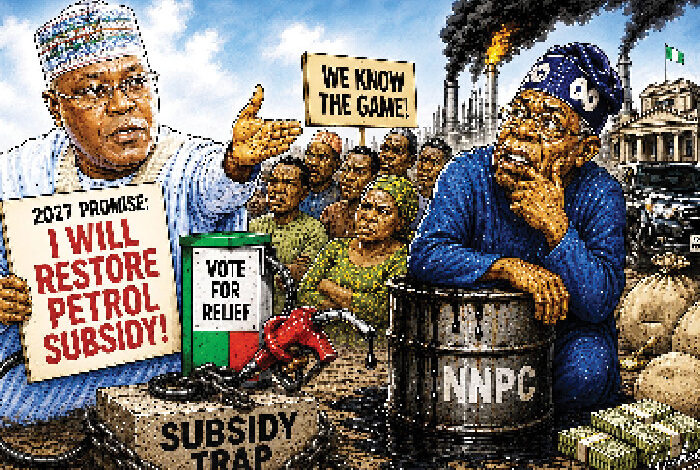
Former Vice President Atiku Abubakar is a politician who knows the game and how to work the crowd. His recent declaration to restore subsidy on petrol if elected as president in 2027 is a classic demonstration of the statement that “in politics, as in war, all things are fair.”
Panicking APC
His attack on President Bola Ahmed Tinubu has ignited the campaign trail and even got the ruling All Progressives Congress (APC) scampering. The party, which had refused to grant any concessions on petrol costs and/or failed to consider any domestic price reviews in light of higher crude prices triggered by the Persian Gulf crises, has begun to shuffle, thanks to Atiku.
It is important for the APC that Atiku has picked a populist refrain at a critical electioneering period, and whether he speaks or uses sign language, his gestures resonate with hardship-stricken voters, desperate for relief. It’s political opportunism at its best.
But it is not entirely Atiku’s fault that most Nigerians now view subsidy as the only thing they have ever benefited from the political elite. For the most part, few people care about the corruption that plagues the subsidy regime because the Tinubu administration has taken the subsidy money and given it back to equally unaccountable governors. On either side, the people think and are beginning to believe they have lost.
States and the money
States (and local governments) in Nigeria have been awash in money. According to figures by the Federal Ministry of Finance, on a comparable monthly basis through December 2025, allocations to states increased by 94 per cent, while allocations to local governments increased by 85 per cent.
One specific example might suffice. From the latest available data for 2026, Ekiti State is the poorest state in terms of federal allocation, receiving the lowest monthly share from the federation account among all 36 states.
Official FAAC 2023 Annual Report from the Nigeria Governors’ Forum Secretariat states that Ekiti State’s average monthly allocation between January and April 2023, just before the subsidy was removed, was about N1.73 billion.
But since the “subsidy is gone” fiat, Ekiti has grown from receiving less than N2 billion in monthly allocations. According to reports from August 2026 on Federation Account Allocation Committee (FAAC) disbursements, Ekiti State received N13.13 billion in May 2026, the lowest among all Nigerian states.
This is just one scenario of what the n il subsidy regime represents if the sub-regional governments were accountable and committed to changing the fortunes and landscape of their people.
Flyovers to nowhere
In July, President Bola Ahmed Tinubu publicly complained that state governors were building bridges rather than arterial roads connecting communities and markets to centres of development. Not exactly the way the President said it, but broadly still within the same context.
Yet, there’s a limit to which Tinubu can complain since 31 of the 36 states are members of his party, and voters might judge him on what the majority of governors, who are members of his party, do or fail to do.