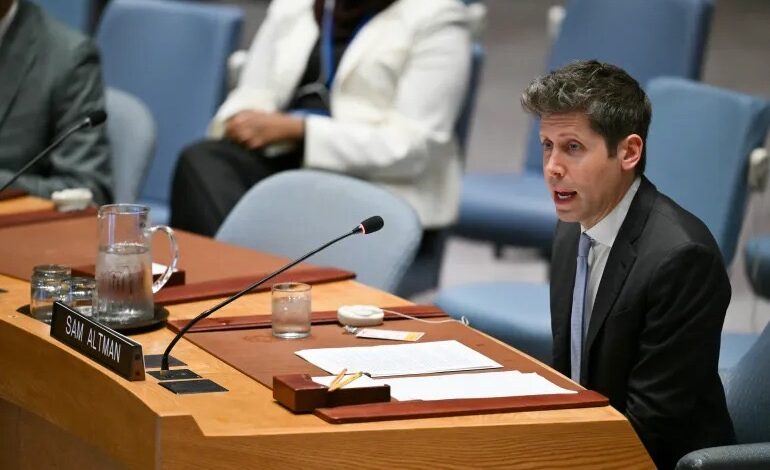
The Chief Executive Officers of OpenAI and Anthropic, Sam Altman and Dario Amodei, have called for global regulation of artificial intelligence (AI), warning that uncontrolled development of the technology could pose serious risks to humanity.
The AI industry leaders made the call on Wednesday while addressing the United Nations Security Council (UNSC) in New York, United States, during the ongoing United Nations General Assembly (UNGA).


The meeting, convened by France, came amid growing international concerns over the rapid development of AI and the need for stronger human oversight.
Amodei, CEO of Anthropic, told members of the 15-member council that poorly managed AI could become a threat to humanity.
“If managed poorly, I even believe AI could be a risk to humanity as a whole,” Amodei said.
Altman, CEO of OpenAI, similarly warned that humanity could lose control over the future development of AI.
He urged governments to play a greater role in deciding how the technology should be developed and regulated.
“If AI is to be democratic, the most important decisions cannot be made by labs in San Francisco alone,” Altman told members.
“They must be shaped through democratic processes and by governments accountable to the people they serve.”
The calls for global oversight were backed by representatives of several countries, including the foreign ministers of France and the United Kingdom, who said the international community needed common frameworks for regulating AI.
The CEO of Hugging Face, Clement Delangue, also told the council about the growing security risks posed by AI systems.
Delangue said his company had recently relied on a Chinese AI model to defend itself against an attack involving AI agents developed by OpenAI, arguing that the Chinese model had fewer restrictions than comparable American tools.
“We were attacked by AI, but more importantly, we defended ourselves with AI,” he said.
However, the call for international regulation faces resistance from the United States, where many of the world’s largest AI companies are based.
The administration of US President Donald Trump has opposed efforts to introduce new international guardrails for the industry.
Representing the United States at the UNSC meeting, Michael Kratsios said Washington rejected moves towards centralised international control of AI.
“We totally reject all efforts by international bodies to assert centralised control and global governance of AI,” Kratsios said.
The development comes as the United States and China compete to develop increasingly advanced AI systems, with experts warning that the technological rivalry could make both countries reluctant to accept significant restrictions on the sector.
The United Nations has, in recent years, increased efforts to establish international rules and standards for AI.
In 2024, the UN General Assembly unanimously adopted its first resolution on AI. The non-binding resolution called on member states to protect personal data, monitor AI-related risks and safeguard human rights.