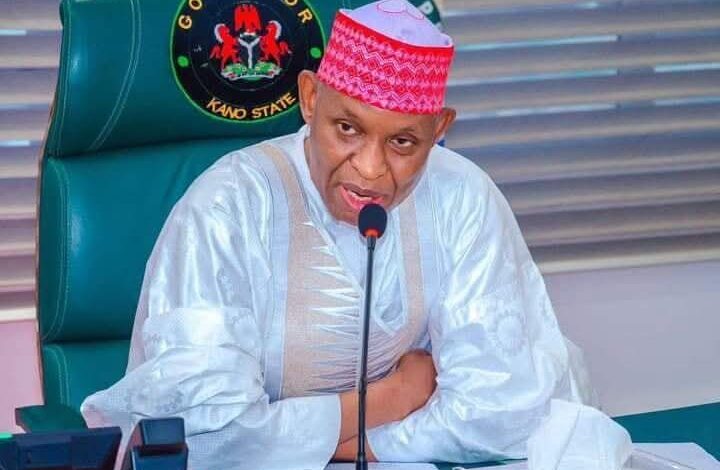
The Kano State Government has moved to strengthen security in local government areas affected by emerging security threats, with plans to support the establishment of additional military formations by the Federal Government and deploy forest guards to vulnerable communities.
The decision followed a meeting between Governor Abba Kabir Yusuf and the chairmen of the 44 local government areas in the state, during which discussions focused on security, infrastructure, healthcare, and grassroots development.
The Commissioner for Local Government and Chieftaincy Affairs, Muhammed Tajo Othman, disclosed the resolutions during a briefing to journalists after the meeting.
The Speaker of the Kano State House of Assembly, the commissioner and the state Accountant-General were also in attendance.
According to the state government, the proposed strengthening of military presence in areas facing security challenges followed discussions between Governor Yusuf and the Minister of Defence.
While the state government does not have constitutional authority to establish or control military bases, the resolutions indicate that Kano intends to work with the Federal Government and security agencies to strengthen the military presence in vulnerable areas.
The planned deployment of forest guards is also expected to complement the activities of federal security agencies, particularly in remote communities and forest areas that may be difficult for conventional security personnel to patrol regularly.
The move comes amid growing concerns about the spread of insecurity across parts of northern Nigeria.
Although Kano has largely avoided the scale of banditry and mass kidnappings recorded in some neighbouring states, including Kaduna, Katsina and Zamfara, concerns have grown over the possibility of criminal networks and armed groups extending their operations into new areas.
The state government said the proposed security arrangement would complement the existing architecture involving the Nigeria Police Force and neighbourhood security structures, with the aim of improving intelligence gathering, rapid response and the protection of lives and property.
Beyond security, the meeting also approved a number of development initiatives across the state’s 44 local government areas.
The government said Computer-Based Test (CBT) and Information and Communication Technology (ICT) centres would be established in each of the 44 local government areas.
According to the resolutions, contracts for the projects have already been awarded, while construction is expected to begin immediately.
In the health sector, the state government resolved to provide a rural ambulance to every ward in Kano State to improve access to emergency healthcare and other essential medical services.
Two drivers are to be employed for each ambulance, with preference given to qualified residents of the communities where the vehicles will be deployed.
The government also approved the installation of electric vehicle charging points at strategic locations within the Kano metropolis as a pilot scheme, which could be expanded to other areas of the state depending on its performance.
Similarly, solar-powered streetlights are expected to be installed across the 44 local government areas.
The government said the streetlighting initiative would improve public safety, enhance visibility at night and contribute to sustainable development.
On human capital and grassroots administration, the meeting resolved to appoint 50 special reporters for each local government area and 35 advisers to each local government chairman.
The government said 15 of the advisory positions would be allocated to members of the former APC structure as part of efforts to broaden grassroots participation and strengthen communication and administration at the local level.