BY HENRY TYOHEMBA, Abuja AND OLUSHOLA BELLO, BUKOLA ARO-LAMBO, Lagos
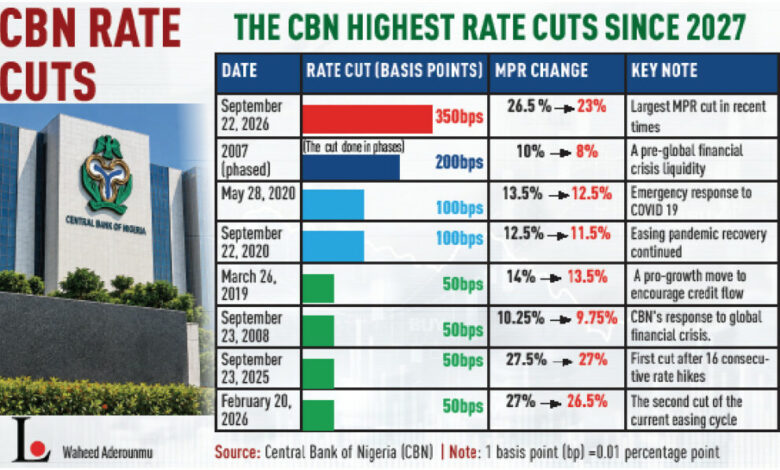
The Lagos Chamber of Commerce and Industry (LCCI), Manufacturers Association of Nigeria (MAN), Association of Small Business Owners of Nigeria (ASBON) and economists have welcomed the Central Bank of Nigeria’s (CBN) decision to cut the Monetary Policy Rate (MPR) by 350 basis points, from 26.5 per cent to 23 per cent, saying the move could lower borrowing costs, improve access to credit and stimulate production and investment.


However, the business groups have stressed that the effectiveness of the decision would depend largely on whether commercial banks transmit the reduction to their lending rates, warning that high borrowing costs remain a major constraint to manufacturers and small businesses.
The CBN Governor, Olayemi Cardoso, announced the decision yesterday at the conclusion of the 307th meeting of the Monetary Policy Committee (MPC), held on Monday and Tuesday.
The committee also recalibrated the Standing Facilities Corridor to plus 50 and minus 300 basis points around the MPR, while retaining the Cash Reserve Requirement (CRR) at 45 per cent for deposit money banks, 16 per cent for merchant banks and 75 per cent for non-Treasury Single Account public-sector deposits.

The director-general of MAN, Segun Ajayi-Kadir, described the reduction as a positive development but said the next critical step was to ensure that it translated into lower lending rates.
He said the decision showed the CBN’s willingness to ease pressure on the real sector and respond to persistent calls from businesses.
“This development is indicative of CBN’s positive disposition to easing the pressure on the real sector and responding to the persistent call of business, as well as yielding to the dynamism of the business environment. However, the elephant in the room remains the interest rate that an average manufacturer will pay when he or she approaches the bank,” he said.
Ajayi-Kadir said the reduction was still insufficient to close the competitiveness gap between Nigerian manufacturers and their counterparts in countries such as Egypt, Morocco and South Africa, where borrowing costs are significantly lower.
“For meaningful impact we need to witness further deep cuts. Even at 23 per cent MPR, prime lending rate will still be 27 to 30 per cent. This is not a palatable situation for any manufacturer. No manufacturer anywhere in the world can be competitive borrowing at 30 per cent,” he said.
He expressed concern that despite three previous MPC rate cuts, bank lending rates had remained high.
“We need to interrogate the transmission end. This is because our experience is that, despite the last three MPC cuts and drop in MPR, bank lending rates remained high. There is a need for additional measures to achieve noticeable impact,” he said.
Ajayi-Kadir called on the CBN to use moral suasion and regulation to encourage banks to transmit the reduction to borrowers.
“We cannot have disinflation on paper and high cost of credit in factory,” he said.
MAN proposed complementary measures, including reducing the CRR from 45 per cent to free more liquidity for manufacturing, operationalising the N1 trillion Manufacturing Stabilisation Fund at nine per cent, creating a special single-digit lending window for manufacturers and introducing a five per cent Development Finance rate for small and medium-sized enterprises.
The association also urged the CBN to continue easing towards a sub-15 per cent MPR in the medium term, while the government addresses power, foreign exchange, logistics and multiple taxation, which it said add more than 40 per cent to production costs.
Similarly, the director-general of the LCCI, Dr Chinyere Almona, welcomed the rate cut, describing it as a significant easing of monetary conditions for businesses, particularly Micro, Small and Medium Enterprises (MSMEs), which have been constrained by high credit costs.
“The Lagos Chamber of Commerce and Industry welcomes the decision of the Central Bank of Nigeria Monetary Policy Committee to reduce the Monetary Policy Rate by 350 basis points, from 26.5 percent to 23 percent. The decision represents a significant easing of monetary conditions and is a welcome development for businesses, particularly MSMEs, which have been severely constrained by the high cost of credit,” she said.
Almona, however, cautioned that a lower MPR would not automatically translate into cheaper or more accessible loans.