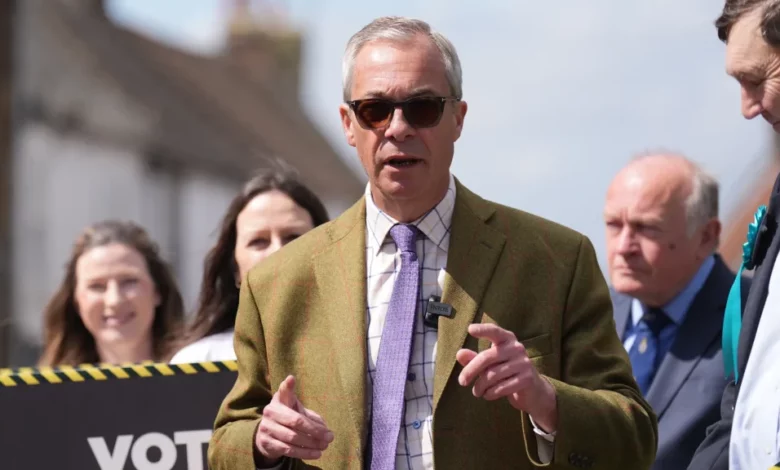
More than half of British voters have an unfavourable view of Reform UK leader Nigel Farage, according to a new national poll that also shows Prime Minister Andy Burnham attracting more positive ratings than other major party leaders.
The survey, conducted by Convergent for the non-profit research organisation Persuasion UK, found that 51% of respondents had a negative opinion of Farage, compared with 28% who viewed him positively.
The poll questioned 6,091 people and comes as Reform UK seeks to strengthen its position as an alternative government ahead of the next general election.
Farage’s personal ratings have also been negative in other recent polls, suggesting the Persuasion UK findings are not isolated.

An Ipsos survey conducted between August 21 and 27 found that 26% of British adults had a favourable opinion of Farage, while a majority viewed him unfavourably.
Opinium polling published in September also showed Farage with a negative net approval rating. Its September 16 survey placed him at -28, among the lowest ratings recorded for the party leaders it tested.
Read related news:
Leader of UK right-wing populist Nigel Farage resigned as MP
Nigel Farage’s Reform UK becomes Britain’s largest party ahead general election
Afghan migrant convicted of threatening to kill Nigel Farage
Burnham records stronger favourability
The Persuasion UK survey found that 43% of respondents viewed Burnham positively, while 28% had a negative opinion of him.
Among people who voted Labour at the 2024 general election, 72% said they had a positive view of the Prime Minister.
Recent independent polling has shown a similar pattern.
Ipsos polling conducted from September 10 to 15 found Labour on 27% voting intention, Reform UK on 23%, the Conservatives on 21%, the Greens on 13% and the Liberal Democrats on 8%.
Opinium’s September 9 poll also found Burnham ahead of Farage when respondents were asked whom they preferred as prime minister, with 43% choosing Burnham and 24% Farage.
These figures measure public opinion at specific points in time and should not be treated as a prediction of a future general election result.
Badenoch, Davey and Polanski ratings
The Persuasion UK findings showed a more even division over Conservative leader Kemi Badenoch.
About 31% of respondents had a positive view of Badenoch, while the same proportion viewed her negatively.
Green Party leader Zack Polanski was viewed positively by 17% of respondents and negatively by 41%.
Liberal Democrat leader Sir Ed Davey recorded a 21% positive rating compared with 29% negative.
Different polling companies use different methodologies, samples and question wording, meaning results should be compared cautiously rather than treated as directly interchangeable.
Cost of living remains a major concern
Beyond leadership ratings, the Persuasion UK research found that the cost of living remained the leading concern, with 60% of respondents selecting it as one of their top issues.
Around 67% said they believed large businesses take advantage of people, while 66% said workers do not receive a fair share.
When respondents were asked what they believed was driving higher prices, 37% identified the US-Iran war and 32% cited the war in Ukraine.
The findings broadly reflect other polling showing economic pressures remain high on voters’ list of concerns, although immigration has also continued to rank prominently. Opinium’s September 9 survey found immigration was selected as a leading issue by 51% of respondents, followed by health and the NHS on 47% and the economy on 44%.
What Farage’s ratings do — and do not — show
Personal favourability is different from voting intention.
A voter may have an unfavourable opinion of a party leader while still supporting that leader’s party, while others may like a politician personally but vote for another party.
The latest polling therefore provides evidence about Farage’s current public image but does not establish how people will vote at the next general election.
Reform UK remains a significant force in national polling. Ipsos’s September survey placed the party on 23%, four points behind Labour and two points ahead of the Conservatives.
The wider political picture therefore remains competitive, with leadership ratings, party support and voters’ priorities capable of changing before the country next goes to the polls.
Related news
NewDailyPrime has also reported on Reform UK’s proposal to reduce the UK civil service to around 300,000 staff, which could mean more than 220,000 fewer full-time-equivalent positions if the party forms a government. Reform UK plans more than 220,000 civil service cuts
NewDailyPrime previously reported on Farage’s proposals affecting migrant housing in Reform-controlled councils. UK councils could stop migrant housing under Farage plan
What readers should know
The 51% figure relates to personal unfavourability towards Nigel Farage in one survey, not the percentage of voters who oppose Reform UK or would refuse to vote for the party.
Other recent polls have also recorded negative personal ratings for Farage, but voting-intention figures show Reform UK continuing to attract substantial support nationally.