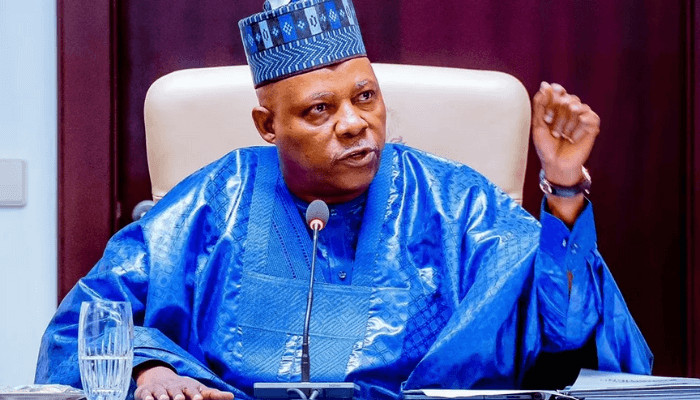
Vice President Kashim Shettima has declared that Nigeria’s democratic journey owes much to journalists and editors who, sometimes at considerable personal cost, insisted that the public deserved to know.
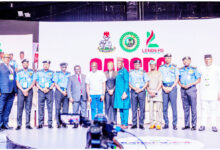
The Vice President stated this yesterday at the ongoing 22nd All Nigeria Editors Conference organised by the Nigerian Guild of Editors (NGE) at the International Conference Centre, Enugu.

He pointed out that the media has earned its place as the Fourth Estate of the Realm because it performs a duty that no democracy can do without.
Shettima noted that journalists interrogate power, inform citizens, shape public debate and preserve the institutional memory of our nation.
He urged the editors to continue telling the full story of Nigeria, including where progress is being made.
The Vice President pointed out that the reforms of President Bola Ahmed Tinubu’s administration have required difficult choices, but insisted that people are beginning to see encouraging signs.
“Nigeria’s economy grew by 4.43 per cent in the second quarter of 2026, compared with 4.23 per cent in the corresponding quarter of 2025, with growth recorded across agriculture, manufacturing, oil and gas, and services.
“As you scrutinise government, I also urge you to continue telling the full story of our country, including where progress is being made.
The reforms of President Bola Ahmed Tinubu’s administration have required difficult choices, but we are beginning to see encouraging signs. Nigeria’s economy grew by 4.43 per cent in the second quarter of 2026, compared with 4.23 per cent in the corresponding quarter of 2025, with growth recorded across agriculture, manufacturing, oil and gas, and services. Inflation has also moderated substantially from earlier levels in the reform period, although we recognise that the real test lies in what these improvements mean for the cost of living and the purchasing power of ordinary Nigerians.
“These numbers give us reason for confidence, but not for complacency. President Tinubu’s objective is clear: macroeconomic stability must translate into jobs, stronger businesses, greater purchasing power and a better quality of life for Nigerians. That work continues, and we are confident that with sustained reforms, the trajectory can only improve.
Government and the media will not always agree, nor should we. Democracy is strengthened when disagreement is informed by facts, exercised responsibly and conducted in good faith. What must unite us is the greater Nigerian project.
“I therefore commend the Nigerian Guild of Editors for sustaining this important platform and for choosing a subject that goes to the heart of the survival of our democracy.
I wish you fruitful deliberations and a successful 2026 All Nigeria Editors Conference.
Thank you, and God bless the Federal Republic of Nigeria.” He stated.
Speaking at the occasion, Governor Peter Mbah of Enugu State stated that government and the media should not necessarily be regarded as adversaries, arguing that both institutions had responsibilities to the people.
Describing the conference as an opportunity for a “temporary ceasefire” between the government and the media, Mbah said the ultimate meeting point between the two should be the truth.
“Today, fortunately, you are our guests. So perhaps, as I said yesterday, we can declare a temporary ceasefire,” he said.
The governor said while the government had the responsibility to be transparent and accountable, the media must establish facts, report the truth and scrutinise those in authority.
He said journalism should not be driven by the desire to prove a preconceived position, stressing that investigative journalism must rigorously examine evidence and competing claims.
“Our responsibility is to be transparent and deliver radical and positive change. Yours is to be independent: look closely, establish the facts, and tell the story as you find it. And the point at which those responsibilities meet should be the truth,” Mbah said.