| Plan to unfold in phases, state-to-state, not blanket directive — Agency
BY NSE ANTHONY-UKO, Abuja, YUSUF BABALOLA and ABIODUN SIVOWAKU, Lagos

With three weeks to October 1, the deadline set by President Bola Ahmed Tinubu for measures to cut intra-state transport fares through Compressed Natural Gas (CNG) and electric vehicles, transport unions have said they have not been consulted by either the federal or state governments and are yet to receive clear implementation guidelines.
Transport unions, stakeholders and analysts who spoke separately to LEADERSHIP also expressed doubts about the practicality of the president’s promise.
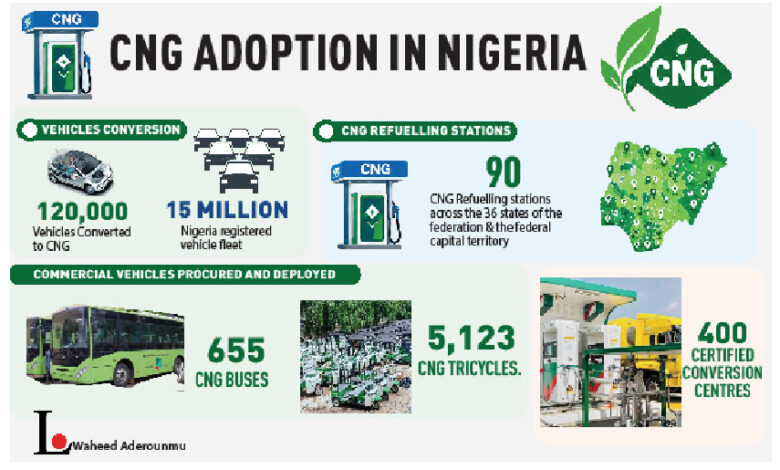
The Presidential Initiative on Compressed Natural Gas and Electric Vehicles (Pi-CNG & EV), however, insisted that the rollout would proceed through phased, state-by-state engagement rather than a blanket directive.
The development followed President Tinubu’s directive that the lower operating costs associated with CNG and electric vehicles should translate into cheaper transportation for Nigerians.
The president, during a meeting with All Progressives Congress (APC) governors at the State House, Abuja, had revealed that the governors had resolved to take immediate measures to bring down intra-state transportation costs by leveraging the cost advantages of CNG and electric vehicles.
He said a joint federal and state committee would be established to commence immediate implementation of the measures agreed with the governors.
However, nearly three weeks to the deadline, transport unions said they were yet to receive clear implementation guidelines.
Speaking exclusively to LEADERSHIP, the Ikeja branch chairman of the National Union of Road Transport Workers (NURTW), Comrade Isiaka Apena, said transporters had not been briefed by either the state or federal government on how the fare reduction would be implemented.
“The issue is that when the President gives a directive to reduce transport fares, the government should convene a stakeholders’ meeting and engage transport unions on how to implement the directive.
“For now, we have only heard about the directive in the news, but we do not know the strategy for implementing it. We do not know whether the government plans to subsidise transport costs or provide CNG-powered vehicles to the unions while directing them on how much to charge passengers.
“It would be difficult to tell a commercial vehicle owner who used his money to buy fuel or fill his vehicle with CNG to charge passengers a fixed fare. I do not think that would be wise. What we can do is appeal to transporters to reduce their fares slightly. For instance, if a transporter charges N1,500 on a route, we can ask the person to reduce it to N1,300.”
Apena said the government could only determine the appropriate fare if it subsidised the vehicle or its operating costs.
“If the fare is N1,500, for example, and the government provides a N500 subsidy, it can direct the operator to charge passengers N1,000 because the government is covering the remaining N500.
“Therefore, I believe the government should set up a committee and meet with the NURTW to determine how best to implement the directive and achieve its objectives.
“The government should clarify whether it plans to provide buses or subsidise a percentage of the operating costs. If that is done, the policy can work. But transport fares will not simply fall without the government providing some form of support.”
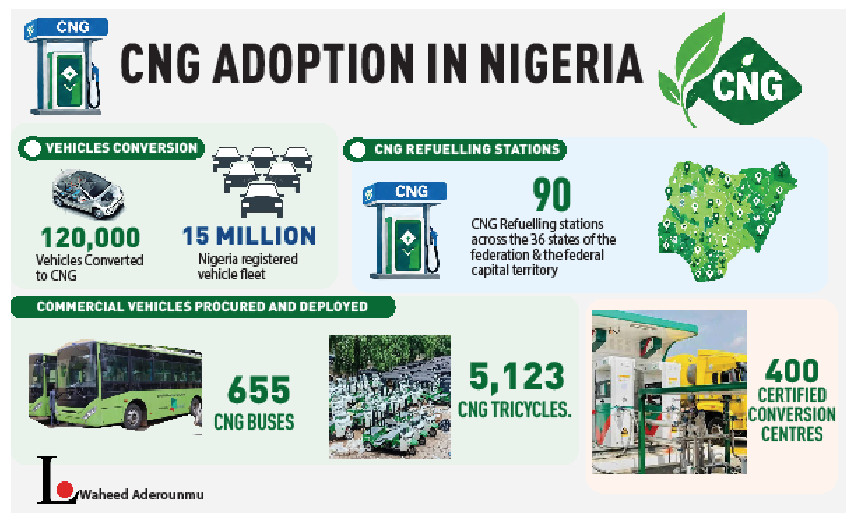
Apena also identified inadequate CNG refuelling infrastructure as another major challenge.
“We have a limited number of refuelling stations. There are often long queues at the few available stations, but the problem will reduce when more stations are established. For instance, Agidingbi is currently the only CNG station in Ikeja, while the next available stations are in Agege or Mushin.