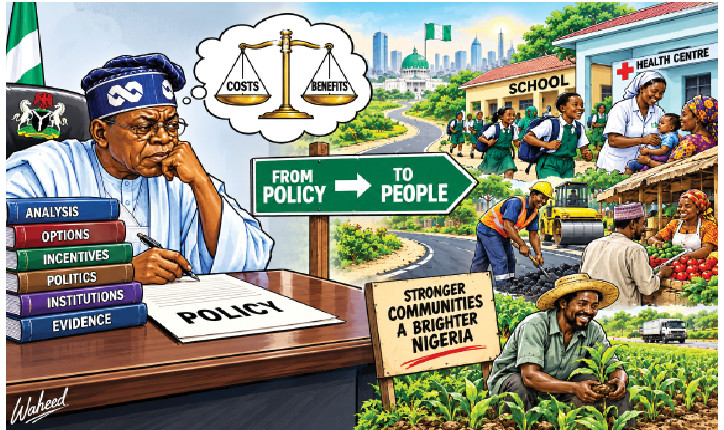
Last week, this column began with a simple proposition: Nigeria’s public policy conversation is often conducted at the wrong altitude. We examined why citizens encounter the state most directly through schools, primary health centres, rural roads, markets, transport systems, environmental services and local government offices. We also argued that a policy problem must first be understood before it is solved. Today, the column continues that argument. If knowing the problem is the beginning, the next question is what happens when a carefully diagnosed problem enters the political and administrative machinery of government. This is where incentives, institutions, competing values and frontline discretion determine whether a promising policy becomes a public good or another abandoned initiative.


From Problems Towards Choices
A government rarely chooses between a good option and a bad option. It usually chooses among imperfect alternatives, each benefiting some citizens, imposing costs on others and carrying uncertainties.
That reality should make policy analysis more rigorous. William K. Bellinger’s work on economics for policy analysis provides a useful discipline: the relevant question is not simply whether government can afford an intervention, but whether its social benefits justify the resources sacrificed elsewhere. Every new road competes with a school. Every government factory competes with health spending. For state policymakers, the essential question is therefore: what else could this money achieve? A N10 billion expenditure should be evaluated against the outcomes forgone by not spending that money elsewhere. That is the difference between accounting for expenditure and analysing public value.
How Incentives Change Behaviour
This reasoning becomes sharper when we consider how citizens respond to government decisions. Lee S. Friedman’s microeconomic approach to policy reminds us that people respond to prices, rules, risks, information and incentives.
Consider local taxation. A local government that increases market levies may expect higher revenue. But if the burden becomes excessive, traders may relocate, evade payment or operate outside formal markets. The government may collect less while economic activity becomes harder to monitor. Similarly, multiple charges on farmers, transporters or small manufacturers can make formal activity less attractive.
The same logic applies to environmental regulation. If government prohibits indiscriminate dumping without providing affordable waste collection, households may continue dumping illegally because the lawful alternative is inaccessible. Enforcement alone cannot solve an incentive problem created partly by inadequate service provision. Good regulation combines rules with feasible alternatives. The objective should be to make desirable behaviour easier, not merely punish undesirable behaviour.
Why Politics Shapes Outcomes
But incentives alone do not explain policy outcomes. Deborah Stone’s work on policy paradox reminds us that public decisions are contests over values as much as calculations of efficiency. Nigerian policymakers operate where questions of distribution are inseparable from development. Who gets the road? Which community receives the hospital? Whose land is acquired? Which informal operators are displaced?
These are political questions with technical dimensions. A policy that is economically efficient may still fail if it is perceived as unfair. A reform that improves aggregate welfare may provoke resistance from groups bearing concentrated losses. Politically intelligent policy design must therefore anticipate winners, losers and the narratives through which both interpret reform.
Urban transportation illustrates the point. Formalising informal transport can improve safety and service standards, but simply removing existing operators can create hardship for drivers and passengers. Successful reform recognises the economic lives embedded in existing arrangements and provides credible transition pathways.
Institutions Carry Policy Forward
Michael Howlett, M. Ramesh and Anthony Perl of the Singapore’s Lee Kuan Yew School of Public Policy remind us that policy is not a single decision, but a process involving agenda setting, formulation, adoption, implementation and evaluation. A brilliant policy document can therefore become a poor programme because institutions lack coordination, information, authority or capacity.
Nigeria’s federal structure makes this especially difficult. Responsibilities are distributed across federal, state and local institutions, while financing and administrative capacity are uneven. A primary school may depend on one level for teachers, another for infrastructure and another for complementary interventions. A primary health centre may receive medicines through one channel, personnel through another and capital investment through a third. When outcomes are poor, each institution can point elsewhere.
The answer is not simply to redraw constitutional boundaries. For policymakers, this means resisting the temptation to treat political urgency as evidence. Urgency can justify action, but it cannot substitute for diagnosis, comparison, measurement and institutional realism and learning. It is to make responsibility visible. Citizens should know which institution is responsible for which service, what standard it must meet and where complaints should go.