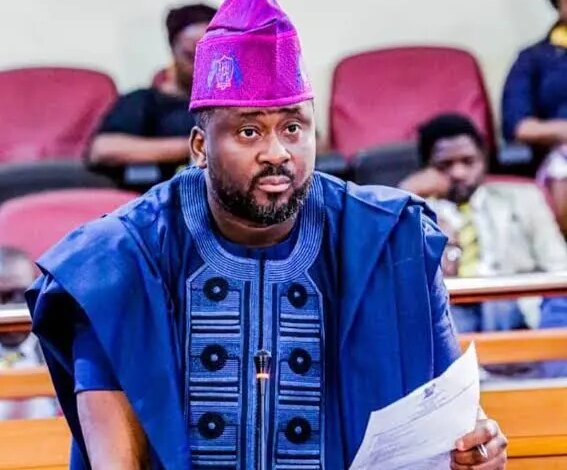
Remember Desmond Elliot? The romantic lead Desmond Elliot? If you did not know him from his Nollywood days, then you would know him as the member representing Surulere Constituency 1 in the Lagos State House of Assembly. He was one of those alleged to have supported the impeachment of Mudashiru Obasa as Speaker of the House in 2025.
If his political career still doesn’t ring a bell, during the #EndSARS protests in 2020, he was also accused of tagging Nigerians using social media as “children,” It was during this time that he pushed for the censorship of social media. An allegation he denied.
And if this still doesn’t ring a bell, then there is another chance to catch up because the new gist is that brother Elliot has found himself in the news for another dramatic reason.
On Sunday, September 14, 2026, Desmond Elliot was filmed kneeling before Femi Gbajabiamila, the Chief of Staff to President Bola Tinubu, and apologising for his remarks during the primaries of the All Progressives Congress (APC) in the state. This may be a sign that personal loyalty has become entangled with political survival in Nigeria.


Elliot apologised to Gbajabiamila over the disagreement that followed the recent APC primary for Surulere Constituency I. He said he was sorry, had no excuse for his actions, and hoped he would be “cultured” in the future. He also appealed for forgiveness and reintegration into the Lagos APC political structure.
The incident followed a dispute over the APC primary, which saw Elliot lose the party’s ticket to Barakat Odunuga-Bakare. Elliot had initially challenged the process before eventually accepting the outcome and apologising to Gbajabiamila.
Before then, he had also come out to say some powerful elements in the party were intimidating his supporters ahead of the primaries, while the same powerful deciders had withdrawn his security team.
There is nothing wrong with apologising after a political disagreement. Politicians, like everyone else, can make mistakes, offend people and attempt to repair relationships. What’s concerning is that such an attempt shows how access to power is often tied to obedience to powerful individuals.
This Elliot issue and a few others suggest that in Nigeria, politicians can spend years building political careers around the support of a godfather, party leader, or influential political family. Once that relationship becomes strained, their position in politics can become weak, regardless of how many citizens voted for them.
That culture has been around for decades, and Lagos has provided some of its clearest examples.
Akinwunmi Ambode became Lagos governor in 2015 after he was anointed as the APC’s candidate by Tinubu. By 2018, however, his relationship with influential figures within the Lagos APC structure had fallen apart. He eventually lost the party’s governorship primary to Babajide Sanwo-Olu, ending his attempt to secure a second term.
The episode became one of the country’s most prominent examples of the influence political godfathers can have over the careers of elected officials.
Academic research on Nigerian godfatherism has also identified the Ambode-Tinubu relationship as a notable case of how powerful political actors can influence who gets a party ticket and who does not.
The same pattern appeared in Edo State. Godwin Obaseki became governor of Edo State in 2016 with the backing of Adam’s Oshiomhole, his predecessor and a major figure in Edo politics and the APC.
Their relationship later dramatically went south. By 2020, Obaseki was fighting to secure the APC’s ticket for a second term while Oshiomhole was the party’s national chairman. Obaseki was eventually disqualified from the APC primary process over issues relating to his credentials. He left the party, joined the PDP, and went on to win the governorship election against the APC candidate, Osagie Ize-Iyamu.
There is an interesting irony in all of this. Nigerian politicians themselves understand how damaging this culture can become.
On May 31 2025, Senate President Godswill Akpabio advised governors not to choose successors simply because those politicians were submissive to them. He specifically warned against selecting people who “kneel” before them, arguing that governors should instead look for people with the capacity and vision to govern.
That warning gets to the heart of the problem because a politician who is selected primarily because they are obedient to the person who selected them may eventually have difficulty separating personal loyalty from public responsibility.
Political slavery might look like an internal party matter when it happens between politicians, but its consequences eventually reach ordinary Nigerians.
When politicians spend considerable energy maintaining relationships with godfathers and political patrons, public office can become less about delivering on a mandate and more about preserving political relevance. A lawmaker may hesitate to oppose a powerful party figure. A governor may avoid confronting an influential political ally. A prospective candidate may accept a weak party primary because challenging the process could mean losing access to the political structure that determines their future. See the case of our brother, Elliot.
All of these instances create a strange situation in which voters elect politicians, but powerful individuals sitting in one corner of their room can determine whether those elected politicians are allowed to continue.
It also affects the quality of people who enter politics. If obedience is rewarded more consistently than more useful qualities, politicians who are good at building relationships with powerful figures may have an advantage over people who are better equipped to govern but unwilling to become political slaves.
The Big Daily is your weekday shortcut to the biggest news shaping Nigeria. We cut through the noise, connect the dots, and explain why the news actually matters, all in one quick read.
Before you say the criticism of political godfatherism can easily become a criticism of political relationships themselves, there’s an explanation for that.
Politicians need mentors who can advise them, support their campaign, and help them navigate political institutions. Younger politicians can also legitimately show respect to older politicians who have helped them. None of that is the problem.
The problem exists when a politician’s relationship with a powerful mentor becomes so important that they cannot act independently without risking their political existence.
A quick look at what happened in Osun recently. Soon after the governorship election, which got Ademola Adeleke from the Accord Party a second term in the government house, he travelled to Abuja to present his certificate of return to President Tinubu of the APC.
The Federal Capital Territory Minister, Nyesom Wike, in his usual manner, came out to say he was the one who told Adeleke to pay a thank-you visit to the president.
This was after the Minister of Aviation and Aerospace Development, Festus Keyamo, congratulated Adeleke on his re-election and said “agreement is agreement.” We wonder what the agreement was that made the APC and Osun State Accord Party align to that extent.
Desmond Elliot’s decision to apologise to Gbajabiamila may ultimately be a personal and political matter between two people who have known each other for years.
Elliot is entitled to decide how he wants to manage that relationship, and an apology does not automatically mean that he has done something wrong by showing respect to a senior politician.
But the reaction to the video is valid because Nigerians have watched this style of politics play out repeatedly. Political careers are now built around powerful patrons. And politicians who fall out with those godfathers can quickly learn just how impossible it is to survive when thrown underwater in Nigerian politics.
Nigeria’s democracy needs political parties with stronger internal institutions, candidates who can build genuine relationships with voters, and elected officials who understand that their first responsibility is to the people they represent.
While political loyalty and personal relationships will always matter, neither should become a substitute for democratic institutions.
Until that changes, Nigeria will continue producing politicians who know how to navigate powerful people but struggle to build people-centred administrations strong enough to outlive them. And that wouldn’t help Nigerians, would it?
What do you think about this?
Drop your opinion in the comment section.
FOLLOW US & Share this with someone who needs to see this.