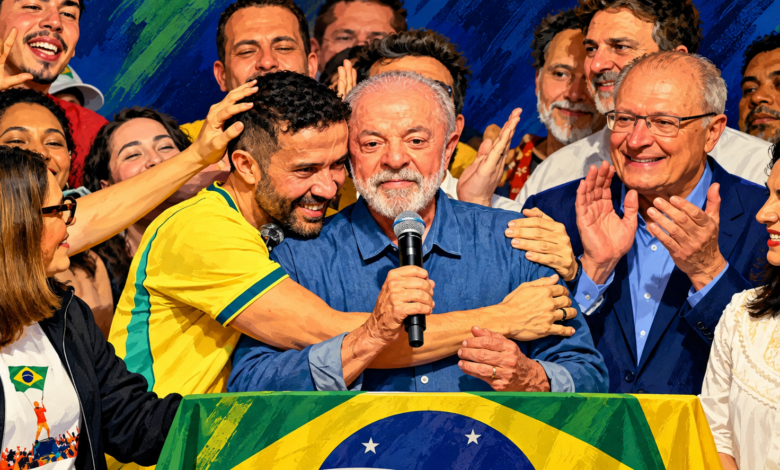
Brazilian President Luiz Inácio Lula da Silva has won a historic fourth term after defeating right-wing rival Flávio Bolsonaro in a closely fought presidential election, triggering celebrations across Brazil and a fresh political dispute over the result.
The 80-year-old leader secured 64,256,232 votes, representing 51.79% of valid ballots, compared with Bolsonaro’s 59,826,041 votes, or 48.21%, in Sunday’s presidential runoff.
The official figures, released by Brazil’s Superior Electoral Court, confirm that Lula defeated his 45-year-old opponent by 4,430,191 votes.
However, rather than concede defeat, Bolsonaro announced plans to challenge the result, claiming that a last-minute decision to extend voting hours had undermined the election.


The development has raised concerns about another prolonged electoral dispute in Latin America’s largest economy, four years after Brazil faced political unrest following the defeat of Bolsonaro’s father, former president Jair Bolsonaro.
Brazil election results: How Lula defeated Bolsonaro
LUIZ INÁCIO LULA DA SILVA
64,256,232 votes
Workers’ Party (PT)
FLÁVIO BOLSONARO
59,826,041 votes
Liberal Party (PL)
LULA’S VICTORY MARGIN
Official second-round valid votes, 25 October 2026. Source: Brazil’s Superior Electoral Court.
Lula’s victory is particularly significant because he finished behind Bolsonaro in the first round on 4 October before recovering to win the decisive second vote.
According to Brazil’s Senate, no presidential candidate had previously overturned a first-round defeat to win the runoff since the country’s return to democracy in the 1980s.
The result also represents a wider victory margin for Lula than in 2022, when he defeated former president Jair Bolsonaro by approximately 2.14 million votes.
Voter participation improved between the two rounds, with abstention falling from 21.08% to 19.21%, according to election figures reported by the Guardian.
Bolsonaro refuses to concede defeat
Despite the official result, Flávio Bolsonaro has disputed the conduct of the election.
His objections centre on a decision by Supreme Court Justice Cristiano Zanin to extend voting hours by two hours following disruption linked to transport problems and severe weather. Bolsonaro argued that changing voting arrangements on election day was unacceptable and said his lawyers would seek to have the result annulled.
However, electoral officials have maintained that the extension did not change the outcome, while legal experts cited by the Associated Press questioned whether his challenge had sufficient grounds to succeed.
The refusal to concede has revived memories of Brazil’s disputed 2022 election, when Jair Bolsonaro lost to Lula and subsequently became involved in efforts to overturn the result.
Jair Bolsonaro is now serving a 27-year prison sentence for plotting a coup following that election.
Lula promises to defend democracy after victory
Following confirmation of his victory, Lula addressed supporters in São Paulo, where thousands celebrated the election result.
He described the outcome as a victory for democracy and promised to govern for all Brazilians, including those who voted against him.
His campaign had focused on defending democratic institutions, protecting social programmes and improving economic opportunities for ordinary families.
However, Lula now faces the challenge of governing a deeply divided country.
Although he secured a clear numerical victory, almost half of valid votes went to his opponent, showing the strength of conservative support.
His government will also face pressure to address living costs, public security, economic inequality and concerns about corruption.
The election leaves Brazil facing a familiar challenge: how to maintain political stability while two competing political movements command substantial public support.
What Lula’s victory means for Brazil and the world
Lula’s re-election has implications beyond Brazil, particularly for international trade, environmental policy and relations with the United States.
Brazil is Latin America’s largest economy and a leading member of BRICS, the international grouping that includes Nigeria, China, India and South Africa.
Lula has supported stronger cooperation between developing economies and advocated a greater role for emerging nations in international decision-making.
His victory therefore offers continuity in Brazil’s foreign policy, although the government will still face difficult economic and diplomatic decisions.
The election also represents a political setback for US President Donald Trump, whose administration has maintained closer political ties with the Bolsonaro family.
On environmental policy, Lula has committed himself to protecting the Amazon rainforest and strengthening international efforts to tackle climate change.
However, his ability to deliver on those commitments will depend on government policy, parliamentary support and the country’s economic circumstances.
What happens next in Brazil?
Lula is expected to begin his new four-year presidential term on 5 January 2027, according to Brazil’s Senate.
Before then, attention will focus on whether Bolsonaro formally pursues his challenge and how electoral authorities respond.
The Superior Electoral Court has already confirmed Lula’s victory, meaning the opposition’s refusal to concede does not, by itself, invalidate the result.
For millions of Brazilians, the immediate concern will be whether the new administration can improve living standards, create economic opportunities and reduce political tensions.
For international partners, including Nigeria, Lula’s continuation in office provides an opportunity to maintain existing diplomatic and economic cooperation.
The greater test, however, will be whether Brazil can move beyond another bitter election and rebuild confidence in its democratic institutions.
Related news
Brazilians rally against proposed Bolsonaro amnesty bill
Brazilian police foil bomb attack at Lady Gaga’s rio concert
Uganda imposes nationwide internet blackout ahead of presidential election
Tinubu, Lula da Silva seal five MoUs to bolster Nigeria–Brazil ties
What readers should know
Lula has won Brazil’s presidential election by more than 4.4 million votes and secured a fourth non-consecutive term. The official result stands, although his opponent has announced plans to challenge it. Lula’s next term begins in January 2027, with economic recovery, political unity and international relations among the major issues facing his administration.