Water justice coalition accuses African leaders of failing citizens, demands end to water privatisation and calls for urgent public investment
African governments are facing renewed pressure to explain why millions of people across the continent still lack access to safe drinking water and adequate sanitation, as a coalition of water justice organisations accuses policymakers of allowing years of underinvestment, weak public utilities and growing commercial interests to deepen the crisis.
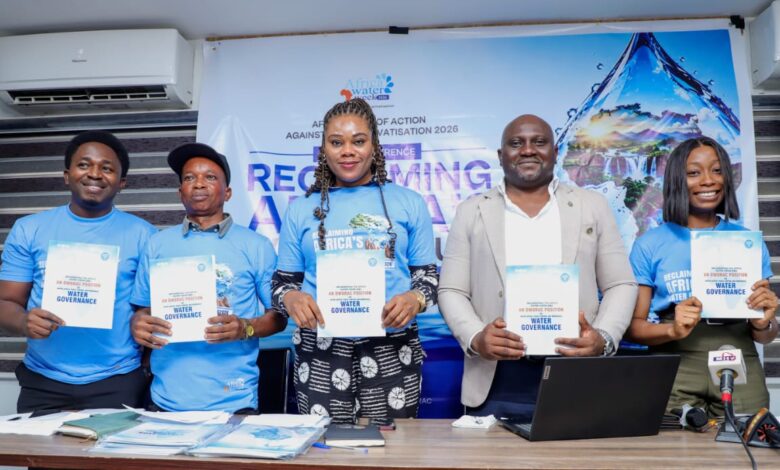
The Our Water, Our Right Africa Coalition (OWORAC) issued the challenge as it marked the 2026 Africa Week of Action Against Water Privatisation, running from October 12 to 18 under the theme, *“Reclaiming Africa’s Water Future: Public Water for All.”*
The coalition said governments across Africa must stop treating water access as a problem that can be resolved simply by inviting private companies into public services, insisting that access to safe and affordable water is a fundamental public responsibility.
Its message presents an uncomfortable question for African leaders: how can governments promise economic development, industrialisation and improved living standards when millions of their citizens still struggle to obtain one of life’s most basic necessities?
According to figures cited by OWORAC, 2.1 billion people globally lacked safely managed drinking water in 2024, while 3.4 billion lacked safely managed sanitation.
In sub-Saharan Africa alone, the coalition said, 167 million people relied on limited drinking-water services in 2024, representing more than half of the global population using services at that level.
These figures expose a serious development challenge for African governments, many of which have repeatedly pledged to improve living standards, expand infrastructure and deliver inclusive economic growth.
For families without reliable household connections, the consequences extend beyond inconvenience. Residents may be forced to collect water from unsafe sources or purchase it from vendors, tankers, private boreholes and public standpipes, often at prices that consume a disproportionate share of household income.
OWORAC cited research indicating that low-income households relying on water vendors in sub-Saharan African cities may pay between 10 and 20 times more per unit of water than wealthier households connected to public networks.
The disparity raises questions about the priorities of governments that have failed to provide reliable public water infrastructure to underserved communities.
When poorer families pay substantially more for water than residents connected to public networks, the burden of infrastructure failure falls most heavily on those least able to afford it.
Rural communities, informal settlements and low-income urban neighbourhoods are particularly vulnerable to unreliable supplies, inadequate sanitation and uncertainty over water quality.
For such households, water scarcity can mean additional expenditure, lost working hours, disrupted schooling and increased exposure to waterborne diseases.
The crisis also places a disproportionate burden on women and girls in communities where they are expected to spend time fetching water instead of pursuing education, employment and other opportunities.
For African governments, the challenge is not merely to announce new water policies but to demonstrate that public investment reaches the communities that need it most.
### Coalition Accuses Governments of Opening the Door to Commercial Control
The coalition expressed concern that governments facing infrastructure and financing gaps are increasingly turning to public-private partnerships, concessions, commercial tariffs, prepaid water meters and other arrangements involving private operators.
OWORAC argued that these models can deepen inequality where access to essential water services becomes increasingly dependent on the ability to pay.
The coalition maintained that years of weak public investment should prompt governments to rebuild and adequately fund public utilities, rather than automatically transfer responsibilities to commercial interests.
Its position is that private-sector participation does not, by itself, guarantee universal access, affordable tariffs, environmental protection or accountable service delivery.
The debate places African governments under pressure to explain how they intend to balance the need for investment with their responsibility to protect the public interest.
While governments may argue that private financing and expertise can help address infrastructure deficits, OWORAC insists that financing arrangements must be judged by whether they improve access, affordability and service quality for ordinary citizens.
The coalition also warned that privatisation and outsourcing in sanitation, wastewater treatment and solid-waste management do not necessarily resolve poor service delivery and may worsen existing problems where regulation is weak.
To support its concerns, OWORAC cited a 2025 Global Witness investigation into a Veolia-managed landfill in Colombia.
According to the coalition’s account, the investigation reported footage that appeared to show untreated leachate being pumped into waterways flowing into protected wetlands. Tests commissioned as part of the investigation reportedly detected elevated mercury levels at one sampling point.
OWORAC also referred to concerns surrounding Veolia’s past operations in Gabon, where the state reportedly alleged that petroleum waste had been found in nearly all pumping stations following years of the company’s operation.
The coalition further criticised Suez’s involvement in Senegal’s urban and peri-urban water systems, raising concerns about the effects on local communities and workers and referring to allegations of financial mismanagement.
These cases do not establish that every private water arrangement fails. However, they reinforce the need for transparent contracts, independent environmental monitoring, effective regulation and clear accountability whenever companies manage essential public services.
African governments must ensure that public resources and citizens’ access to water are not compromised by poorly supervised agreements or arrangements that leave communities with limited influence over decisions affecting their lives.
Companies cited in connection with particular allegations should be given the opportunity to respond, and the claims should be assessed against the underlying investigations and official records.
The coalition said droughts, floods, pollution and other climate-related disruptions were worsening existing water vulnerabilities across Africa.
These pressures make the need for resilient infrastructure, effective water-resource management and reliable public utilities increasingly urgent.
Governments that fail to plan for climate risks face the prospect of worsening shortages, damaged infrastructure, contaminated water sources and greater pressure on already underserved communities.
OWORAC argued that public-sector weaknesses should not become a justification for surrendering control of essential services to commercial interests.
Instead, it called for stronger public institutions, greater investment in water infrastructure and workers, improved data systems and meaningful community participation in water governance.
The coalition’s argument places responsibility firmly on governments to establish policies that protect public water resources and ensure that essential services remain accessible to all.
The campaign comes as the African Union has designated 2026 as the Year of *“Assuring Sustainable Water Availability and Safe Sanitation Systems to Achieve the Goals of Agenda 2063.”*
The Africa Water Vision 2063 and Policy, alongside the 2026 United Nations Water Conference, offer opportunities for African leaders to turn continental commitments into practical improvements.
But the central test will be implementation.
African governments must demonstrate how much they are committing to water and sanitation, how funds are being spent, which communities are receiving improved services and what measures are in place to prevent corruption, waste and poor project delivery.
Without transparent budgets, measurable targets and public reporting, ambitious declarations risk becoming another set of promises that fail to change conditions for vulnerable households.
OWORAC has developed a position paper titled *Implementing the Africa Water Vision 2063: An OWORAC Coalition Position on Water Justice, Public Financing and Democratic Water Governance* to address financing, accountability and public participation in the implementation of the continental vision.
The coalition and its allies are calling on African governments to:
1. **Guarantee universal access to safe water:** Treat affordable and reliable water and sanitation as a human right and a core public responsibility.
2. **Commit adequate public funding:** Establish measurable national and regional financing targets for water infrastructure and sanitation.
3. **Rebuild public water utilities:** Strengthen the institutions responsible for delivering water services and protect them from undue commercial influence.
4. **Publish contracts and expenditure:** Make water-related agreements, tariffs, financing arrangements, allocations and spending records transparent to the public.
5. **Give communities a voice:** Ensure that residents, workers, women and other affected groups participate meaningfully in decisions about water services.
OWORAC also demands the rejection of privatisation, commercialisation, concessions, public-private partnerships, management and lease contracts, outsourcing and prepaid water-meter arrangements that transfer control or delivery of public water services to commercial interests.
The coalition’s position is that African governments must prioritise publicly financed and democratically accountable water systems rather than make access increasingly dependent on commercial arrangements.
The Week of Action is backed by organisations including the Senegalese Water Justice Network; Corporate Accountability and Public Participation Africa and Amaka Nweke Foundation of Nigeria; Water Citizens Network/Revenue Mobilisation Africa of Ghana; Green Scenery of Sierra Leone; Voices for Water of Zimbabwe; Biodiversity and Biosafety Association of Kenya; and Corporate Accountability International, among others.
Their campaign puts a fundamental responsibility before African governments: to show that water policies are improving people’s lives rather than simply producing strategies, agreements and investment announcements.
The challenge is especially significant for countries where rapid urbanisation, population growth, weak infrastructure and climate pressures are increasing demand for reliable water supplies.
For citizens who must spend scarce income buying water or travel long distances to find it, the distinction between a government promise and a functioning public service is immediate and measurable.
African leaders must therefore be judged on transparent financing, reliable infrastructure, affordable access and demonstrable improvements in water quality and sanitation.
**The bottom line is clear: Africa cannot achieve inclusive development while millions of its people struggle to obtain safe drinking water. Governments must explain their priorities, disclose how public funds are spent and demonstrate that every water policy serves the public interest.**
The right to water cannot be meaningful if access depends on a household’s ability to pay prices it can barely afford.
**The Press Nigeria