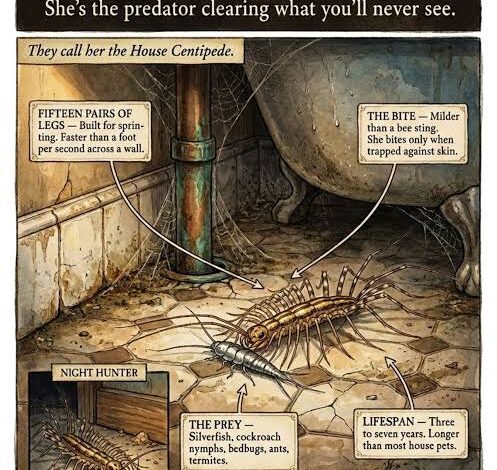
At first sight, the house centipede may look frightening because of its numerous long legs, unusual body shape and incredible speed. However, before reaching for an insecticide or slipper to kill it, you may want to understand the important role this little creature plays in your home.
The house centipede (Scutigera coleoptrata) is a natural predator that helps control household pests. Although its appearance can be intimidating, it generally poses little danger to humans and is not an insect that should automatically be treated as a threat.
An adult house centipede typically measures between 35 and 60 millimetres in body length. It has a yellowish-grey or brown body, usually marked with three dark bluish or reddish stripes running along its back. Its most striking feature is its 15 pairs of exceptionally long, delicate legs, which enable it to move remarkably fast.
Unlike insects, which have six legs, the house centipede belongs to the arthropod group known as centipedes. Its body is flattened and divided into 15 segments, with each segment bearing a pair of legs. Its external skeleton is made primarily of chitin.

### Why is the house centipede beneficial?
Here is something many homeowners do not know: the house centipede is a natural pest controller.
It feeds on several household pests, including:
* Cockroaches and their young.
* Flies and mosquitoes.
* Termites.
* Spiders.
* Silverfish.
* Fleas.
* Moths and their larvae.
* Other small insects and arthropods.
It catches its prey using its speed and specialised venom-delivering front appendages. The venom immobilises its victims, allowing the centipede to feed on them.
### Can a house centipede harm humans?
Generally, house centipedes avoid humans and prefer to hide in dark, damp places such as bathrooms, basements, drains and corners of buildings.
Although they possess venom, bites are uncommon and usually occur only when the animal is handled or trapped. A bite may cause temporary pain, redness or swelling, but serious reactions are rare.
### Should you kill it when you see one?
Not necessarily!
House centipedes can actually help reduce the population of unwanted insects inside your home. However, seeing many of them regularly could indicate an underlying problem, such as excessive moisture or an abundance of other household pests.
Rather than killing every centipede you encounter, consider reducing indoor humidity, fixing water leaks, sealing cracks and controlling other insect infestations.
The interesting lesson: Not every creature that looks frightening is dangerous. Sometimes, nature provides its own pest-control service, and the house centipede is one of those unexpected helpers.
Before you kill that strange-looking creature crawling across your bathroom wall, remember: it might be helping to protect your home from cockroaches and other unwanted visitors!