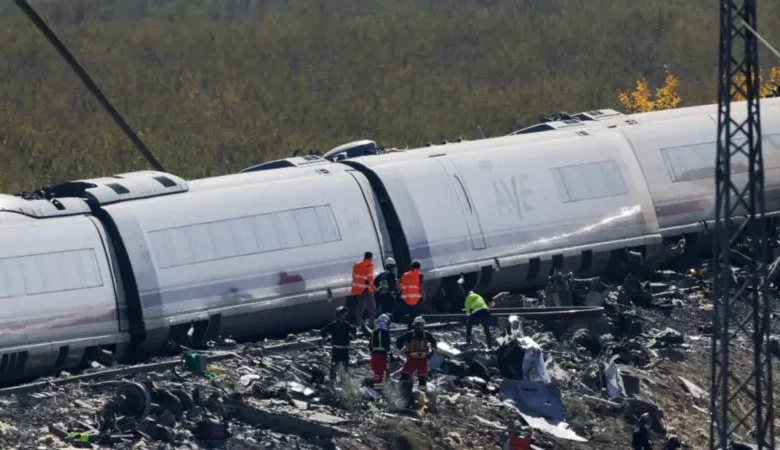
At least 68 people have been killed and scores injured after two high-speed trains collided in Spain, triggering a major emergency response and leaving the country mourning the victims.
Spanish Prime Minister Pedro Sánchez expressed condolences to the victims and their families, acknowledging the scale of the tragedy and its impact on the nation.
“The whole country is grieving,” Sánchez said, expressing solidarity with those affected by the disaster.
Emergency services, including firefighters, police officers, medical personnel and rescue workers, were deployed to the scene to search for survivors, recover victims and assist injured passengers.


Authorities have launched an investigation into the circumstances surrounding the collision, with initial accounts pointing to a computer failure and subsequent decisions by railway control officials.
READ RELATED STORY
Spain declares state of emergency after 3,000 migrants cross from Morocco
UK court jails Nigerian man for masturbating on train
COMPUTER FAILURE PRECEDED COLLISION
Spain’s Transport Minister, Óscar Puente, provided further details about the circumstances leading to the collision, describing the accident as “truly unbelievable”.
According to Puente, a computer failure initially brought six moving trains to a halt, including the Renfe and Iryo trains that were subsequently involved in the crash.
He explained that when a system failure occurs, responsibility for managing train movements shifts to the railway control centre.
“In the event of a system failure, the control centre takes over,” Puente said, adding that the control centre subsequently authorised the trains to resume their journeys without imposing speed restrictions.
The minister described the decision to allow the trains to move again as having been made “under inexplicable circumstances”.
The decision resulted in the Renfe train colliding with the Iryo train, which was stationary further along the tracks.
Investigators are expected to examine the computer failure, the decisions taken by the control centre and the circumstances in which the trains were authorised to resume their journeys.
GOVERNMENT EXPRESSES CONDOLENCES
Sánchez said emergency services were working to assist those affected, with authorities coordinating rescue operations and support for passengers and their families.
Spain’s King Felipe VI and Queen Letizia also expressed sadness over the collision, extending their support to the victims, their relatives and emergency personnel involved in the response.
European Commission President Ursula von der Leyen expressed solidarity with Spain following the disaster.
INVESTIGATION UNDERWAY
The collision has raised questions about railway safety, signalling systems and operational procedures in Spain, which operates one of Europe’s largest high-speed rail networks.
Investigators are working to establish the sequence of events leading to the crash and determine whether technical failures or operational decisions contributed to the disaster.
Authorities are also working to identify victims, notify relatives and provide medical care to the injured.
As Spain mourns the victims, attention is turning to the investigation and the measures needed to prevent a similar tragedy.