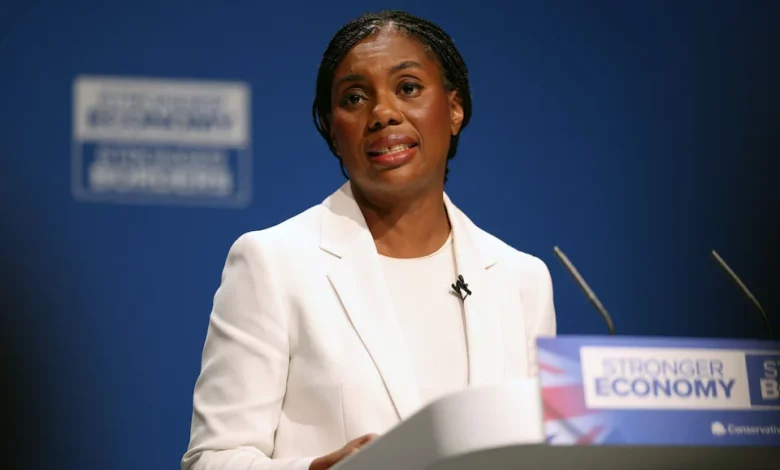
Conservative Party leader Kemi Badenoch has warned that Britain could face widespread civil unrest similar to the riots in France unless the Labour government tightens immigration controls and makes it harder for migrants to obtain permanent residency and British citizenship.
Badenoch issued the warning on Tuesday, 20 October 2026, amid growing disagreement within the Labour government over proposed immigration reforms that could require migrants to wait longer before qualifying for indefinite leave to remain (ILR).
Speaking at a press conference, the opposition leader argued that the current immigration system was too lenient and called on Home Secretary Shabana Mahmood to introduce tougher rules.
She also acknowledged that previous Conservative governments had allowed immigration to reach levels she now considered excessive.


Her comments came as France struggled to contain violent unrest that began with protests over education and rising living costs before spreading to several cities.
However, the French demonstrations have multiple reported causes, and there is no established evidence that immigration was responsible for the latest outbreak of violence.
Badenoch warns Britain against repeating France’s unrest
Badenoch said the government needed to take public concerns about immigration seriously to prevent further political and social tensions.
She argued that Britain risked experiencing similar difficulties to those seen in France if politicians failed to address weaknesses in the immigration system.
The Conservative leader told reporters:
“I don’t want us to end up with how France is ending up, with so much civil unrest.”
She added that politicians needed to accept responsibility for their decisions rather than avoid difficult reforms.
Badenoch maintained that obtaining British citizenship should be more demanding, arguing that permanent residency currently provides a route to citizenship that is too accessible.
She also said the Conservatives would support Mahmood if the Home Secretary introduced meaningful restrictions.
However, she suggested that the government’s proposed changes might not go far enough.
Conservative leader admits mistakes over immigration
During the press conference, Badenoch acknowledged that immigration had increased significantly under previous Conservative administrations.
The party governed Britain from 2010 until Labour won the general election in 2024.
Badenoch conceded that the former government had allowed too many people to enter the country, with some now approaching eligibility for permanent settlement.
She accepted that mistakes had been made but insisted that political leaders should concentrate on correcting the system.
Her admission comes as the Conservatives seek to establish a new immigration policy while Labour faces criticism over its own reform proposals.
The debate also raises questions about how immigration decisions made under previous governments should affect migrants who entered Britain legally and have since established careers, families and communities.
What changes is the Labour government proposing?
At the centre of the disagreement is the government’s proposal to reform the system for obtaining indefinite leave to remain.
ILR allows eligible foreign nationals to live and work in Britain without a time limit on their immigration permission.
Under the existing standard route for many qualifying migrants, settlement can be obtained after five years, provided applicants meet the relevant requirements.
The government has proposed increasing the standard qualifying period to ten years under an earned settlement system, with different arrangements for certain categories of migrants.
The proposals would place greater emphasis on conduct, economic contribution and integration when determining settlement eligibility.
Some groups could face longer qualifying periods, while others might qualify earlier under specified conditions.
The changes have not been presented as a blanket rule already applying to everyone currently living in the UK.
The Home Office’s official earned settlement consultation explains that the proposed system would make settlement dependent on qualifying requirements rather than simply completing a fixed period of residence.
Labour ministers divided over immigration reforms
Badenoch’s comments followed disagreements within the Labour government about how the proposed settlement changes could affect migrants and community relations.
Energy Secretary Miatta Fahnbulleh has raised concerns that requiring migrants to wait longer for permanent residency could undermine integration and social cohesion.
Her criticism centred on the argument that people who have already established lives in Britain need greater certainty about their future.
Other Labour figures, including Angela Rayner, have expressed concerns about fairness for workers who entered the country under existing immigration arrangements.
Particular attention has focused on overseas care workers, many of whom came to Britain through government-approved visa routes to fill staffing shortages.
Critics of retrospective changes argue that extending settlement requirements for people already living in the UK could alter expectations established when they originally moved.
Supporters of stricter settlement rules, meanwhile, argue that immigration policy should place greater emphasis on integration, contribution and public confidence.
The government must therefore decide how to balance immigration controls with the interests of employers, migrant workers and communities.
Why France is facing violent protests
The latest unrest in France began amid demonstrations over conditions in education and concerns about the rising cost of living.
The protests subsequently expanded into broader complaints about public services, government policies and economic inequality.
Violence broke out in several cities, with reports of looting, fires, damage to buildings and confrontations between protesters and security officers.
French authorities responded with additional security measures, including local curfews and the deployment of more officers.
Prime Minister Sébastien Lecornu acknowledged shortcomings in the authorities’ response, while officials faced questions about whether sufficient preparations had been made.
Although Badenoch cited the unrest as a warning about Britain’s immigration policies, reports from France identify education, household finances and dissatisfaction with government decisions among the principal drivers of the demonstrations.
The comparison therefore remains a political argument rather than evidence that Britain faces an equivalent crisis because of immigration.
What could tougher immigration rules mean for Nigerians in the UK?
The dispute is particularly relevant to Nigerians living and working in Britain, including those employed in health and social care, technology, education and other sectors.
Many Nigerian migrants rely on work visas or family routes that can provide a pathway towards permanent settlement.
Changes to ILR requirements could affect how long some migrants must remain on temporary immigration permission before qualifying for permanent residence.
Depending on the final rules, longer qualifying periods could also influence the cost of maintaining immigration status, family planning and decisions about employment.
However, the exact impact will depend on the final legislation and Immigration Rules, including any transitional protections for people already in the UK.
Nigerians holding valid visas should not assume that Badenoch’s remarks or the government’s proposed reforms have automatically changed their immigration status.
Applicants should continue following the rules currently applicable to their visa category and monitor official Home Office announcements.
Badenoch also challenges closer UK-EU relations
Badenoch used the same press conference to challenge arguments for closer relations between Britain and the European Union.
She criticised Prime Minister Andy Burnham’s approach to strengthening ties with the EU, questioning whether closer integration would resolve Britain’s economic and political difficulties.
Pointing to unrest in France and economic challenges in Germany, she argued that EU membership did not provide a solution to every national problem.
However, she also acknowledged that leaving the EU had not automatically resolved all Britain’s difficulties.
Her remarks placed the debate over immigration within wider disagreements about economic policy, Brexit and the country’s future relationship with Europe.
What happens next?
The immediate question is whether the Labour government will proceed with its proposed settlement reforms in their current form or make changes following concerns raised by ministers, MPs and affected communities.
Badenoch has indicated that the Conservatives would support stronger immigration controls, while maintaining pressure on the Home Secretary to go further.
For migrants already living in Britain, the most important developments will be the final settlement requirements, when any changes take effect and whether transitional arrangements protect people who entered under previous rules.
The debate also leaves a wider question about the relationship between immigration policy and social cohesion.
Badenoch has warned that failing to tighten immigration could contribute to unrest, but the disturbances in France demonstrate that public disorder can emerge from several economic, political and social grievances.
Whether the proposed British reforms address public concerns without creating new difficulties for migrants and employers will remain central to the political debate.