Nigeria’s economy has continued to expand under President Bola Tinubu’s economic reforms, but an estimated 123 million Nigerians were still living in extreme poverty in 2025, according to the World Bank.
The latest figures raise questions about how quickly improvements in economic growth, government revenue and foreign reserves are translating into better living conditions for ordinary Nigerians.
The World Bank’s updated country assessment shows that Nigeria’s economy grew by 4.2 per cent in the first half of 2026, compared with 3.9 per cent during the corresponding period of 2025.
However, the institution said growth remained insufficient to create enough productive jobs or significantly reduce poverty.
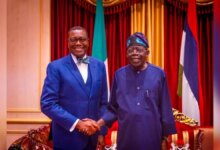
Its estimates indicate that 50.8 per cent of Nigerians, representing approximately 123 million people, lived in extreme poverty in 2025.
A further measure showed that 69.6 per cent of the population lived below the lower-middle-income poverty threshold of $4.20 per person per day, measured using international purchasing power parity.
These are separate poverty indicators rather than figures that should be added together.
Nigeria’s economic growth has yet to reach many households
The findings reinforce concerns first raised in the World Bank’s October 2025 Nigeria Development Update, titled From Policy to People: Bringing the Reform Gains Home.
In that report, published on 8 October 2025, the World Bank acknowledged improvements in the country’s economic performance but warned that rising national output and stronger government finances had not substantially improved household welfare.
It found that Nigeria’s economy expanded by 3.9 per cent in the first half of 2025, supported by services, non-oil industries, agriculture and improvements in oil production.
Foreign reserves had exceeded $42 billion, while the current account surplus reached 6.1 per cent of gross domestic product.
The institution also projected that public debt would decline from 42.9 per cent of GDP to 39.8 per cent in 2025.
Despite those improvements, millions of Nigerians continued to experience financial hardship, with food prices placing particular pressure on low-income families.
According to the report, poorer households could spend up to 70 per cent of their income on food.
The World Bank also found that the cost of a basic food basket increased fivefold between 2019 and 2024.
This meant that even where economic indicators were improving, many households were still struggling to meet everyday needs.
Food inflation remains a concern
The World Bank’s updated assessment indicates that inflation has fallen considerably from its previous levels, although the cost of essential goods remains a challenge.
Headline inflation declined from 27.4 per cent in March 2025 to 15.1 per cent in February 2026.
However, inflation averaged 15.7 per cent between March and July 2026, while food inflation reached 20.3 per cent in July.
The figures show that inflation has slowed, but prices are still rising overall.
For example, a reduction in inflation from 27 per cent to 15 per cent does not mean food and other goods have become 12 per cent cheaper. It means the overall rate at which prices are increasing has slowed.
For households whose incomes have not increased sufficiently, the pressure on living standards can therefore continue even as inflation declines.
World Bank calls for stronger social protection
The World Bank has identified social protection as an important policy response to Nigeria’s continuing poverty challenges.
In its October 2025 recommendations, the institution urged the Federal Government to expand regular cash transfers for extremely poor households and develop a system capable of responding to economic shocks.
It also recommended tackling food inflation by addressing insecurity, transport difficulties, agricultural input shortages and restrictions affecting food imports.
Another priority was improving public spending to ensure that government resources produce measurable improvements in education, healthcare and other essential services.
The World Bank’s April 2026 Nigeria Development Update reinforced the importance of investing in human capital, particularly early childhood nutrition, healthcare and education.
Higher reserves, but pressure on government spending
Nigeria’s external financial position has improved further.
According to the World Bank’s updated country assessment, gross foreign reserves reached $51.9 billion at the end of July 2026.
The current account surplus also increased from $1.4 billion in the final quarter of 2025 to $5 billion in the first quarter of 2026.
Nevertheless, government spending and debt-servicing pressures remain significant.
The World Bank projected that Nigeria’s fiscal deficit would increase from 3.1 per cent of GDP in 2025 to 3.5 per cent in 2026.
It also warned that weaknesses in budget management and public investment could limit the benefits of higher government revenue.
What will determine whether Nigerians benefit?
The World Bank expects Nigeria’s economy to grow by an average of 4.4 per cent annually between 2026 and 2028.
However, the institution maintains that stronger economic growth must be accompanied by investment, improved infrastructure, productive employment and effective social protection.
For Nigerians, the central issue is no longer simply whether the economy is growing, but whether that growth is creating jobs, improving purchasing power and reducing poverty.
Without measurable progress in these areas, stronger economic indicators may continue to coexist with financial hardship among millions of households.
Related news
What readers should know
The World Bank’s original warning was issued on 8 October 2025. Its subsequent 2026 assessments indicate that economic stabilisation has continued, but poverty remains widespread. The figure of 123 million refers to an estimate for 2025, not a confirmed count for October 2026.
Nigeria’s progress will therefore need to be assessed through household incomes, job creation, food affordability and the effectiveness of government support programmes, not GDP growth alone.