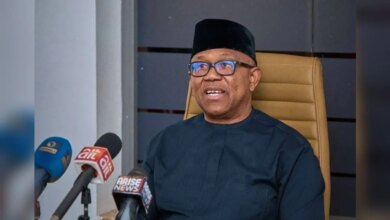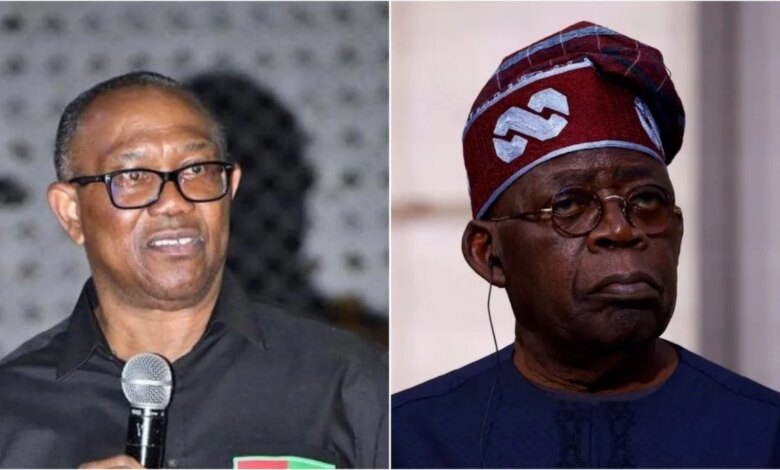
The presidential candidate of the Nigeria Democratic Congress (NDC), Peter Obi, has criticised the recent 30-day petrol discount announced by President Bola Tinubu-led Federal government.
Obi specifically described the policy as a political gimmick that fails to address the economic hardship facing Nigerians.
He said the initiative was a reactive measure that substituted political optics for sound economic policy.
In a statement he personally issued on Sunday, the former Anambra State governor said he delayed his reaction to the announcement to assess its implementation and outcomes before reaching his conclusion.
“Now, having assessed the outcomes, the policy is a substitution of political optics for sound policy,” he said.
Obi traced the current economic hardship to the removal of petrol subsidy by Tinubu on May 29, 2023, arguing that the decision was taken without adequate consultation or proper assessment of its potential effects on the economy and the livelihoods of ordinary Nigerians.
He also faulted the subsequent floating of the naira and tax reforms, which he said were poorly sequenced and implemented in a disorganised and insensitive manner.
According to him, the simultaneous implementation of three budgets further undermined transparency and accountability.
Obi argued that the combined effects of these policies had fuelled inflation and driven up the prices of goods and services, worsening the economic difficulties faced by Nigerians.
He listed rising multidimensional poverty, unemployment, insecurity, inequality and business closures among the consequences of the government’s economic policies. He also cited shrinking opportunities, youth migration and a general decline in citizens’ well-being.
The NDC presidential candidate accused the Tinubu administration of failing to conduct and publish detailed regulatory impact assessments of its policies.
He said a competent government would have used such assessments to engage stakeholders and ordinary Nigerians in developing more inclusive and sustainable economic strategies.
Questioning the rationale behind the 30-day petrol discount, Obi asked whether the initiative could significantly improve the country’s economic situation.
“What really does the President Bola Tinubu-led government want to achieve with a one-month discount of less than 5% on fuel cost? Will it reduce poverty, unemployment, insecurity, and inequality? Will it increase productivity and exports?” he asked.
He further questioned whether the initiative was a test to determine if petrol subsidy should be restored or a political strategy ahead of the 2027 general election.
“Too many questions, no answer!” Obi added.
He also criticised the limited number of petrol stations participating in the initiative, arguing that the arrangement would prevent most Nigerians from benefiting from the discount.
According to him, the Federal Government said the discount would be available at Nigerian National Petroleum Company (NNPC) Retail stations, estimated at about 900 nationwide.
Obi contrasted this figure with the estimated 24,000 petrol stations across the country, arguing that the scheme would cover fewer than four per cent of filling stations.
Using an estimated population of 243 million, he calculated that there would be approximately 243,000 Nigerians for every NNPC Retail station, assuming the outlets were evenly distributed across the country.
He noted that the distribution of the stations was not even, raising further concerns about access to the discount.
“Imagine 243,000 Nigerians struggling for a N66.00/per litre discount in each of the NNPC petrol stations,” he said.
“This is certainly not how to govern a richly blessed and endowed nation!”
Obi said he would provide a more detailed explanation of his position on petrol subsidy and outline a policy roadmap for ensuring fair, transparent and affordable petroleum product pricing.
He maintained that subsidy should be restored, not only on petrol but also in agriculture, healthcare, education and infrastructure.
“Research on our current revenue and revenue potential in a productive Nigeria under an incorrupt, transparent and competent government which my leadership will enthrone affirms my position that subsidy should be restored to Nigerians,” he said.
However, Obi argued that addressing the country’s economic challenges required more than subsidy, stressing the need for leadership committed to reducing the cost of living through policies that improve citizens’ welfare.
“It is clear that President Tinubu’s October 1 policy announcement is neither of that. It is plain political optics masked as policy,” he said.
“Nigerians are tired of those gimmicks. It is time for real change.”