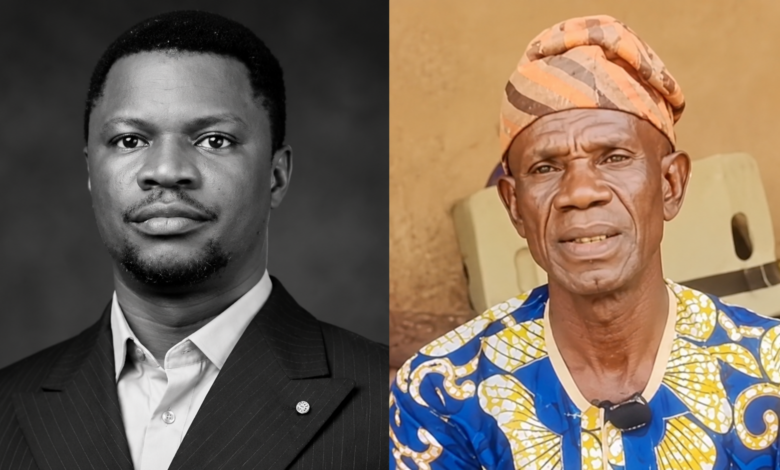
An investigative visit to the home of late gospel singer Toluwanisings’ father has intensified public debate over parental responsibility, family estrangement and the circumstances behind their relationship. While the elderly man denies neglecting his son, his account of his modest living conditions and hopes for a house in Oyo has prompted fresh questions for about what the public knows, what it assumes and whose voices are still missing.
The controversy surrounding late Nigerian gospel singer Toluwanisings has taken another turn following an investigative visit by journalist DunmininuKingdom to the residence of the singer’s biological father.
In a video titled “This is where Toluwanisings’ father is living. Investigation Continues…”, the journalist visited the father’s home and questioned him about his relationship with his son, his religious conversion, his years in northern Nigeria and his present living conditions.
The interview has added a new dimension to a dispute that has already generated intense public reactions over the singer’s family relationships and burial arrangements. It has also exposed a difficult question at the heart of the debate: what responsibilities do parents and successful children owe each other, and how much can outsiders conclude about a family from a brief interview after a death?
The father rejected suggestions that he had failed in his parental responsibilities. He also denied having a serious disagreement with his son. He insisted that their relationship was not marked by the conflict being discussed online.
However, his account of his present circumstances, including the rent he pays and his hope that a house in Oyo would be completed, has drawn attention to the financial and emotional questions surrounding the family.
RELATED NEWS:
Father denies neglecting his son
During the interview, DunmininuKingdom asked whether the singer’s conversion from Islam to Christianity had affected his father’s willingness to care for him.
The father dismissed that suggestion, explaining that both Muslims and Christians belonged to their family and that he had been happy when his son became a Christian.
“I didn’t neglect to care for him,” he said.
He added that there had been no serious disagreement between them that could have caused a lasting rift.
When the interviewer asked whether they had ever fought publicly or experienced a major falling-out, the father responded, “God forbid. We never fought.”
He also maintained that he had fulfilled his duties as a father while his son was alive.
These statements offer the father’s account of the relationship, but they do not independently settle the questions raised by members of the public. The interview does not establish the extent of his involvement in the singer’s upbringing, the nature of their financial relationship or how frequently they communicated.
Those details matter because the absence of a public quarrel does not necessarily establish the closeness of a relationship. Equally, a parent’s modest circumstances do not, by themselves, prove that a child neglected them.
The distinction is essential in a case where public sympathy and criticism have often developed faster than verifiable information.
₦40,000 annual rent and an unfinished hope
One of the most striking portions of the interview concerned the father’s accommodation.
Asked whether the property belonged to him or had been rented, he explained that he was living there as a tenant. He put his annual rent at between ₦35,000 and ₦40,000, saying the amount had recently increased to ₦40,000.
He also explained that he previously lived in the family house after returning from northern Nigeria, where he had worked as an electrician specialising in house wiring.
The father said he had hoped to have a house in Oyo completed, adding that his son had spoken about it. Following the singer’s death, however, he said he had to manage his present accommodation while waiting until he could afford to rent another place.
“I just have to manage where I am,” he said.
The account has fuelled public discussion about whether the singer supported his father and what arrangements, if any, existed concerning the anticipated house.
Even so, the interview leaves crucial details unresolved. It does not establish who owned the proposed property, who financed its construction, how far the project had progressed or whether the singer had made a formal commitment to complete it.
Without those details, it would be premature to conclude that the father’s present living conditions resulted from his son’s actions or inaction.
The significance of the disclosure lies in the questions it raises, not in any verdict it delivers.
Father recalls years apart
The interview also offered some background to the physical distance between father and son.
The father said he had lived in northern Nigeria, where he worked as an electrician, while Toluwanisings spent time in Ibadan and Lagos.
He explained that, after returning from the North, he first went to the family house. His account suggests that the two had spent significant periods in different locations, although the interview did not establish how this affected their communication or relationship.
Geographical separation can complicate family relationships, but it does not automatically demonstrate emotional estrangement. The circumstances surrounding their time apart, including the frequency of visits, telephone conversations and financial assistance, were not explored in sufficient detail to support a firm conclusion.
Further interviews with relatives who knew the family’s circumstances over the years could help establish a clearer chronology.
Journalist defends his approach
The visit follows criticism directed at DunmininuKingdom over allegations that his earlier coverage favoured the singer’s paternal relatives.
Before visiting the father, the journalist issued a statement describing himself as an independent investigator committed to fairness and the right of relevant parties to respond.
He said he had been trying to contact Toluwanisings’ widow and manager but had not succeeded. He also expressed willingness to hear from the maternal side of the family if its members wished to participate.
“My responsibility is to ask questions, seek answers, listen to different perspectives, and present information responsibly,” he stated.
He maintained that interviewing one side of a dispute did not mean the investigation had ended, emphasising that responsible reporting requires continuing inquiries and verification.
The statement is relevant to the criticism surrounding the investigation. However, a declaration of impartiality is only the starting point. Balance ultimately depends on the evidence gathered, the questions asked, the treatment of conflicting accounts and the opportunity given to relevant parties to respond.
The father’s interview therefore represents one part of an inquiry that needs further evidence before its central questions can be resolved.
Public reactions reveal competing views
The video’s comment section reflects the different moral positions through which Nigerians are interpreting the family dispute. Some commenters have defended the journalist’s decision to investigate, while others have emphasised parental responsibility, children’s obligations and the need to hear from more relatives.
Prince Kehinde Oyekale criticised people who had attacked the journalist before the outcome of his investigation was known. He suggested that the visit could help the father and other members of Toluwanisings’ family achieve a better life.
“You guys were just saying sort of negative things towards this guy,” he wrote. “This guy is really doing this to find a better life for the father and the rest of the family of Toluwanisings.”
He called for patience while the investigation continued.
His position points to an important distinction in public accountability: questioning a journalist’s methods is legitimate, but criticism should also take account of the evidence eventually produced. At the same time, an investigation should be assessed on its findings rather than on assumptions about whether it will improve anyone’s circumstances.
Moses Abraham called for the inquiry to extend beyond the paternal relatives, suggesting that the maternal side of the family should also be interviewed.
He wrote that a more complete investigation would require accounts from the extended family and the singer’s maternal relatives to help explain why the relationship between Toluwanisings and his father had allegedly been distant.
His comment raises a relevant reporting question. Relatives may possess different information about a family’s history, and of course, their accounts may clarify disagreements or expose contradictions. Their statements, however, would still require careful verification rather than automatic acceptance.
Foluke Olukitibi, meanwhile, praised the father for not speaking negatively about his late son.
“I love the fact that Baba never spoke bad concerning his son,” she wrote.
Her reaction reflects the value some viewers place on restraint during a public family dispute, particularly when the person at the centre of it can no longer respond.
However, respectful language alone cannot establish the full history of a relationship. A fair assessment requires both civility and evidence.
Jolly Amoko focused on the responsibilities children have towards their parents, even where past relationships may have been difficult.
“I know it’s not easy but no matter how our parents wrongs us, if God blesses us let’s take care of them and let God judge them,” she said.
She described this as a lesson she had drawn from the singer’s story.
Her comment captures a moral position shared by some viewers — that financial success should create an opportunity to support ageing parents, regardless of past disagreements.
Yet, the principle also raises questions about circumstances. The interview does not establish what the father and son had agreed upon, whether either party had made requests for support, or whether there were personal considerations unknown to the public.
Yemi Popoola Adeliyi, another commenter, placed part of the discussion on spouses. He said women could encourage their husbands to support their families, particularly when they were financially comfortable.
His reaction introduces the role of marriage and household decisions into the conversation. However, it does not establish that Toluwanisings’ wife prevented him from assisting his father, nor does the interview provide evidence for such a conclusion.
Olatunde Sunday offered a shorter position, stating that parents, particularly fathers, should take care of their children.
His comment is reflective of the other side of the debate: parental responsibility begins long before children become financially independent. A balanced discussion of family obligations must recognise that support can flow in both directions, with the nature of those obligations shaped by individual circumstances.
Another commenter, Princevictor Imoru, invoked a Yoruba proverb about the relationship between history and inherited knowledge where he particularly urged reconciliation among relatives. His contribution also included speculation about the singer’s paternity.
The public’s curiosity does not make an unverified allegation true. Any question about biological parentage would require compelling evidence and careful consideration of the privacy and dignity of the people involved.
The burial dispute and the missing answers
The father’s interview also touched on preparations for the singer’s burial. He estimated that the committee handling the arrangements could spend at least ₦5 million.
However, the interview does not settle the disagreement over where Toluwanisings should be buried. Nor does it establish the late singer’s documented wishes, if any, concerning his final resting place.
Those questions require separate clarification from the people organising the burial and any relatives who possess relevant information.
The dispute also demonstrates the risks of allowing unresolved family matters to become public contests in which individual statements are treated as conclusive proof. A single interview can reveal valuable information, but it cannot substitute for a full account of the people, events and decisions involved.
What the investigation still needs to establish
The next stage of the inquiry should seek answers to several specific questions.
What was the history of the father’s relationship with Toluwanisings? What financial support, if any, passed between them? What was the proposed house in Oyo, who owned it, and what stage had construction reached? What do relatives on both the paternal and maternal sides know about the relationship? And what arrangements have been made for the burial, including the estimated cost and the family’s competing preferences?
The widow and manager should also have a fair opportunity to respond to relevant questions, especially where public commentary has drawn them into the dispute. Their response should not be presumed, and silence or an unsuccessful attempt to make contact should not be treated as proof of wrongdoing.
New Daily Prime has not independently verified the father’s account, the ownership or status of the proposed Oyo property, the financial history between father and son, or the competing claims about their relationship. These points require further reporting.
For now, the interview provides a window into the father’s present circumstances and his recollection of the relationship. It does not deliver a final verdict on who fulfilled their responsibilities or why the family’s private affairs have become a subject of national discussion.
The most responsible outcome would be an investigation that hears all relevant parties, tests their accounts against available evidence and distinguishes established facts from personal interpretations.
Toluwanisings’ death has left a family dispute in the public arena. The challenge now is to establish the truth without turning unanswered questions into accusations, or grief into a contest in which the loudest account automatically wins.
For More News Updates, Visit New Daily Prime News