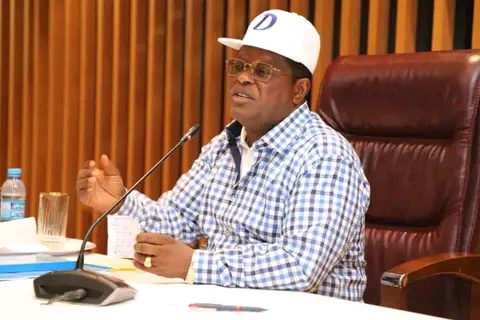
Works Minister David Umahi has defended the Federal Government’s decision to reroute a 40-kilometre section of the Lagos-Calabar Coastal Highway through Ondo State, citing deep ground depressions, unsuitable construction material and the high cost of building across the original alignment.
Umahi gave the explanation in Abuja while reviewing progress on President Bola Tinubu’s major road projects. He acknowledged receiving petitions over the diversion but said the decision followed engineering assessments rather than arbitrary intervention.
“I am aware of petitions against me saying I diverted the Ondo section. I welcome that. That is how it is supposed to be because we are serving the public. You are subject to public scrutiny,” he said.
The minister explained that parts of the original route crossed pits more than 100 metres deep and lacked suitable sharp sand for up to 300 metres. Those conditions, he said, would have made construction significantly more expensive than work across ordinary terrain.


The ministry therefore redesigned the alignment to avoid the difficult ground. Umahi said filling operations exceeding 10 metres in depth were nearly complete.
The diversion affects Sections 4A and 4B, which cover 67 kilometres across Ogun and Ondo states. The route comprises 27 kilometres in Ogun and about 40 kilometres in Ondo, terminating around the Ondo-Edo axis.
READ RELATED NEWS UPDATES:
Cost, engineering and public accountability
The explanation raises a central question for a major public infrastructure project: does the revised route deliver better value than the original plan?
Avoiding unstable or difficult terrain can reduce construction risks and costs. However, the minister did not disclose the original and revised contract estimates, the amount saved through the detour or the cost of redesigning and filling the new alignment.
Those figures would help the public independently assess the financial case for the change. The engineering explanation provides the government’s justification, but comparative cost estimates and technical assessments would offer a clearer picture of its value.
Other sections record progress
Umahi said the 47.47-kilometre Section 1, running from Victoria Island in Lagos, had been completed and was ready for commissioning. The dual pavement on Section 2, a 55-kilometre stretch ending at the Lagos-Ogun boundary, was expected to be completed in November.
He also reported progress on Sections 3A and 3B near Calabar, covering 65 kilometres, with construction exceeding 30 per cent. Work is also ongoing on an 82-kilometre dual carriageway in Akwa Ibom.
The minister disclosed that Tinubu had directed the coastal highway’s continuation from Ondo into Edo to follow the existing East-West Road instead of a new alignment. The 104-kilometre corridor includes the 45-kilometre Benin Bypass, intended to reduce the need for motorists to cross Benin City’s congested urban centre.
Umahi said sections of the East-West Road would need to be raised by up to two metres in locations exposed to present and projected flooding.
What motorists need to watch
For road users and communities along the corridor, the key measures of success will be completion timelines, construction quality, flood resilience and the effect on travel time and transport costs.
The government’s defence explains why it changed the route. Published cost comparisons, technical assessments and measurable delivery milestones would help establish whether the decision achieves its stated objectives.
For More Details, Visit New Daily Prime News