United Nigeria Airlines is turning to Nigeria’s short-term debt market to raise ₦20 billion, a move that could finance its expansion plans while testing how far the country’s domestic aviation sector can use capital-market funding to grow.
The airline’s proposed commercial paper issuance is the first tranche of a ₦100 billion programme, according to its September 2026 investor presentation. The transaction would make the carrier the first Nigerian domestic airline to access the short-term debt market through commercial paper.
The planned fundraising comes as the company prepares to expand its domestic, regional and international services. However, the money raised will need to support growth while the airline meets its repayment obligations within the agreed period.
Commercial paper is a short-term debt instrument that companies use to raise funds from investors, usually to finance working capital and other immediate business needs. Unlike selling shares, the instrument does not require a company to give investors an ownership stake. The issuer must, however, repay the borrowed funds according to the agreed terms.


United Nigeria Airlines plans to issue the ₦20 billion in two series, with maturities of 270 days and 364 days. Meristem Capital Limited will lead the transaction, supported by Cordros Advisory Services, Coronation Merchant Bank, FCMB Capital Markets, FSL Advisory and Quantum Zenith Capital & Investments.
RELATED NEWS:
The airline’s financial results provide the immediate context for the move. Its revenue climbed from ₦10.3 billion in 2021 to ₦90.8 billion in 2025, while profit after tax rose from ₦1.3 billion to ₦23.8 billion over the same period.
Revenue reached ₦95.6 billion in the first half of 2026. The airline also recorded a monthly recovery in August, when turnover increased to ₦19.4 billion from ₦14.1 billion in July. It reported a net profit of ₦1.2 billion for August.
These figures suggest that the carrier has built a stronger revenue base. Nevertheless, higher turnover alone does not guarantee that expansion will be profitable. Aircraft acquisition, maintenance, fuel, insurance and other operating expenses can place considerable pressure on airline finances.
Two credit assessments will also shape investor perceptions of the fundraising. Agusto & Co. assigned United Nigeria Airlines a short-term rating of A3 and a long-term rating of BBB-, with a stable outlook. DataPro gave the airline short-term and long-term ratings of A1 and BBB, respectively.
The ratings provide investors with assessments of the airline’s creditworthiness, although they do not guarantee repayment or eliminate investment risk.
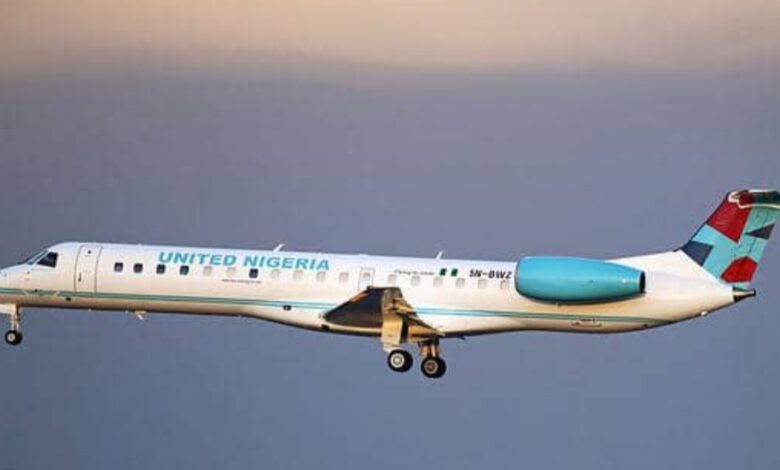
United Nigeria Airlines currently operates 10 aircraft, including Embraer ERJ-145s, Boeing 737-800s, Embraer E190s and CRJ900s. It plans to receive six additional aircraft before the end of 2026.
If delivered as planned, the additional aircraft could increase capacity and support new routes. For passengers, the potential benefits include more flight options and improved connectivity, although actual gains will depend on how the airline deploys the fleet.
The central test is whether the ₦20 billion can translate into sustainable expansion without placing excessive pressure on the airline’s finances. Investors will also watch the issuance terms, repayment arrangements and use of proceeds as the transaction progresses.
United Nigeria Airlines has recorded substantial financial growth. Its next challenge is to convert that momentum into a larger, reliable operation while meeting the obligations attached to its borrowing.
For More Details, Visit New Daily Prime News