The United Nations climate summit in Türkiye has ended in a diplomatic deadlock, with several countries rejecting the final proposed agreement over its failure to address fossil fuels, climate financing and the needs of vulnerable nations, despite nearly two days of additional negotiations.
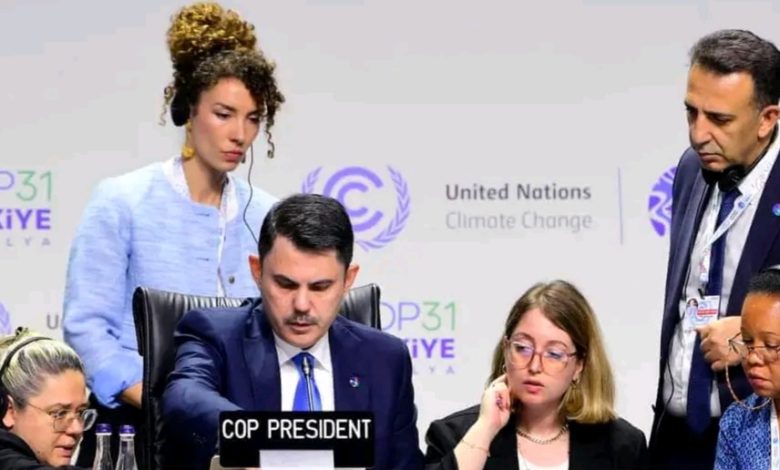
COP31 President Murat Kurum confirmed at the closing plenary on Sunday that the final draft agreement, known as the Antalya Pact, would not be approved, leaving nearly 200 countries divided over key climate commitments after the conference exceeded its scheduled November 20 closing date.
The breakdown exposed deep disagreements over how governments should finance climate adaptation, manage the transition away from fossil fuels and address the growing consequences of global warming, particularly in developing countries.
The extended negotiations, which pushed the summit nearly 48 hours beyond its original deadline, ended amid visible frustration among delegates, with the European Union, the United Kingdom, Canada, Norway and several other countries rejecting the proposed text.


The African Group of Negotiators (AGN), represented by Ghana at the closing plenary, also expressed dissatisfaction with the agreement, although its representatives acknowledged the draft amid concerns about the negotiation process and its implications for the continent.
RELATED NEWS:
Africa faults climate financing commitments
Speaking on behalf of the African Group of Negotiators, Ghana’s representative criticised the COP31 presidency for what she described as disrespectful treatment during the plenary, after she was interrupted while delivering the bloc’s position.
She accused the conference leadership of applying unequal standards during the proceedings, saying the interruption undermined the principles of multilateral negotiations.
The African bloc also highlighted significant shortcomings in the proposed agreement, particularly on adaptation finance, loss and damage, trade-related climate measures and the transition to cleaner energy.
On adaptation financing, the draft reaffirmed an ambition to triple funding by 2035 but failed to establish a specific baseline or financial figure. The details were deferred to a future meeting under the Antalya–Addis Ababa Roadmap.
The AGN also faulted the absence of concrete financial commitments for loss and damage, arguing that expressions of support without measurable resources would offer little relief to communities already facing floods, droughts, food insecurity and other climate-related challenges.
“These are not small gaps. For millions of children, youth, women and men in communities already facing floods, droughts and food insecurity, a commitment without a baseline cannot be called finance,” the representative said.
She also criticised the proposed treatment of just transition: that the text failed to sufficiently reflect Africa’s development priorities or establish a dedicated programme to support countries balancing economic growth with climate action.
EU rejects pact over fossil fuel omission
The European Union also rejected the Antalya Pact, accusing the COP31 draft of failing to respond adequately to the urgency of the climate crisis.
The EU representative said the document did not reflect the scientific demands of climate action, failed to address the implementation gap and risked weakening efforts to keep global warming within the 1.5-degree Celsius limit.
The bloc particularly objected to the omission of fossil fuels from the final cover decision, describing the absence as unacceptable at a time when countries are expected to accelerate efforts to reduce greenhouse gas emissions.
The United Kingdom, Canada, Panama, Ukraine and other countries also expressed objections to the proposed agreement.
Nigeria’s position raises questions
Nigeria’s absence from the closing plenary discussions also attracted attention, as the country’s head of delegation was not present in the room when African representatives and other delegations outlined their objections to the proposed outcome.
The absence leaves unanswered questions about Nigeria’s participation in the final deliberations, particularly given the country’s exposure to flooding, coastal erosion, rising temperatures and the financial demands of climate adaptation.
New Daily Prime earlier reported that COP31 negotiations had run into serious difficulties after a revised draft removed explicit language on transitioning away from fossil fuels and dropped a proposed $120 billion annual climate adaptation financing target.
The earlier report also highlighted the implications of the omissions for developing countries, particularly African nations that require substantial financial assistance to protect communities, strengthen infrastructure and expand clean energy systems.
The final breakdown has now deepened those concerns, as the summit ended without consensus on the proposed agreement.
If negotiations are suspended without a new draft, discussions could be reconvened at the next climate summit in Ethiopia, which is scheduled to host COP32 in 2027.
The outcome leaves countries facing renewed pressure to reconcile competing economic interests, climate financing demands and commitments to reduce emissions, while communities already experiencing the consequences of climate change continue to bear the costs of delayed action.
For More News Updates, Visit New Daily Prime News