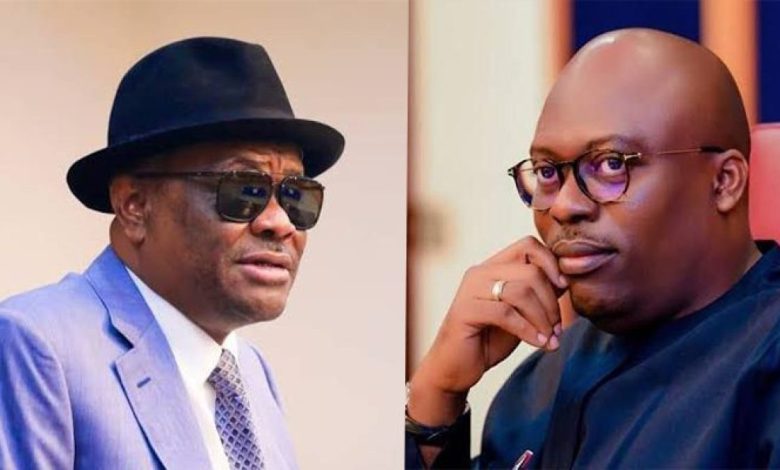
Rivers State Governor Siminalayi Fubara’s decision to reunite politically with Nyesom Wike has brought renewed attention to an exclusive New Daily Prime interview in which an aide to the Federal Capital Territory Minister argued that the governor needed to seek reconciliation with his political opponents.
In the interview conducted by Dr Olaoluwa Vincent Ajayi and published on 17 April 2025, Lere Olayinka defended Wike’s role in the Rivers political crisis and urged Fubara to reconsider his approach to the dispute.
More than a year later, the political situation has changed.
Fubara has publicly recognised Wike’s leadership of the Rainbow Coalition, a political alliance involving members of different parties working to secure President Bola Tinubu’s re-election in 2027.
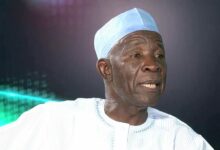
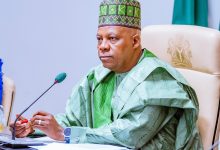
The development marks a significant shift from the bitter confrontation that once divided the Rivers State government and House of Assembly.
What Wike’s aide told New Daily Prime
During the April 2025 interview, Olayinka rejected allegations that Wike was responsible for the political instability in Rivers State.
He argued that Fubara was responsible for decisions that worsened the confrontation with state lawmakers.
Olayinka also maintained that the governor needed to accept the political situation and seek an agreement with those opposing him.
Speaking about how Fubara should respond to the crisis, he suggested approaching influential figures he could “appeal to, persuade, or even beg.”
The remarks were made when relations between Fubara and Wike’s political camp had deteriorated.
At the time, the dispute had already resulted in legal battles, disagreements over the legitimacy of the House of Assembly and federal intervention in the state’s administration.
The interview provided New Daily Prime readers with a direct account of the position taken by one of Wike’s senior political aides.
However, Olayinka’s comments represented his political assessment. They did not establish that Fubara was solely responsible for the crisis.
Read the original interview: What Lere Olayinka told New Daily Prime about Fubara and Wike.
From political confrontation to reconciliation
The dispute between Fubara and Wike began in 2023, shortly after the governor succeeded his former political ally.
Their disagreement developed into a struggle over political influence, legislative authority and control of party structures in Rivers State.
The crisis deepened in March 2025 when President Tinubu declared a state of emergency and suspended the governor, his deputy and members of the state House of Assembly.
Retired Vice Admiral Ibok-Ete Ibas was appointed to administer the state during the emergency period.
In September 2025, Tinubu ended the emergency rule, allowing Fubara and other elected officials to resume their responsibilities.
The return to democratic administration did not immediately settle the underlying political disagreements.
Further reconciliation efforts continued into 2026.
By October, Fubara and Wike were meeting again with lawmakers and other political stakeholders.
On 19 October, the Rivers State House of Assembly reversed its decision to declare the seats of three lawmakers previously aligned with Fubara vacant.
The development was widely viewed as another step towards easing tensions between the rival camps.
Fubara publicly accepts Wike’s leadership
The clearest sign of their political realignment emerged in November 2026.
At a campaign rally in Port Harcourt on 7 November, Fubara pledged to mobilise at least three million votes for President Tinubu in the 2027 presidential election.
He made the commitment under the political leadership of Wike, who coordinates the Rainbow Coalition in Rivers State.
The Presidency subsequently confirmed that Tinubu had welcomed the reconciliation between the two politicians.
The President praised Fubara for embracing efforts to restore peace after the prolonged disagreement.
On 12 November, the governor reinforced his position during the inauguration of the Rivers APC Presidential Campaign Council and Rainbow Coalition.
He declared his commitment to the political movement and urged supporters to demonstrate loyalty through their actions.
Fubara also made clear that those unwilling to accept his new political direction were free to pursue a different path.
The governor’s position suggests that reconciliation has moved beyond private discussions between political leaders to a broader restructuring of alliances ahead of the 2027 elections.
What has changed for Rivers politics?
The political consequences extend beyond the relationship between Fubara and Wike.
The Rainbow Coalition is bringing together politicians associated with both the All Progressives Congress and the Peoples Democratic Party to support Tinubu’s re-election.
The arrangement has also influenced the state’s governorship contest, with Kingsley Chinda emerging as the coalition’s preferred candidate.
Fubara’s support for the arrangement reflects a significant change in the political calculations surrounding his administration.
Wike, meanwhile, has increasingly turned his attention towards the national election campaign.
On 25 November, the FCT Minister said he wanted to take on additional campaign responsibilities in Imo and Kwara states, arguing that his political mobilisation work in Rivers and the Federal Capital Territory was already well advanced.
These developments illustrate how a dispute that once threatened the functioning of Rivers State’s political institutions has evolved into an alliance focused on the next general election.
However, questions remain over how the arrangement will operate in practice, particularly where supporters of the former rival camps disagree over candidates and political appointments.
Did Fubara follow the advice given in 2025?
The political changes give fresh significance to Olayinka’s earlier interview with New Daily Prime.
In April 2025, the minister’s aide believed Fubara should seek accommodation with those who held political influence in the state.
By November 2026, the governor had publicly returned to Wike’s political camp.
That sequence does not establish that Fubara personally begged anyone or that he acted because of Olayinka’s advice.
What it demonstrates is a substantial change in the governor’s public political position.
The earlier interview provides a record of the position being advanced by Wike’s camp during one of the most difficult periods of the Rivers crisis.
It also offers useful context for understanding the political calculations behind the reconciliation.
For Rivers residents, the more important question is whether the agreement will provide lasting stability and allow the government and legislature to concentrate on public services, infrastructure and economic development.
The coming months will test whether the political alliance can survive disagreements over candidates, party loyalties and the distribution of influence.
As preparations for the 2027 elections intensify, Fubara and Wike now face a different challenge: demonstrating that their renewed cooperation can deliver more than a temporary political settlement.
Read related news
Isaac Fayose accuses Wike of vote buying over alleged ₦10m offer to FCT councillors
Obidient Movement asks INEC to probe Wike’s ₦10m election offer
“Wike has been proven right” – Lere Olayinka