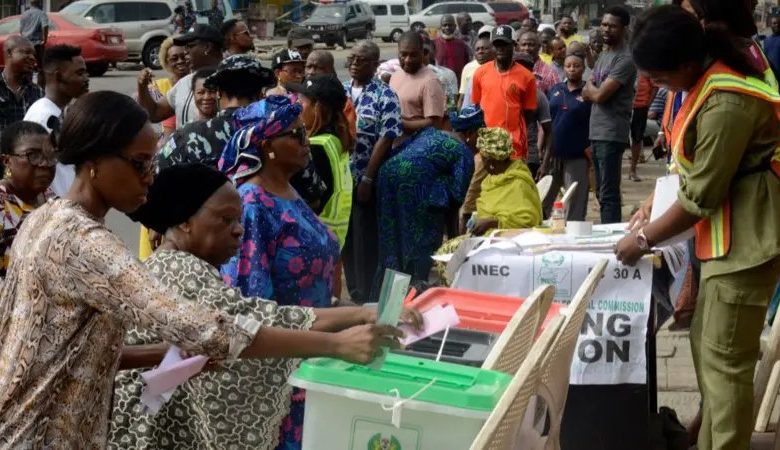
The Independent National Electoral Commission (INEC) has been asked to explain why voters used colour-coded paper ballots during its mock election exercise in Lagos on Saturday.
Paul Ibe, Media Adviser to former Vice-President Atiku Abubakar, raised the issue after an incident at Polling Unit 011, Ward B, Akoka, Lagos.
He said participants were reportedly told to cast mock votes on paper after receiving verbal instructions that different colours represented political parties.
Ibe questioned whether the colours were only dummy options for testing or had been assigned to registered political parties. He also asked whether such an arrangement formed part of INEC’s approved procedure.


Questions over ballot instructions
The issue raised by Ibe centres on what voters were shown and told before casting their practice votes. He said his understanding of INEC’s public explanation was that participants would vote without seeing the names or logos of registered political parties.
However, the reported use of colours representing parties at the Akoka polling unit has raised questions about how the exercise was conducted there.
Ibe wants the commission to clarify whether the colours represented actual registered parties or were simply options created for the test.
READ RELATED NEWS
INEC tests election technology nationwide: What worked, what failed?
INEC’s digital defences: How secure is Nigeria’s 2027 election technology?
INEC conducted BVAS mock trial in 289 FCT polling units ahead of area council elections
He also asked where voters were informed about the arrangement before the exercise began. This is important to understanding whether participants received instructions that matched the procedure approved by INEC.
His questions focus on both the ballot design and the information given to voters. Participants need to understand what each option represents before taking part in a practice voting exercise.
The report from Akoka does not establish whether the same method was used at other polling units. Ibe acknowledged that he could not determine whether the incident was isolated or reflected standard practice.
Exercise tests election technology
INEC’s mock exercise is intended to test its accreditation and result-uploading processes ahead of the 2027 general elections. The two activities are meant to help the commission check the systems that will support voting and the transmission of results.
The exercise is not intended to produce actual election results. Ibe said any results generated during the test should serve only the purpose of checking the systems.
This is important because participants are casting practice votes, not choosing candidates in an actual election. How INEC presents the options and explains the exercise can help voters understand the purpose of their participation.
Ibe raised the issue in a post on X dated November 28, 2026. He also invited people who participated in the exercise to share what happened at their polling units.
He asked participants to identify their polling units and locations, describe what appeared on their ballots and explain the instructions given by election personnel. Such accounts could show whether the experience at Akoka was also reported elsewhere.
WHAT READERS SHOULD KNOW
The exercise covers two separate technical tasks: accrediting voters through BVAS and uploading election results.
Both are being tested ahead of the 2027 elections, and any recorded votes are meant for testing purposes only.
The issue raised by Ibe goes beyond the colours used on paper ballots. It also concerns whether voters understood the options presented to them and the purpose of casting those practice votes.
For More News Details, Visit www.NewDailyPrime.news.