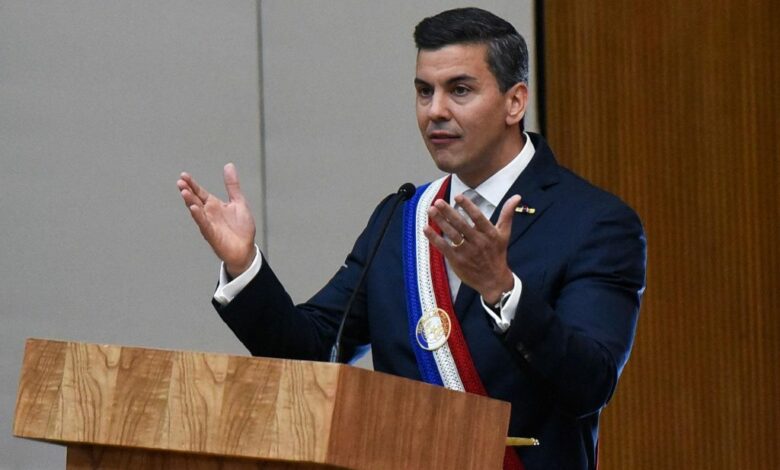
Paraguay’s Congress has rejected President Santiago Peña’s resignation offer following the collapse of Ueno Bank, escalating a political crisis that has triggered impeachment proceedings, criminal investigations and widespread protests across the South American country.
Peña announced his intention to step down on Thursday, November 5, in a video posted on his official X account, saying his decision was intended to protect national stability, social peace and democratic institutions.
However, lawmakers rejected his resignation offer, leaving him facing a Senate impeachment trial over allegations surrounding the banking crisis and his administration’s handling of public funds deposited with the troubled financial institution.
The president’s resignation offer was rejected by both chambers of Congress, while prosecutors continued investigating the circumstances surrounding the bank’s collapse.


The development has intensified uncertainty over Paraguay’s political leadership, particularly as opposition lawmakers accuse Peña of conflicts of interest and inadequate oversight of the financial institution.
BANK COLLAPSE TRIGGERS POLITICAL CRISIS
The crisis began after Paraguay’s central bank seized Ueno Bank, a rapidly expanding digital lender with close business connections to Peña, following concerns about its financial position and lending practices.
The institution, which served approximately three million customers, held about $800 million in public deposits, including funds linked to government institutions and the country’s state pension and health system.
Regulatory investigations uncovered risky lending to companies connected to the bank’s owners, alongside inadequately documented transactions and expenses that had been incorrectly recorded as assets.
Following adjustments to its financial statements, the bank’s capital position fell below half the legally required minimum, prompting regulators to intervene and suspend its operations.
The shutdown left millions of customers temporarily unable to access their savings, salaries and other financial resources, raising concerns about the protection of public funds and the stability of Paraguay’s banking sector.
PEÑA’S BUSINESS CONNECTIONS UNDER SCRUTINY
The president has faced growing criticism over his previous financial relationship with Grupo Vázquez, the business conglomerate that controlled Ueno Bank.
Peña reportedly held shares in the group until March 2025, raising questions about potential conflicts of interest, particularly as government agencies and public institutions deposited substantial funds with the lender during his administration.
Opposition lawmakers have accused the president of failing to provide adequate oversight and allowing political connections to influence the handling of the institution.
Peña has denied wrongdoing, maintaining that the banking crisis should be addressed through regulatory and judicial investigations.
The controversy has also prompted the departure of Central Bank President Carlos Carvallo, who previously headed Financiera Ueno, the institution that preceded Ueno Bank.
Meanwhile, prosecutors have charged 27 bank officials and business associates with alleged financial offences, while several senior executives have been detained pending further legal proceedings.
READ RELATED NEWS
America rejects Trump? Democrats seize congress — What happens next?
France moves G7 foreign ministers’ meeting to Paris as protests intensify
Putin to miss 2027 G20 summit in Britain as Burnham cites sanctions
Trump’s political future at stake as democrats fight to take control of congress
PROTESTS CONTINUE AS CUSTOMERS DEMAND THEIR MONEY
The banking crisis has sparked demonstrations in the capital, Asunción, where depositors, pensioners, students and workers have demanded the recovery of their money and accountability from government officials.
Protesters have accused political leaders of failing to protect ordinary citizens, with demonstrations also involving employees of Ueno Bank and companies associated with its parent group.
Some demonstrators have demanded Peña’s removal, arguing that his previous business connections to the bank raise serious questions about his administration’s handling of the crisis.
Security forces have deployed to control the demonstrations, with police using pepper spray and rubber pellets to disperse some protesters.
Authorities have begun arrangements to transfer customer accounts to other financial institutions and facilitate repayments through the country’s deposit guarantee system.
The Associated Press reported that the guarantee scheme is expected to cover the full balances of approximately 97 per cent of Ueno’s customers.
POLITICAL FUTURE REMAINS UNCERTAIN
Peña’s rejected resignation offer has left Paraguay facing further political uncertainty as impeachment proceedings and criminal investigations continue.
The Senate trial could determine whether he remains in office, while prosecutors are examining the bank’s financial dealings, regulatory oversight and the handling of public funds.
The crisis has also raised broader concerns about financial accountability, political influence and public confidence in Paraguay’s institutions.
For thousands of affected customers, however, the immediate priority remains recovering their savings and ensuring that the collapse of one of the country’s major digital lenders does not produce further economic hardship.