The Senate has ruled out reviving the controversial contracts behind Nigeria Air, while calling for a fresh national carrier and direct flights to China, shifting attention from a disputed airline project to Nigeria’s access to international aviation markets.
Nigeria’s aviation policy faces a fresh test after lawmakers rejected further investment in the failed Nigeria Air arrangement and called on the Federal Government to secure reciprocal flight rights for Nigerian airlines in China.
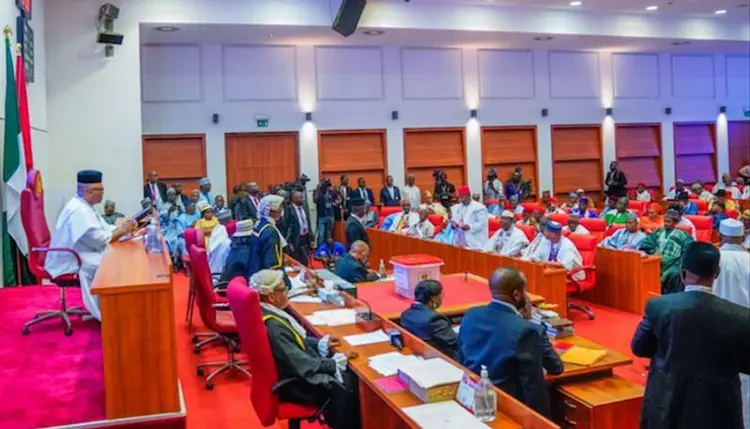
The resolution followed a motion sponsored by Senate Chief Whip, Senator Tahir Monguno, during Tuesday’s plenary. Senate President Godswill Akpabio announced the chamber’s position, describing further discussions on the abandoned contracts as unproductive.
However, the Senate did not abandon the idea of a national airline. It wants the government to explore a new arrangement capable of giving Nigeria a credible presence in international aviation without returning to the controversial contracts.


RELATED NEWS:
Nigeria Air: A failed project, not a settled national carrier question
The Nigeria Air initiative was unveiled in May 2023, shortly before former President Muhammadu Buhari left office. Ethiopian Airlines was presented as the proposed strategic partner, with plans for a private-sector-led ownership structure.
The project soon became entangled in controversy over its ownership, financing and procurement arrangements. In August 2024, the Federal High Court in Lagos declared the proposed sale to Ethiopian Airlines invalid and legally ineffective.
The Economic and Financial Crimes Commission (EFCC) is also prosecuting former Aviation Minister Hadi Sirika, his daughter, Fatima, her husband, Jalal Hamma, and their company over alleged contract fraud involving ₦1.5bn and gratification proceeds of ₦1.3bn. The allegations have not been established by a final court judgment.
The Senate’s position signals a rejection of the old contractual route, not necessarily the need for a Nigerian-owned airline. That distinction matters because a national carrier could still be established through a different ownership, investment and management structure.
Akpabio recalled the former Nigerian Airways, saying it once operated between 32 and 40 aircraft. He questioned how the country had moved from that capacity to depending heavily on foreign airlines for international connectivity.
Why China has become central to the debate
Beyond the national carrier question, lawmakers want Nigeria to renegotiate and enforce its Bilateral Air Services Agreement (BASA) with China.
The agreement provides the framework for commercial air services between the two countries. However, Nigerian travellers seeking direct access to China often have to connect through foreign aviation hubs, while Chinese airlines operate services into Nigeria.
Akpabio said the arrangement placed Nigerian businesspeople at a disadvantage.
He told the Senate that Nigerian travellers frequently rely on airlines operating through Kenya, Ethiopia and other countries to reach China, while Chinese passengers enjoy direct connections to Nigeria.
The proposed change could benefit traders, manufacturers, exporters and businesses that depend on regular movement between both countries. Direct flights could reduce journey times, simplify cargo movement and improve access to Chinese suppliers and markets.
Senator Monguno also proposed reciprocal airport slots, code-sharing arrangements and temporary airport fee waivers to encourage Nigerian operators to establish the routes. He called for diplomatic engagement to ease business visa access for Nigerian traders.
Direct flights will require more than an agreement
The Senate’s proposal is commercially attractive, but securing flight rights alone will not put Nigerian aircraft on the route.
Airlines need suitable aircraft, trained personnel, regulatory approvals, maintenance arrangements and sufficient passenger or cargo demand to sustain long-distance operations. They must also secure airport slots and establish commercially viable schedules.
The government would therefore need to identify capable Nigerian operators and determine whether they can sustain the financial and operational demands of direct services to China.
Monguno also suggested a naira settlement window, using the existing bilateral currency swap framework, to reduce dependence on dollar transactions. However, such an arrangement would require agreement between financial institutions and workable currency-conversion mechanisms. It cannot automatically eliminate foreign exchange costs.
The Senate adopted the motion through a voice vote and mandated its Committees on Aviation and Foreign Affairs to monitor implementation and report back within four weeks.
That deadline provides an opportunity to assess whether the ministries can turn the resolution into concrete diplomatic and aviation measures.
The major issue for Nigeria now is whether the country can build a commercially sustainable carrier, secure fair access to foreign markets and prevent another expensive aviation project from collapsing under weak planning and disputed contracts.
For More News Updates, Visit New Daily Prime News