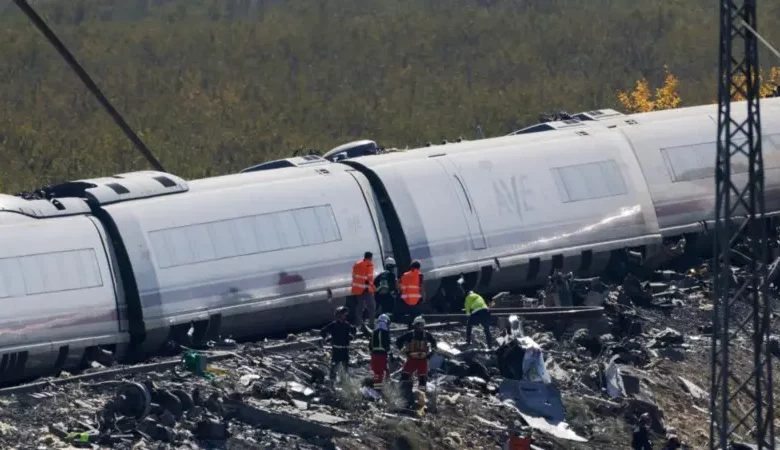
Spanish authorities have identified several foreign nationals among the 69 people killed in last week’s high-speed train collision in central Spain, as investigations continue into one of Europe’s deadliest railway disasters in recent years.
According to officials, four American citizens and one Canadian were among the victims, alongside nationals from Japan, Argentina, Mexico, Tunisia and the Czech Republic.
Authorities confirmed on Monday, November 2, that 66 of the 69 victims had been identified, including 54 Spanish nationals and 12 foreign citizens. Three victims are yet to be formally identified.
The remaining missing-person reports involve two Australians and one Japanese national, whose families have expressed a desire to travel to Spain to assist with the identification process.


IDENTIFICATION PROCESS CONTINUES
Forensic specialists have faced significant difficulties identifying victims because of the severity of the crash.
According to Spanish authorities, 53 of the 66 identified victims were confirmed through fingerprint analysis, while the remaining 13 were identified through DNA testing.
The identification process has been particularly distressing for relatives, with investigators sometimes relying on individual body parts to establish victims’ identities.
Authorities said families had been notified of 60 identifications, while arrangements were continuing to inform the relatives of the remaining victims.
The accident occurred on Wednesday, October 28, near the village of Urda in Toledo province, approximately 130 kilometres south of Madrid.
A high-speed train operated by Spain’s state-owned Renfe railway company crashed into the rear of a stationary train belonging to private operator Iryo.
READ RELATED NEWS
Four migrants die after eight-day sea journey from Gambia to Spain’s Canary islands
Southgate: Managerial authority fading in Modern football
Preliminary information indicated that an automatic train protection system failure had brought trains to a halt along a 63-kilometre stretch of track.
However, a control centre subsequently authorised the Renfe train to resume its journey while the other train remained stationary.
The collision killed 69 people and injured dozens, prompting a major emergency response and a three-day national mourning period.
RAILWAY SAFETY UNDER SCRUTINY
The disaster has raised concerns about the safety of Spain’s high-speed railway network, particularly following another deadly collision in January that claimed 46 lives on the Madrid-Seville route.
Prime Minister Pedro Sánchez has promised a thorough investigation and improvements to restore public confidence in the country’s railway system.
The latest accident has also increased political pressure on the government, with questions emerging over railway maintenance, infrastructure investment and the effectiveness of existing safety mechanisms.
Spain’s high-speed railway network carried approximately 45 million passengers last year, making the investigation particularly significant for the country’s transport sector.
With a general election scheduled for November 29, the tragedy has become a major political and public concern as authorities face growing demands for accountability and stronger railway safety measures.