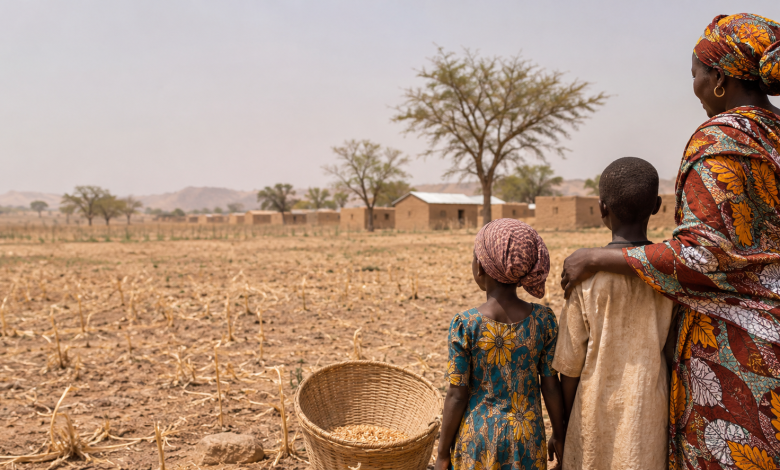
An estimated 33.5 million Nigerians could face serious food shortages between June and August 2027, including 23.3 million people across the country’s 16 northern states and the Federal Capital Territory, according to food security projections highlighted in a new United Nations report.
The World Food Programme (WFP) and Food and Agriculture Organization (FAO) warned on Friday, 27 November 2026, that northern Nigeria remains among the world’s five most serious hunger hotspots, alongside Sudan, South Sudan, Somalia and Yemen.
The findings show that approximately 1.5 million people in Nigeria’s northeast and northwest could face Emergency-level food insecurity, while 40,271 people in Borno State are projected to experience the most severe household-level classification, known as Catastrophe.
The warning comes despite years of government investment in cash transfers, agricultural assistance, school feeding and poverty-reduction programmes, raising questions about whether existing interventions can protect vulnerable households before the next lean season.

According to the FAO–WFP Hunger Hotspots report, conflict, displacement, economic pressures and declining humanitarian funding are increasing the risks facing vulnerable communities.
Borno faces the most severe hunger threat
Borno State is among the areas facing the greatest danger, with 40,271 residents projected to experience catastrophic food insecurity between June and August 2027.
The figure represents people expected to fall into Phase 5 of the Cadre Harmonisé food-security classification, the most severe category.
At this level, households may face extreme shortages of food and a heightened risk of starvation, severe malnutrition and death.
However, the projection does not mean that famine has been formally declared across Borno State.
A famine classification for an area requires additional evidence relating to food deprivation, acute malnutrition and mortality.
The assessment therefore serves as an early warning, giving the government and humanitarian organisations an opportunity to intervene before conditions deteriorate.
Borno has experienced years of insurgency, displacement and disruption to agricultural activities, leaving many families dependent on humanitarian assistance.
The latest Cadre Harmonisé analysis also projects that about 670,110 people in Borno could face Emergency-level food insecurity during the same period.
Food crisis could affect 33.5 million Nigerians
The wider national assessment estimates that 33.5 million people across 26 states and the Federal Capital Territory could experience Crisis-level food insecurity or worse during the 2027 lean season.
That compares with approximately 26.8 million people assessed as facing Crisis-level food insecurity or worse during October–December 2026, within the same assessment.
The difference is approximately 6.7 million people, although the two periods reflect different seasonal conditions.
Food insecurity often becomes more severe during the lean season, when supplies from previous harvests decline and households must purchase more food.
The 2027 projection is slightly below the 34.7 million forecast for the 2026 lean season in an earlier assessment.
However, the earlier analysis covered 27 states and the Federal Capital Territory, compared with 26 states and the FCT in the latest assessment, so the figures should not be treated as directly comparable evidence of improvement.
Why hunger remains a threat across northern Nigeria
Armed violence remains one of the major causes of food insecurity.
In parts of the northeast and northwest, insecurity has prevented farmers from accessing agricultural land, disrupted trade and forced families to abandon their communities.
Some households have lost crops, livestock, businesses and regular sources of income.
The WFP estimates that more than 3.7 million people are internally displaced in Nigeria.
High food and fuel prices have added to the difficulties, reducing the purchasing power of households already struggling to meet essential needs.
For families depending on daily wages, small businesses or subsistence farming, losing income can quickly affect the number and quality of meals available.
Displacement also makes it harder for children and pregnant women to access adequate nutrition and healthcare.
The WFP says it is responding through emergency food and cash assistance, while supporting farmers with seeds and irrigation and livestock owners with feed, vaccinations and access to water.
What has the Nigerian government done to tackle poverty and hunger?
Successive Nigerian governments have introduced social protection and poverty-reduction programmes, including N-Power, the National Home-Grown School Feeding Programme, the Government Enterprise and Empowerment Programme and the National Cash Transfer Programme.
These initiatives were designed to support vulnerable households, improve employment opportunities, encourage small businesses and reduce food insecurity.
The World Bank reports that more than 42 million people have received digital cash transfers under the expanded National Social Safety Nets Programme.
However, the number of beneficiaries reached does not establish how many people have escaped poverty permanently.
More recently, President Bola Tinubu’s administration introduced additional initiatives through the Federal Ministry of Humanitarian Affairs and Poverty Reduction.
On 26 August 2026, the ministry launched the $1 billion Household Prosperity and Economic Social Protection Project (HOPE-SP), aimed at connecting emergency assistance with longer-term economic recovery.
The initiative, unveiled in Abuja by First Lady Oluremi Tinubu, seeks to improve household targeting, strengthen social protection and help vulnerable families build sustainable livelihoods.
The ministry has also introduced the One Humanitarian, One Poverty Response System to improve coordination across humanitarian and poverty-reduction programmes.
In October, the ministry announced the National Emergency Relief and Stabilisation Intervention, offering ₦50,000 assistance to selected vulnerable households.
The government says the initiative is intended to help families cope with the rising cost of living.
However, these recent programmes have not yet produced sufficient independently verified evidence to establish their long-term effect on household poverty.
The new UN assessment therefore raises a crucial question: whether existing interventions are reaching the communities facing the greatest hunger risks.
Government faces questions over effectiveness of relief programmes
The challenge for Nigerian authorities is not simply the number of poverty-reduction programmes announced, but whether assistance reaches vulnerable families before their conditions deteriorate.
The government must also address security challenges preventing farmers from cultivating land and traders from transporting agricultural products.
In communities affected by insurgency and displacement, financial assistance alone may be insufficient if families cannot safely return to farming or other economic activities.
The latest warning makes it necessary to examine how many vulnerable households have received food assistance, cash transfers and productive assets, and whether those interventions have improved food security.
It also raises questions about the effectiveness of coordination between the ministries responsible for agriculture, humanitarian affairs, health and social protection.
An assessment of programme performance would need to distinguish between the number of people receiving assistance and the number experiencing sustained improvements in living standards.
The UN findings do not establish that government interventions have failed. Equally, announcements about funding and beneficiary targets cannot demonstrate that the risk of hunger has been reduced.
Humanitarian funding falls by 62%
The hunger warning comes as international assistance for some of the world’s most vulnerable communities continues to decline.
According to the FAO and WFP, humanitarian funding for food security and nutrition across the five highest-concern hunger hotspots fell from approximately $5.1 billion in 2022 to $2 billion in 2025.
That represents a reduction of approximately 62 per cent.
The five areas are northern Nigeria, Sudan, South Sudan, Somalia and Yemen.
The reduction has raised concerns about the ability of humanitarian organisations to maintain food distributions, nutrition services and emergency support.
The agencies warn that inadequate funding, combined with insecurity and restricted humanitarian access, could make it more difficult to prevent worsening conditions.
They have called for stronger international action, improved humanitarian access and assistance that helps vulnerable families maintain food production and livelihoods.
What the findings mean for Nigerians abroad
For Nigerians living in the UK, Europe, the United States and Canada, the warning could have implications for relatives and communities already struggling with high living costs.
Families affected by displacement, reduced agricultural production or lost income may face increasing pressure during the months preceding the 2027 harvest.
Some diaspora households may consequently face additional requests for financial assistance.
However, the assessment does not establish that every household in northern Nigeria will experience the same level of food insecurity.
The projections cover specific areas and periods, with the severity of the crisis varying between communities.
Nigerians seeking assistance should obtain information from recognised humanitarian organisations and official government channels.
Can Nigeria prevent the projected hunger crisis?
The UN’s warning is a projection, not a declaration that the predicted outcomes are inevitable.
Improved security, agricultural production, humanitarian funding and effective social protection could reduce the severity of food shortages.
Nevertheless, the latest assessment shows the scale of the challenge confronting Nigeria as the country approaches 2027.
Millions of vulnerable residents face the possibility of serious food insecurity, while communities already experiencing displacement and conflict remain particularly exposed.
The central question is whether government agencies, humanitarian organisations and international partners can deliver effective assistance before the next lean season.
For Nigeria, the test will be whether existing poverty-reduction programmes translate into more secure food supplies, stronger household incomes and measurable protection for the people most at risk.
Read related news from New Daily Prime
Bernard Doro launches initiative to lift 50 million Nigerians out of poverty in 5 years
Doro flags off food, nutrition distribution in Plateau
Bernard Doro promises N-Power payments, pledges major reforms