The sun had barely risen over Western Rogo when Abubakar Hafizu loaded his cart for what he believed would be an ordinary morning run to the Sundu Market.
He had done this hundreds of times — hauling maize across the Gwangwan Bridge, exchanging greetings with neighbours along the road, arriving at the market in time to meet his regular buyers. He was 56 years old and had built his life around this rhythm.
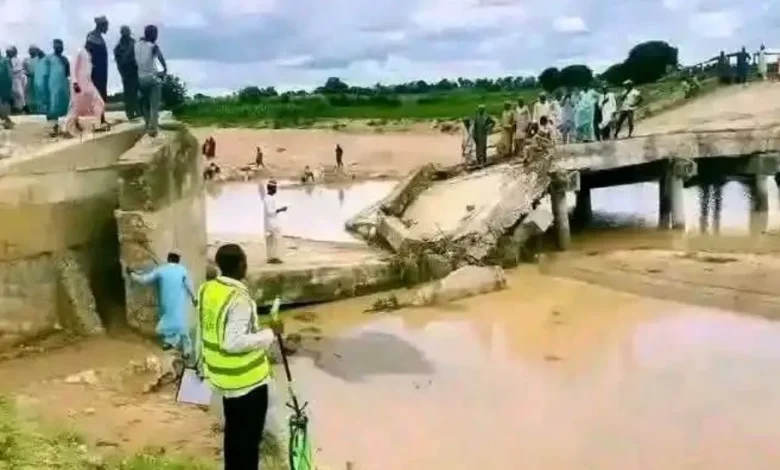
That morning, the bridge was gone.
By the time he reached the crossing and saw what had happened, much of what he had stored — grain that had taken a full farming season to grow, harvest, and dry — had already been ruined by water. He stood at the edge of the broken span and watched. There was nothing else to do.
“I lost over four million naira worth of maize,” he said. “Most of it drowned. I didn’t know the bridge had collapsed.”
For the communities strung along the Gwangwan corridor in Western Rogo Local Government Area of Kano State, the collapse of the bridge did not arrive as a single catastrophe. It arrived slowly, in the shape of things that stopped happening.
The woman who used to carry soybeans on her head to sell before nightfall stopped going. The children who crossed every morning for school started missing days, then weeks.
The pregnant woman who needed to reach Rogo General Hospital in an emergency found the road leading nowhere.
The bridge, many residents will tell you, was never just concrete and steel. It was the arrangement their lives were built around. It was what made morning possible.
Sani Shuaibu Rogo, a community advocate who grew up watching trucks cross that bridge at dawn, has spent months trying to make the outside world understand what its loss has meant to the people who depended on it. He speaks carefully, like a man who has told this story many times and worries that it still is not being heard.
“Household incomes have dropped drastically,” he said. “Youths are idle. Women who depended on petty trade to feed their families have nothing. The bridge was our connection to everything.”
What he describes is not merely hardship. It is the quiet unravelling of a community’s daily life.
Cultural gatherings that once brought villages together have dwindled. Religious events and family visits that relied on ease of movement have grown infrequent.
The elderly, who once moved between communities with the help of younger relatives, now remain in place — sometimes unable to access care when they need it most. The social bonds that infrastructure silently holds together have begun to fray.
Patients requiring urgent medical attention — among them pregnant women who need emergency obstetric care — can no longer reach Rogo General Hospital along the route the bridge once provided. Health workers have described situations where vulnerable residents, cut off and without alternatives, are left to manage without the help that should be available to them. The distance that was once bridgeable has become, in the most literal sense, impassable.
For the children, the consequences may prove to be the longest-lasting. Parents in communities beyond the collapsed bridge now face the daily dilemma of whether it is safe to send their sons and daughters to school. Many have decided it is not.
The classrooms that should hold them sit at a distance no longer easily crossed, and the years in which children learn what they cannot unlearn are slipping past.
“It directly undermines the government’s Education for All agenda,” said Usman Abubakar, a resident, his voice carrying the weariness of someone who has made this point before without result. “How can policy ambitions be achieved when basic infrastructure lies in ruin?”
What deepens the anguish for many is the sense that this did not have to happen — or, having happened, need not have been allowed to persist. Election after election, residents say, politicians have arrived in Western Rogo with promises.
The bridge, the roads, the neglected infrastructure of a community that has waited patiently for its turn — all of it has featured in campaign speeches. And after each election, the same silence.
“Year after year, politicians come here to campaign,” Shuaibu Rogo said. “They promise to fix the bridge and the road network. After the elections, you never see them again.
“People have lost faith. They no longer believe that their votes translate into anything meaningful.”
That loss of faith may be the wound that heals last. A community that once engaged in the life of its local government, that believed participation mattered and that leadership listened, has grown disenchanted in ways that go deeper than politics. What residents describe is a feeling of abandonment — not dramatic or sudden, but accumulated over years of broken promises and unrepaired bridges.
Shuaibu Rogo has written on behalf of his people to the Kano State Government, to the Rogo Local Government Council, to every elected representative whose constituency includes the communities now stranded behind a collapsed crossing. His message is not elaborate.
“The Gwangwan Bridge is not just concrete — it is the lifeline of Kano West,” he said.
“Its collapse has created year-round poverty, youth redundancy, and declining living standards for farmers, traders, women, and families who once thrived on this corridor. We are not asking for charity. We are asking for what was promised and what is owed.”
Abubakar Hafizu, 56, is still farming. He has not stopped. But the morning runs to Sundu Market that once defined his days are gone, and the loss he carries is not only the grain that drowned at the crossing. It is the life that was organised around a bridge that is no longer there — and the quieter grief of not knowing when, or whether, it will be rebuilt.
What do you think about this?
Drop your opinion in the comment section.
FOLLOW US & Share this with someone who needs to see this.
🚨BREAKING: Watch The Video Clip Here ➤