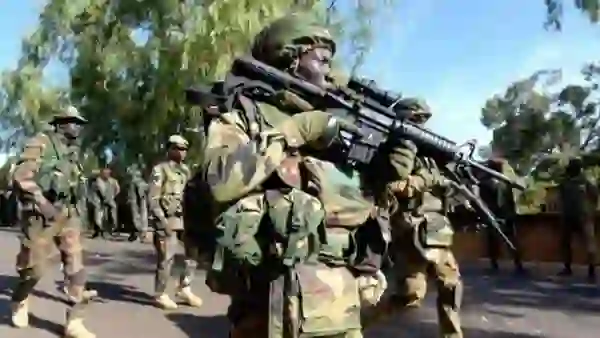
In recent times, public discourse around Nigeria’s security situation has often focused on criticism of the Federal Government, with attention drawn to incidents such as kidnappings, bombings, and violent attacks across parts of the country. While these concerns are valid, they frequently overshadow the consistent efforts and sacrifices of the Nigerian armed forces, who continue to confront complex security threats nationwide.
Reports from security analyst Zagazola Makama highlight notable progress made by troops across various regions. Over the past week, military operations have recorded significant successes against insurgents, terrorists, bandits, and other criminal elements operating within the country.
One such operation involved the rescue of 13 passengers abducted from a Benue Links bus travelling from Makurdi to Otukpo. Troops of Sub-Sector 1B under Operation Whirl Stroke carried out a coordinated search-and-rescue mission in a forest in Ohimini Local Government Area, successfully freeing the victims. Contrary to initial reports, the perpetrators were identified as local criminal elements rather than external armed groups. The rescued individuals received medical attention, while authorities have taken steps to support affected students who missed their examinations.
In Plateau State, troops responded swiftly to multiple security incidents. Along the Kpashio-Ansa Road in Bassa LGA, they rescued victims of a gun attack and evacuated them for treatment. In separate operations, soldiers arrested suspects linked to violent crimes, including individuals involved in targeted killings. Weapons and ammunition were recovered, reinforcing ongoing efforts to curb the cycle of violence in affected communities.
Further operations in Plateau revealed a pattern of locally driven conflicts involving armed groups within communities. Troops have continued patrols, made arrests, and recovered stolen livestock, all aimed at restoring stability in flashpoint areas such as Riyom, Barkin Ladi, and Bokkos.


In the North-East, troops of Operation Hadin Kai recorded successes against insurgents. In Borno State, soldiers neutralised terrorists attempting to infiltrate key areas and safely detonated improvised explosive devices to prevent potential harm to civilians. Similar efforts in Yobe led to the arrest of individuals supplying logistics to insurgent groups.
Elsewhere, troops thwarted a kidnap attempt in Edo State, rescued victims, and arrested suspects. In Sokoto State, soldiers repelled an ആക്രമ by armed terrorists, forcing them to retreat after a gun battle. In Kogi State, a suspected terrorist camp was destroyed following credible intelligence, while a logistics courier abandoned supplies meant for criminal elements.
In the South-East, joint security forces carried out patrols in Imo State, successfully detecting and defusing explosive devices, thereby preventing possible attacks.
Beyond domestic operations, Nigeria continues to engage internationally on counterterrorism strategies. At the Antalya Diplomacy Forum 2026 in Türkiye, Defence officials joined global discussions on strengthening cooperation and intelligence sharing to combat violent extremism.
These operations reflect the ongoing commitment of Nigeria’s armed forces to safeguarding the nation despite difficult and dangerous conditions. While security challenges persist, the efforts and sacrifices of military personnel remain significant.
Rather than focusing solely on shortcomings, there is a need to acknowledge and support the work being done by those on the frontlines, many of whom risk—and sometimes lose—their lives in the line of duty.
🚨BREAKING: Watch The Video Clip Here ➤