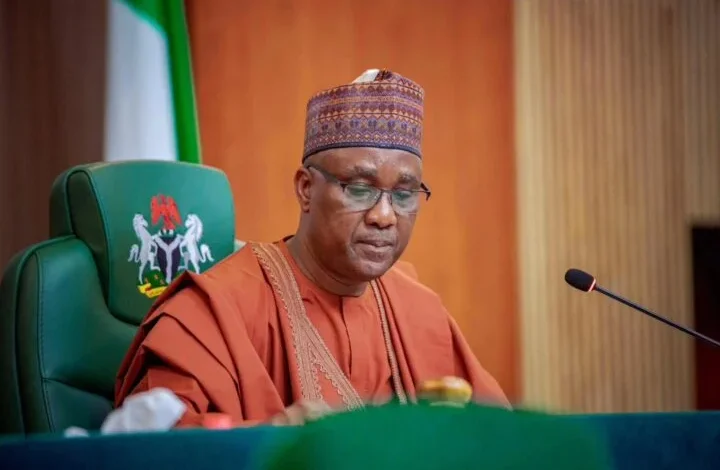
At 3 years, Speaker Tajudeen Abbas’ 10th House boasts record legislation and stability. Critics say it lacks teeth as executive requests sail through and oversight reports gather dust, writes JAMES KWEN
The 10th House of Representatives was inaugurated through a proclamation letter by President Bola Tinubu on Tuesday, 13 June 2023. On that fateful day, 353 out of 359 members present for the inauguration voted for the member representing Zaria federal constituency of Kaduna state, Hon. Abbas Tajudeen, as Speaker.
Also, the member representing Bende federal constituency of Abia State, Hon. Benjamin Kalu, had emerged Deputy Speaker of the 10th House unopposed.
Abbas, in his acceptance and inaugural speech, pledged that under his watch, the 10th House shall sustain and even surpass the gains of the 9th House.
He said the 10th House will introduce reforms and innovations to benefit Nigerians. He added that, in a matter of weeks, the Green Chamber will roll out its legislative agenda, which will shape its operations.
Consequently, the House later unveiled a comprehensive Legislative Agenda with eight key priority areas, including strengthening good governance, improving national security, law reform, and economic growth and development.
Others are social sector reform and development, inclusion and open parliament, influencing/directing Nigeria’s foreign policy, and climate change and environmental sustainability.
In line with its legislative agenda, the 10th House has received and processed about 1,500 bills, 1000 motions and 300 petitions, with several of them passed and even signed into law in the last three years.
Some of the important bills include: Electric Power Sector Reform Act (Amendment) Bill, 2023; Nigeria Hunters and Forest Security Service (Establishment) Bill, 2023; Federal Audit Service Bill, 2023; Control of Small Arms and Light Weapons Bill, 2023; Armed Forces Act (Amendment) Bill, 2023; National Assembly Library Trust Fund Act (Amendment) Bill, 2024 and Student Loans (Access to Higher Education) Act (Repeal and Enactment) Bill, 2024.
Others are: Mandatory Inclusion of Teachings on Breast and Cervical Cancers into the Curriculum of All Senior Secondary Schools in Nigeria Bill, 2023; Mandatory Inclusion of Preventive Measures and Teachings on Sexual Gender-Based Violence into the Curriculum of All Levels of Secondary Schools in Nigeria Bill, 2023; Revenue Mobilisation Allocation and Fiscal Commission Act (Repeal and Enactment) Bill, 2023 and National Anthem Bill, 2024.
Also passed are Appropriations Bills(Budgets), 2024, 205 and 2026, the four tax reform bills, namely – Nigeria Tax; Nigeria Tax Administration; Nigeria Revenue Service and Joint Revenue Board of Nigeria (Establishment), Electoral Act(amendment) bill, 2026 and the State Police Bill, 2026, while the remaining 43 prioritised Constitution alteration bills are awaiting voting and final passage.
Furthermore, the 10th House introduced sectoral debates and briefings to engage with heads of Ministries, Departments, and Agencies (MDAs) to enable lawmakers interact with MDAs and gain a deeper understanding of the specific challenges faced by each sector which so far featured service chiefs and heads of security agencies, Central Bank, Finance and National Planning, Agriculture and Food Security and Customs.
The 10th House also fosters a harmonious and professional relationship with the executive for the efficient functioning of governance, political stability, effective legislation, and the overall health of Nigeria’s democratic system, promoting transparency, accountability, and good governance practices.
The Green Chamber also held the ‘House Open Weeks,’ which, according to Speaker Abbas, the 10th Assembly embraced the ‘OPEN NASS’ Project, which enhances not only oversight and law-making but also the transparency of the National Assembly itself.
Also, to strengthen public engagement and improve the legislative process, the House organised a National Dialogue on State Policing, a national discourse on Nigeria’s security challenges and good governance at the local government level, and a workshop for its security-based committees on non-kinetic strategies to combat insecurity and terrorism in Nigeria.
Last year, the House held special plenary sessions to deliberate on the state of national security, with a view to identifying the causes and effects and to proffering solutions to be conveyed via resolutions to the executive.
As part of the resolutions from the sessions, the House called for the establishment of a Special Court for terrorism, banditry and kidnapping; expansion of a Multi-Agency Anti-Kidnap Fusion Cell, as well as open, expeditious and transparent prosecutions of terrorism-related cases, among others.
Furthermore, members of the House donated 50% of their monthly salaries of N600,000 for six months, amounting to N704.98 million, and handed them over to President Tinubu for disbursement to suffering poor Nigerians.
The House also conducted a series of probes during the period under review. Some of the notable ones included: investigation into the rising insecurity in the Federal Capital Territory (FCT) despite the installation of a $460 million CCTV system funded through a Chinese loan; the status and whereabouts of the funds recovered from the National Social Investment Programme Agency (NSIPA) estimated at over N30 billion from 2024–2025 and over $1.8 billion and $2.8 billion grants received by Nigeria from the Global Fund and the United States Agency for International Development (USAID) for the fight against HIV/AIDS, Tuberculosis and Malaria, as well as for strengthening health systems from 2021-2025.
Others were investigation into the management of N12 trillion injected into Nigeria’s Development Finance Institutions (DFIs) in the past seven years; non-remittance of over N5 trillion operating surplus and N11 trillion government revenue by the Central Bank of Nigeria (CBN), the implementation of the $696 million (N1.06trillion) Nigeria Community Action for Resilience and Economic Stimulus (NG-CARES) social intervention programme of the federal government.