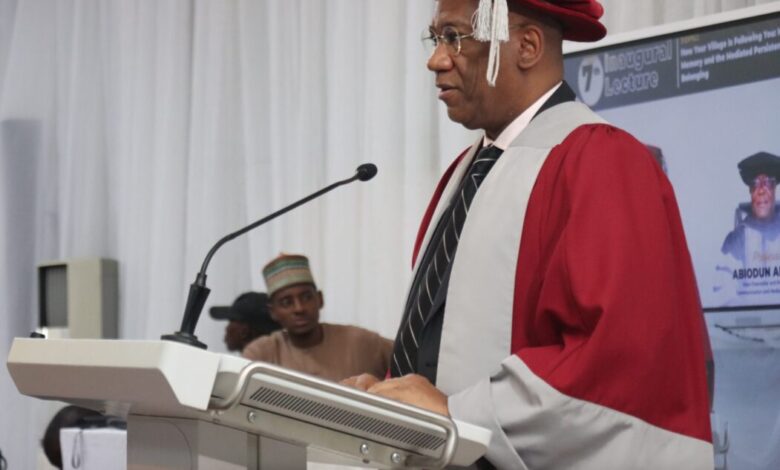
The Founder and Chancellor of Baze University, Dr. Yusuf Datti Baba-Ahmed, has pledged ₦25 million to support research into indigenous Nigerian knowledge systems following a thought-provoking inaugural lecture by the university’s Vice-Chancellor, Prof. Abiodun Adeniyi.
The seventh Inaugural Lecture of Baze University, held on Tuesday, June 9, 2026, attracted academics, policymakers, traditional rulers, students, alumni, media practitioners, and other distinguished guests to the university auditorium in Abuja. Prof. Adeniyi delivered a lecture titled, “How Your Village Is Following You: Mobility, Memory and the Mediated Persistence of Belonging.”


Declaring the event open, Baba-Ahmed described inaugural lectures as one of academia’s most important traditions, emphasising that universities are ultimately measured by the quality of scholarship and ideas they contribute to society.
“Today marks an important moment in the continuous story of our university,” he said. “Universities exist to ask difficult questions, challenge assumptions, expand the boundaries of knowledge, and help society better understand itself.”
The Chancellor noted that although Prof. Adeniyi now serves as Vice-Chancellor, the inaugural lecture had been scheduled before his appointment.
“Despite his new role, he remains a scholar, a teacher, a researcher, and an intellectual. At the heart of every great Vice-Chancellor is a commitment to scholarship and learning,” he added.
In his lecture, Prof. Adeniyi argued that migration should no longer be understood merely as physical movement from one place to another. Rather, individuals carry their memories, identities, relationships, and histories with them wherever they go.
“The village is not merely a geographical location; it is a moral archive, a symbolic anchor, and a continuing source of identity formation,” he said.
Tracing migration from the eras of slavery and colonialism to contemporary movements driven by economic realities and globalization, the communication scholar noted that many young Africans increasingly associate migration with opportunity and fulfilment.
“There is a deep-seated belief that fulfilment cannot be formed within existing realities. People think that if they want to give life meaning, they must have an alternative to Nigeria and Africa,” he observed.
According to him, technological advancement has transformed, rather than diminished, people’s attachment to their roots. Mobile phones, social media platforms, messaging applications, and digital networks now enable migrants to remain deeply connected to their communities, making physical absence no longer synonymous with social absence.
“Communication now goes beyond substitution; it represents groups, forms relationships, and creates new kinds of human interaction,” he said.
Prof. Adeniyi further explained that while identity has traditionally been sha(ped by factors such as religion, gender, class, age, and education, digital participation increasingly influences how people understand themselves and their communities.
He noted that memories once preserved through oral traditions are now stored in digital archives of photographs, videos, messages, and online interactions, allowing people to carry traces of their histories wherever they go.
While acknowledging the benefits of technology, he cautioned against emerging challenges associated with artificial intelligence and digital platforms, including misinformation, surveillance, digital manipulation, and governance concerns.
Despite these challenges, he maintained that technology has strengthened rather than weakened people’s sense of belonging.
“Invariably, the beginning point, the origin, the place is no longer where one comes from; it is where one continues to be seen from,” he stated.
Also speaking at the event, former Deputy Speaker of the House of Representatives, Hon. Emeka Ihedioha, described Prof. Abiodun Adeniyi as a long-standing friend of over three decades, commending his consistency as a respected communication scholar and leader in Nigeria’s academic space. He also praised the Chancellor of Baze University, Dr. Yusuf Datti Baba-Ahmed, for his commitment to scholarship and the development of the education sector in Nigeria, noting that the university’s infrastructural facilities reflect high standards and a strong vision for academic excellence.
In his goodwill message, the Director-General/CEO of Voice of Nigeria, Mallam Jibrin Baba Ndace, commended Prof. Adeniyi for his contributions to media and communication scholarship, describing the lecture theme as timely and relevant in an era shaped by migration, digital media, and evolving identities.
He also praised Baze University Founder and Chancellor, Senator Yusuf Datti Baba-Ahmed, for his commitment to academic excellence and intellectual engagement. Ndace noted that Voice of Nigeria, through its multilingual broadcasts in English, French, Arabic, Hausa, Fulfulde, Igbo, Yoruba, Swahili, and Mandarin, continued to amplify conversations on culture, identity, migration, and development across Africa and beyond.