0
…Targets Reduction Of Cash Outside Banks To 40%
…Reassigns Dep Govs In Strategic Shake-Up To Drive Reforms
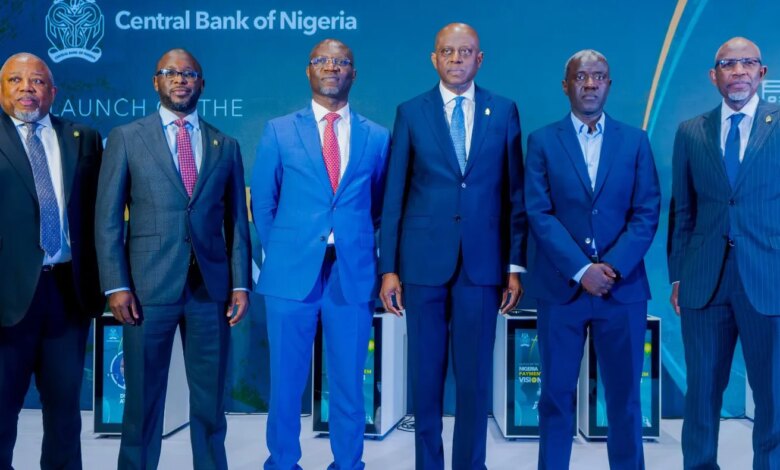
The governor of the Central Bank of Nigeria (CBN), Olayemi Cardoso, on Monday, unveiled an ambitious blueprint to transform how Nigerians pay, save, invest, trade and access financial services, declaring that “cash should no longer be king” as the country accelerates its transition to a digitally-driven economy.
At the launch of the Nigeria Payments System Vision 2028 (PSV 2028) in Abuja, Cardoso outlined far-reaching targets that could reshape the nation’s financial landscape over the next three years, including reducing the dominance of cash transactions, expanding financial inclusion to 95 percent of adults, slashing fraud losses to near-zero levels and bringing an estimated 50 million more Nigerians into the formal financial system.
The initiative comes as the apex bank seeks to deepen the impact of its broader economic reforms, strengthen monetary policy effectiveness, stimulate economic growth and create new opportunities for millions of Nigerians, particularly market women, farmers, small business owners and young entrepreneurs.
“Today, we unveil more than a payment strategy. We unveil a vision for how Nigerians will transact, trade, save, invest and participate in an increasingly digital economy,” Cardoso told regulators, bank executives, fintech operators, development partners and other stakeholders gathered at the event.
At the heart of the new vision is a determined effort to reduce Nigeria’s heavy dependence on physical cash.
Latest CBN Money and Credit Statistics show that currency in circulation stood at N5.65 trillion in April 2026. Of that amount, N5.08 trillion was outside the banking system, meaning that roughly N90 out of every N100 in cash remains outside banks.
For Cardoso, this represents a major obstacle to economic management and financial inclusion.
“I would like to see a situation where we will reduce cash outside the banking system to less than 40 percent of money in circulation,” he said.
The governor argued that reducing cash holdings outside banks would improve the effectiveness of monetary policy, strengthen financial intermediation, support efforts to tame inflation and improve transparency across the economy.
His comments also reflect growing concern within the apex bank about the persistence of cash-based transactions despite rapid growth in digital payments and mobile banking.
Cardoso recounted how he watched a television programme during the recent Sallah celebrations and observed traders rejecting card payments from customers.
“I don’t blame them. It’s us I blame. We need to do a lot more work to build trust and to ensure that people have no doubt that they are dealing with a strong and reliable payments system,” he said.
The statement underscores one of the central challenges confronting Nigeria’s digital payments revolution — trust.
Despite significant advances in fintech innovation, instant transfers and mobile money services, many Nigerians still experience transaction failures, delayed reversals and network disruptions that discourage wider adoption of electronic payments.
Perhaps the most ambitious target announced by the CBN governor is raising financial inclusion from approximately 74 percent today to 95 percent by 2028.
Data from Enhancing Financial Innovation and Access (EFInA) show that financial inclusion rose from 68 percent in 2020 to 74 percent in 2023, largely driven by mobile money operators, fintech firms and non-bank financial institutions.
Cardoso Wants That Progress Accelerated
“In 2023, a very large number of Nigerian adults had access to financial services. Under Vision 2028, I would like to see this reaching 95 percent inclusion.
“That means 50 million more market women, farmers and young people will have a bank account or wallet in their name with their name and BVN protecting them.”
For millions of Nigerians currently excluded from formal financial services, such access could prove transformative.
Financial inclusion allows individuals to save securely, access credit, receive government support payments, build financial histories and participate more effectively in economic activities.
Cardoso described an efficient payments ecosystem as one of the fastest routes to poverty reduction.
“One of the fastest ways to take a large number of people out of poverty is through an efficient payments system,” he said.
“The journey is to impact the lives of the poor. The journey is to lift people out of poverty, and the journey is to have an impact on GDP.”
Economic experts have long argued that expanding access to financial services improves productivity, strengthens household resilience and stimulates economic growth, particularly among low-income populations.
For ordinary Nigerians, the Payments System Vision 2028 promises tangible benefits beyond policy pronouncements.
The roadmap aims to make digital payments faster, safer, cheaper and more reliable.
Consumers are expected to benefit from fewer transaction failures, quicker settlements, improved interoperability among payment platforms and broader access to financial services through mobile phones and digital wallets.
For Nigerians receiving remittances from family members abroad, the strategy could result in faster and cheaper cross-border transfers.
The CBN also expects deeper digital adoption to improve transparency, reduce transaction costs and support the country’s transition toward a more formalised economy.
For small businesses and entrepreneurs, the implications may be even greater.
Cardoso said the new framework would enable traders and business owners to receive payments faster, expand beyond local markets and participate more actively in regional and international trade.
With Nigeria positioning itself to take advantage of opportunities under the African Continental Free Trade Area (AfCFTA), seamless and interoperable payment systems could become critical enablers of cross-border commerce.
Industry analysts say improved payments infrastructure could unlock significant opportunities for exporters, technology companies, creative businesses and service providers seeking access to Africa’s 1.4-billion-person market.
A major pillar of PSV 2028 is restoring and strengthening public confidence in digital transactions.
Cardoso announced that the apex bank is targeting fraud losses of less than 0.001 percent of total transaction value by 2028.
To achieve this, the CBN plans deeper integration of the Bank Verification Number (BVN) framework, stronger linkage with national identity systems and expanded deployment of artificial intelligence-powered fraud detection technologies.
“By 2028, we must commit to cutting fraud losses to less than 0.001 percent of all transactions.
“With NIN, BVN linkage and AI fraud detection, people’s money must be safer in the digital system than under their mattress.
“A payment system is only as strong as the trust people have in it.”
The governor said trust would remain central to the success of Nigeria’s digital payments future, particularly as more citizens embrace electronic transactions.
Cardoso also highlighted the growing role of open banking in driving innovation across Nigeria’s financial services sector.
According to him, more than 100 licensed application programming interfaces (APIs) have already been made available under the country’s open banking framework.
Industry observers believe open banking could trigger the next phase of fintech growth by enabling secure data-sharing between financial institutions and technology firms.
The development is expected to foster new digital products, expand credit access, improve customer experiences and increase competition within the financial services industry.
Cardoso stressed that payment systems should no longer be viewed merely as tools for moving money.
“In a modern economy, payment infrastructure is not simply a financial utility. It is a strategic national asset,” he said.
He argued that modern payment systems reduce the cost of doing business, boost productivity, support trade, improve transparency and strengthen investor confidence.
The CBN believes that PSV 2028 will support broader economic reforms by enhancing trade and remittance flows, attracting investment, strengthening the country’s balance of payments and deepening economic formalisation.
Meanwhile, the CBN has embarked on a major leadership realignment with the redeployment of its four deputy governors, a move analysts say is aimed at strengthening the execution of ongoing monetary, banking and financial sector reforms at a critical stage of the country’s economic recovery.
The redeployment, which took effect on June 1, 2026, saw experienced technocrats reassigned across key policy, operations, corporate administration and financial stability portfolios, signalling the apex bank’s determination to align leadership expertise with emerging priorities in inflation control, banking sector recapitalisation, financial system resilience and market confidence restoration.
Under the new arrangement, Mr. Philip Chukwuemeka Ikeazor moves from Financial System Stability to head the Economic Policy Directorate, while Dr. Muhammad Sani Abdullahi (Dattijo) leaves Economic Policy to oversee Corporate Services. Ms. Emem Nnana Usoro transitions from Corporate Services to Operations, while Mr. Lamido Abubakar Yuguda moves from Operations to Financial System Stability.
The reshuffle, which has been reflected on the CBN’s official website, comes at a time when the apex bank is pursuing an ambitious reform agenda under Governor Olayemi Cardoso, including efforts to tame inflation, deepen foreign exchange market reforms, strengthen financial institutions and enhance operational efficiency across the financial system.
At the heart of the realignment is Ikeazor’s appointment as Deputy Governor in charge of Economic Policy, a portfolio that remains central to the CBN’s efforts to sustain monetary stability and support economic growth.
A veteran banker with more than three decades of experience, Ikeazor previously oversaw Financial System Stability and has held senior leadership positions across some of Nigeria’s leading financial institutions, including Union Bank, United Bank for Africa, Ecobank and Keystone Bank, where he served as Managing Director and Chief Executive Officer.
An Economics graduate of the University of Buckingham and alumnus of the Wharton Executive Programme, Ikeazor is widely regarded as a pragmatic banking professional with a deep understanding of financial sector dynamics.
Moving to Corporate Services is Dr. Muhammad Sani Abdullahi, who until now led the Economic Policy Directorate.
Abdullahi brings a strong public policy and development economics background to his new role. Before joining the CBN, he served as Kaduna State Commissioner for Budget and Economic Planning and worked as a United Nations policy adviser and consultant to the World Bank.
A graduate of Economics from Ahmadu Bello University, Zaria, Abdullahi furthered his studies in the United Kingdom, earning advanced degrees from the University of Manchester and a Ph.D. from the University of Reading.
The redeployment also positions Ms. Emem Usoro as Deputy Governor in charge of Operations, a critical role responsible for overseeing currency management, payments systems and the operational backbone of the central bank.
Usoro’s appointment places a seasoned commercial banking executive at the centre of efforts to improve operational efficiency and modernise financial infrastructure.
Before joining the CBN leadership team, she built an extensive career in commercial banking, serving as Executive Director at United Bank for Africa and gaining experience across branch management, credit administration, operations and marketing.
Her professional credentials include fellowship of the Chartered Institute of Bankers of Nigeria, while her executive education spans both Lagos Business School and Harvard Business School.
Meanwhile, Lamido Yuguda’s reassignment to Financial System Stability places one of the country’s most experienced regulators at the forefront of systemic risk oversight.
Yuguda, who joined the CBN as Deputy Governor for Operations in 2025, previously served as Director-General of the Securities and Exchange Commission (SEC) and has extensive experience in capital markets regulation, reserves management and financial sector supervision.
His career also includes service as an economist in the Africa Department of the International Monetary Fund (IMF) and membership of the CBN’s Monetary Policy Committee.
A graduate of Accountancy from Ahmadu Bello University, he also holds a Master’s degree from the University of Birmingham and is a Chartered Financial Analyst (CFA).
Market analysts say the redeployment reflects the CBN’s recognition that the next phase of reforms requires specialised leadership across multiple fronts.