Delta Marks 2026 Civil Service Week With Major Reform Agenda To Build Digital, Efficient Public Service

0
The Delta State Government has reaffirmed its commitment to building a modern, technology-driven and citizen-centred public service as activities marking the 2026 Delta State Civil Service Week commenced with the unveiling of far-reaching reforms aimed at repositioning the state’s workforce.
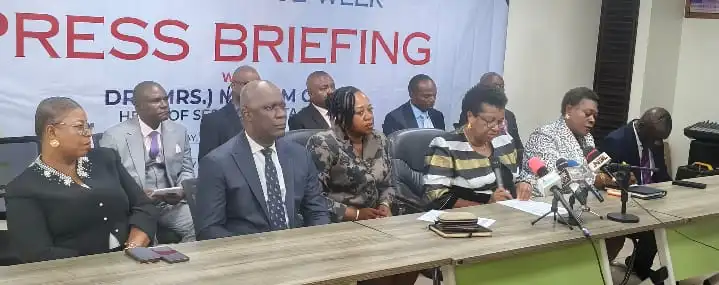
Addressing journalists during a press briefing at the Ministry of Information Conference Hall, Asaba, the Delta State Head of Service, Dr. (Mrs.) Mininim Oseji, said this year’s celebration, themed “Reforms, Resilience and Results,” reflects the state’s determination to strengthen governance through professionalism, accountability, innovation, integrity and service excellence.
Dr. Oseji explained that the Civil Service Week provides an opportunity to assess the progress made in transforming the public service while setting a clear direction for sustained institutional reforms capable of delivering improved services to Deltans.

She disclosed that within her first 14 months in office, her administration has embarked on an ambitious reform programme combining the revival of dormant initiatives with the introduction of innovative policies designed to improve staff welfare, boost productivity and accelerate digital transformation.
Among the revived initiatives are the return of The Bureaucrat publication, the restoration of Civil Service Week celebrations, regular breakfast dialogue sessions with staff, courtesy visits by retired Permanent Secretaries, implementation of a revised dress code and stricter attendance monitoring through the use of time books to reduce lateness and absenteeism.
The Head of Service said new reforms introduced under her leadership include large-scale digitalisation training, virtual learning programmes, online staff performance assessments using Google Forms, expansion of the staff transport support scheme, establishment of a Meetings, Incentives, Conferences and Events (MICE) Committee, regular in-house capacity-building programmes and the strengthening of Planning, Research and Statistics Departments across Ministries, Departments and Agencies (MDAs).
She further disclosed that civil servants have undergone specialised training in agriculture, financial literacy, estate management, grant writing, research ethics, autism awareness, etiquette, event planning and video content creation to equip them with practical skills for improved service delivery.
As part of efforts to motivate workers, Dr. Oseji announced the introduction of a ₦200,000 award for the best-performing department within the Office of the Head of Service and another ₦200,000 prize for the Best Civil Servant Farmer. She also revealed that interested civil servants are being provided with agricultural inputs and sponsored for financial counselling programmes to encourage self-reliance and sound financial management.
A major highlight of the reform agenda is the ongoing transformation of the Delta State Staff Training Centre into a world-class capacity development institution modelled after Singapore’s Civil Service College. According to the Head of Service, the upgraded centre will feature modern ICT infrastructure, enhanced learning facilities and partnerships with professional training organisations to prepare civil servants for contemporary governance.
She noted that specialised training programmes have already commenced in Digital Transformation, Electronic Records Management and e-Governance, Research, Planning and Statistical Systems for the MORE Agenda, as well as Advanced Secretarial Duties and Office Administration.
Looking ahead, Dr. Oseji unveiled the next phase of the reform agenda, announcing plans to establish a pilot ICT Hub in the Office of the Head of Service, which will subsequently be replicated across ministries, extra-ministerial departments, secretariats and Local Government Area headquarters to drive statewide digitalisation.
She also disclosed that the reform programme would be extended to the local government system through collaboration with the Directorate of Local Government Affairs and the Local Government Service Commission, ensuring that governance reforms reach the grassroots.
The Head of Service described the public service as the engine room of government, stressing that strengthening institutions and investing in workers remain critical to delivering quality education, healthcare, environmental management, infrastructure and economic development across Delta State.
Activities lined up for the 2026 Civil Service Week include a public lecture, quiz competition, dinner and award night, football tournament, golf competition and other indoor sporting events designed to promote teamwork, staff wellness and professional excellence.
Dr. Oseji expressed profound appreciation to Governor Rt. Hon. Sheriff Oborevwori for his unwavering support and timely approval of funds for the successful organisation of the Civil Service Week, describing his leadership as a source of inspiration in driving public sector reforms under the MORE Agenda.
She also commended the College of Permanent Secretaries, Heads of Ministries, Departments and Agencies, directors, staff of the Office of the Head of Service, members of the Central Planning Committee and the media for their contributions towards the successful celebration.
Reaffirming her commitment to sustained reforms, Dr. Oseji called on civil servants to embrace innovation, uphold ethical standards and remain committed to excellence as Delta State continues to build an efficient, accountable and results-oriented public service capable of meeting the aspirations of its citizens.
Observers say the reforms, if consistently implemented, have the potential to strengthen institutional capacity, improve productivity and position the Delta State Civil Service as one of the leading digitally enabled public services in Nigeria.